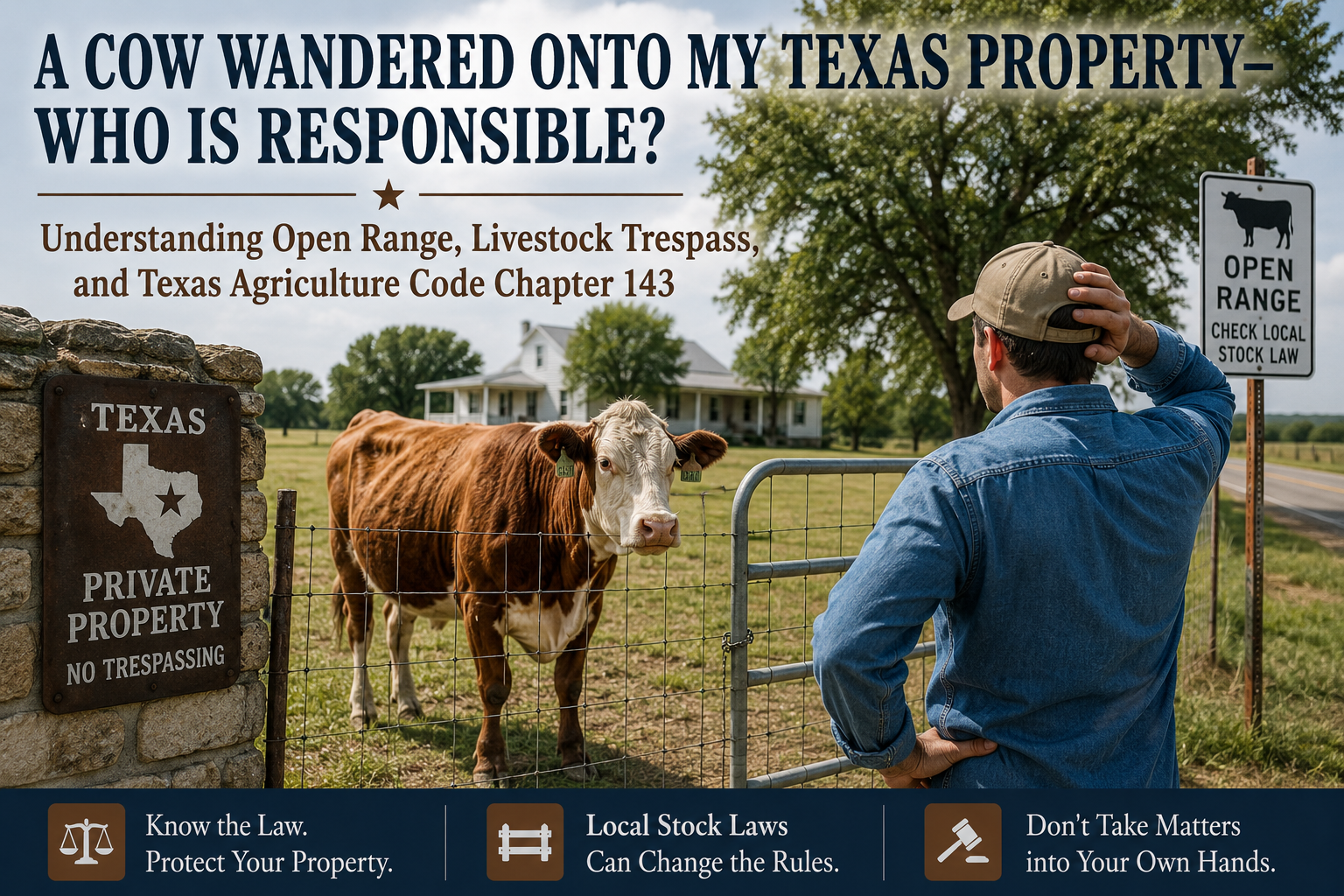
Texas is famous for cattle, ranches, fences, and enormous stretches of rural land. That history has also produced an unusual body of law governing a surprisingly practical question:
What happens when somebody else's cow, horse, goat, or other livestock wanders onto your property?
The answer is more complicated than many Texans might expect.
Texas has historically followed an open-range tradition, but that does not mean livestock owners everywhere in Texas are free to let their animals wander wherever they please. Local stock laws, highway restrictions, fencing rules, and Texas Agriculture Code Chapter 143 can dramatically change the rights and responsibilities of both livestock owners and neighboring landowners.
There is even a separate statutory procedure under Chapter 142 for dealing with an “estray”—essentially stray livestock whose owner may not immediately be known.
So if a cow appears in your yard one morning, the legal answer is not necessarily as simple as “the cow shouldn't be there.”
Is Texas Really an “Open Range” State?
Historically, yes.
The traditional Texas rule developed in a world in which livestock commonly roamed and landowners were generally expected to fence animals out, rather than requiring every livestock owner to fence animals in.
But modern Texas law contains major exceptions.
Texas Agriculture Code Chapter 143 is titled “Fences; Range Restrictions.” It establishes procedures through which particular counties or areas can restrict livestock from running at large.
That means the legal question is not simply:
“Is Texas open range?”
A better question is:
“What range restrictions apply to this particular property?”
That distinction can determine whether the livestock owner or neighboring property owner bears the relevant legal responsibility.
Texas Counties Can Restrict Livestock From Running at Large
Chapter 143 permits local elections concerning whether specified livestock may run at large within a county or defined area.
This creates one of the stranger features of Texas property law: the livestock rules applicable to one piece of land may differ from those applicable somewhere else in Texas.
Texas Agriculture Code § 143.026 even provides a procedure for a subsequent election to determine whether livestock should again be permitted to run at large in an area that previously restricted them.
If the election favors allowing the animals to run at large, the statute provides that:
“a person may permit an animal of the class mentioned in the proclamation to run at large”
after the statutory waiting period.
The practical result is important.
The mere fact that somebody else's cattle entered your property does not necessarily establish that the livestock owner violated Texas law.
Location matters.
The Type of Animal Can Matter Too
Chapter 143 does not create a single universal rule governing every animal in every location.
Different provisions address particular categories of livestock, and historical local elections may themselves apply to particular animals.
As a result, determining whether livestock were unlawfully running at large may require examining not only the current Agriculture Code but also the legal status of the particular county or area.
This is one reason livestock disputes can be considerably more complicated than they initially appear.
The sentence “Your cow was on my land” establishes an important fact.
It does not necessarily resolve the legal dispute.
What Does Texas Law Say About Fences?
The Agriculture Code gets wonderfully specific here.
Texas Agriculture Code § 143.028 provides:
“A person is not required to fence against animals that are not permitted to run at large.”
The same statute then establishes standards for a sufficient fence where animals are permitted to run at large.
Among other things, § 143.028 states:
“a fence must be at least four feet high”
and then provides additional requirements concerning how the fence must be constructed.
That language illustrates the basic logic behind traditional range law.
If livestock are lawfully permitted to roam, neighboring landowners may have fencing responsibilities.
If the animals are legally prohibited from running at large, the analysis changes considerably.
What If the Cow Is Standing in the Road?
This is where the romantic image of open-range Texas encounters the modern highway system.
Chapter 143 separately regulates livestock on highways. Texas law does not simply give livestock owners a universal right to let cattle wander across major roadways because Texas historically followed open-range principles.
This distinction matters because wandering livestock can create an obvious danger to motorists.
A collision between an automobile and a cow is not merely an inconvenience. It can result in catastrophic property damage and serious personal injury.
Accordingly, a livestock dispute involving an animal wandering through neighboring acreage may present different legal issues from a case involving livestock entering a highway.
The precise location and circumstances matter.
What If You Don't Know Who Owns the Cow?
Now the problem moves from Chapter 143 to another excellent portion of the Texas Agriculture Code: Chapter 142, governing estrays.
Section 142.001 defines an “estray” as:
“stray livestock, stray exotic livestock, stray bison, or stray exotic fowl.”
And Texas's definition is considerably broader than just cows and horses.
Chapter 142 separately defines “exotic livestock” to include certain nonindigenous plant-eating mammals and specifically references animals from families that include swine, horses, tapirs, rhinoceroses, elephants, deer, and antelope.
Yes, the Texas Agriculture Code has contemplated the possibility that the unidentified animal wandering around may effectively be an estray rhinoceros.
This is why reading statutes is sometimes rewarding. Haha.
Can You Just Keep a Stray Cow?
Finding livestock on your land does not ordinarily mean that you have acquired a free cow.
Chapter 142 establishes procedures for the reporting, capture, identification, disposition, and recovery of estrays.
Those procedures exist in part because livestock are valuable property. An animal may have wandered a considerable distance from its owner, escaped through damaged fencing, or become separated from other livestock.
Accordingly, a landowner confronting an unknown animal should not simply assume:
“Well, apparently I own a cow now.”
Texas law provides a process for dealing with the situation.
The Sheriff Has a Role in Texas Estray Law
One particularly interesting feature of Chapter 142 is the role given to local law enforcement in dealing with estrays.
The statutory framework contemplates reporting stray livestock and provides procedures through which the appropriate authorities can attempt to determine ownership and handle the animal.
That approach makes sense.
A private landowner may have no reliable way to determine whether an unfamiliar cow belongs to the ranch next door, somebody several miles away, or someone else entirely.
More importantly, trying to capture a frightened horse or large cow can be dangerous.
Chapter 142 even defines a “perilous condition” as a circumstance in which capturing and impounding the estray presents an immediate threat to law-enforcement personnel or to the health of the animal.
The Legislature apparently recognizes the obvious:
Sometimes the cow does not wish to participate in the legal process.
Can You Hurt Livestock That Trespass Onto Your Property?
This is another area where landowners should be extremely careful.
Texas Agriculture Code § 143.033 specifically addresses liability associated with maiming, wounding, or killing certain trespassing livestock.
The existence of a trespass does not automatically give a property owner unrestricted authority to injure somebody else's animal.
That distinction is important because two different property interests are involved.
The land belongs to one person.
The livestock belong to somebody else.
Texas law can therefore protect a landowner's rights against unlawful livestock intrusion without converting an unwanted cow into an object the landowner is free to destroy.
A landowner confronting livestock should generally focus on safely documenting and reporting the situation rather than escalating it unnecessarily.
What If the Animal Damages My Property?
This is where a seemingly quirky agricultural-law question can become an ordinary civil dispute.
A wandering animal might damage:
- fences;
- landscaping;
- crops;
- vehicles;
- structures; or
- other property.
The resulting liability question can depend heavily on why the animal was there and what legal duty applied to its owner.
If the livestock owner was legally prohibited from allowing the animal to run at large, the case may look very different from a situation in which livestock were lawfully permitted to roam and the neighboring landowner had the relevant fencing obligation.
Evidence can therefore become extremely important.
Photographs and video of the livestock, damaged property, fences, gates, roadways, and surrounding area can help establish what actually happened.
Escaped Livestock Do Not Automatically Mean a Negligent Owner
Another important distinction is between an animal escaping and an owner negligently or unlawfully allowing livestock to roam.
Animals are animals.
Fences can fail. Gates can be damaged. Storms can knock down barriers. Livestock can escape despite substantial precautions.
Accordingly, the mere presence of a cow outside its normal enclosure does not necessarily answer every question about civil liability.
As in many negligence and property cases, the surrounding circumstances matter.
How did the animal escape?
What fencing existed?
Did the owner know about a recurring problem?
Had the livestock escaped previously?
Was the owner legally required to prevent the animal from running at large in that location?
Those facts can transform an amusing neighborhood story into a genuine legal dispute.
Why Local Law Matters So Much
Perhaps the most important lesson of Texas open-range law is that statewide generalizations can be dangerous.
Chapter 143 expressly incorporates local elections and geographically specific range restrictions. The statutory scheme even contains mechanisms for extending restrictions into adjoining areas and for later elections concerning whether particular livestock may again run at large.
Consequently, somebody dealing with a livestock dispute should determine what stock law actually applies to the property involved.
Two landowners in different parts of Texas could encounter superficially identical wandering cows and nevertheless face different legal rules.
Practical Steps When Livestock Wander Onto Your Property
If livestock unexpectedly appear on Texas property, a landowner should generally avoid turning the situation into an improvised roundup.
Document where the animals are located and any visible property damage. If ownership is known, contacting the owner may resolve the problem quickly. If the owner is unknown, the estray procedures of Texas Agriculture Code Chapter 142 may become relevant.
If the animal is in a roadway or creating an immediate safety hazard, the situation may warrant prompt contact with law enforcement.
And before assuming that the livestock owner necessarily violated the law merely because an animal crossed a property line, determine whether the area is subject to a local stock law or other applicable range restriction.
Texas Open-Range Law Is Really Property Law With Cows
The popular image of Texas open-range law belongs to cattle drives, ranches, and the nineteenth-century frontier.
The modern legal reality is considerably more interesting.
Texas Agriculture Code Chapters 142 and 143 create a statutory system dealing with stray livestock, fences, range restrictions, local elections, highways, and conflicts between livestock owners and neighboring landowners. The Legislature's current statutory website identifies Chapter 142 as “Estrays” and Chapter 143 as “Fences; Range Restrictions.”
Those rules can determine who was responsible for keeping an animal contained, how an unidentified animal should be handled, and what happens when wandering livestock cause a real-world dispute.
So if you wake up tomorrow and discover somebody else's cow standing in your yard, there are at least three things worth remembering:
Do not assume the cow is illegally there. Do not assume the cow now belongs to you. And definitely do not assume Texas law has nothing specific to say about the cow.
It does.
Quite a lot, actually.
This article is for general educational purposes only and does not constitute legal advice. Texas livestock and property laws can vary depending on the location, applicable local stock laws, the type of livestock involved, and the particular facts of a dispute. Anyone facing a specific livestock, property-damage, or land-use dispute should consult applicable law and qualified legal counsel.
At David C. Barsalou, Attorney at Law, PLLC, we help clients navigate business, family, tax, estate planning, and real estate matters ranging from document drafting to litigation with clarity and confidence. If you’d like guidance on your situation, schedule a consultation today. Call us at (713) 397-4678, email barsalou.law@gmail.com, or reach us through our Contact Page. We’re here to help you take the next step.