What Happens When a Texas Estate Runs Out of Money?
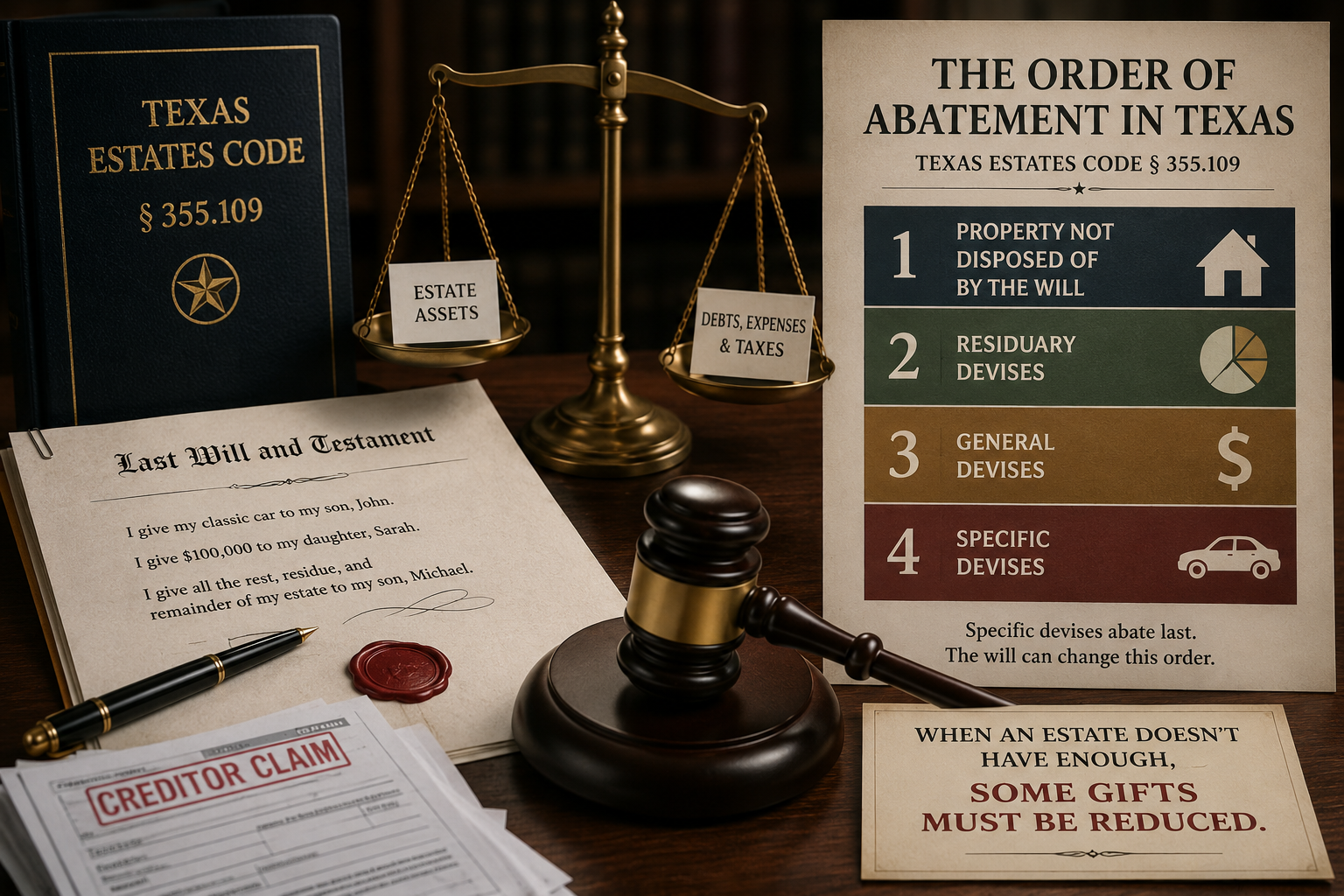
Many people assume that if a will leaves property to beneficiaries, those gifts will automatically be distributed exactly as written. In reality, an estate must first pay its debts, expenses of administration, taxes, and other legally enforceable obligations. When there are not enough assets to satisfy all gifts under a will, Texas law applies a doctrine known as abatement.
Abatement is one of the least understood areas of probate law, yet it can dramatically alter who receives property from an estate and how much they ultimately inherit.
What Is Abatement?
Abatement is the legal process of reducing gifts made under a will when the estate lacks sufficient assets to satisfy all obligations and all testamentary gifts.
Imagine a decedent leaves:
- A specific gift of a classic car to Child A;
- $100,000 to Child B;
- The remainder of the estate to Child C.
If the estate's debts and expenses exceed available liquid assets, some gifts may have to be reduced or eliminated before distribution.
The question becomes: Which beneficiary bears the loss?
Texas law provides the answer.
Texas Estates Code § 355.109
The Texas Legislature has established the order in which devises abate. Texas Estates Code § 355.109 provides:
"Except as provided by the will, shares of distributees abate, without any preference or priority as between real and personal property, in the following order:
(1) property not disposed of by the will;
(2) residuary devises;
(3) general devises; and
(4) specific devises."
Tex. Estates Code § 355.109.
This statutory hierarchy determines who bears the financial burden when estate assets are insufficient.
Understanding the Four Categories
1. Property Not Disposed of by the Will
Assets that pass through intestacy generally abate first.
For example, if a decedent forgot to include a bank account in a will and that account passes under Texas intestacy laws, that property is typically exhausted before gifts specifically made under the will are reduced.
2. Residuary Devises
A residuary devise is the "everything else" clause found in many wills.
An example might read:
"I give all the rest, residue, and remainder of my estate to my daughter."
The residuary beneficiary often bears the first major financial hit when estate obligations exceed expectations.
3. General Devises
General devises usually involve gifts of money or property payable from general estate assets.
Examples include:
- "$50,000 to my son."
- "$25,000 to my church."
These gifts are typically reduced only after residuary gifts have been exhausted.
4. Specific Devises
Specific devises identify particular property.
Examples include:
- "My Rolex watch to John."
- "My ranch in Montgomery County to Sarah."
- "My 1967 Mustang to Michael."
Specific gifts generally receive the highest level of protection and abate last.
Can a Will Change the Statutory Order?
Yes.
Texas law allows a testator to alter the default rules through careful drafting.
Texas Estates Code § 355.109 begins with the phrase:
"Except as provided by the will..."
This means a properly drafted will may shift the burden of abatement to different beneficiaries than would otherwise occur under the statute.
For example, a will could expressly direct that certain gifts must be preserved regardless of estate liabilities.
Why Abatement Creates Litigation
Abatement disputes frequently arise when:
- Real estate values decline after death;
- The estate contains illiquid assets;
- Significant creditor claims are filed;
- Administration costs become unexpectedly large;
- Tax liabilities exceed expectations.
Beneficiaries often discover that what appeared to be a guaranteed inheritance is actually contingent upon the estate's ability to satisfy its obligations.
In many contested probate proceedings, beneficiaries disagree not over the existence of debts, but over which gifts should bear the burden of paying them.
Related Probate Concepts
Abatement often intersects with:
- Ademption by extinction;
- Exoneration of liens;
- Family settlement agreements;
- Creditor claims;
- Independent administration;
- Estate insolvency.
Although these doctrines are distinct, they frequently arise in the same probate matters.
Practical Takeaways
For Texas beneficiaries, the key lesson is simple: a gift in a will is not necessarily guaranteed. Estate debts, taxes, and administration expenses must be addressed before beneficiaries receive distributions.
For estate planners, understanding abatement can help avoid unintended consequences and family disputes. A carefully drafted will can modify the default statutory scheme and provide greater certainty regarding who bears financial shortfalls.
When an estate lacks sufficient assets to satisfy every gift, Texas law does not leave the issue to chance. Instead, the Estates Code establishes a clear order of priority, ensuring that losses are allocated according to longstanding probate principles.
Need Help With a Texas Probate Matter?
Whether you are serving as an executor, defending your inheritance rights, or administering an estate facing creditor claims, understanding the rules of abatement can make a significant difference in the outcome of a probate case. An experienced Texas probate attorney can help evaluate the estate's assets, liabilities, and distribution priorities under the Texas Estates Code.
At David C. Barsalou, Attorney at Law, PLLC, we help clients navigate business, family, tax, estate planning, and real estate matters ranging from document drafting to litigation with clarity and confidence. If you’d like guidance on your situation, schedule a consultation today. Call us at (713) 397-4678, email barsalou.law@gmail.com, or reach us through our Contact Page. We’re here to help you take the next step.