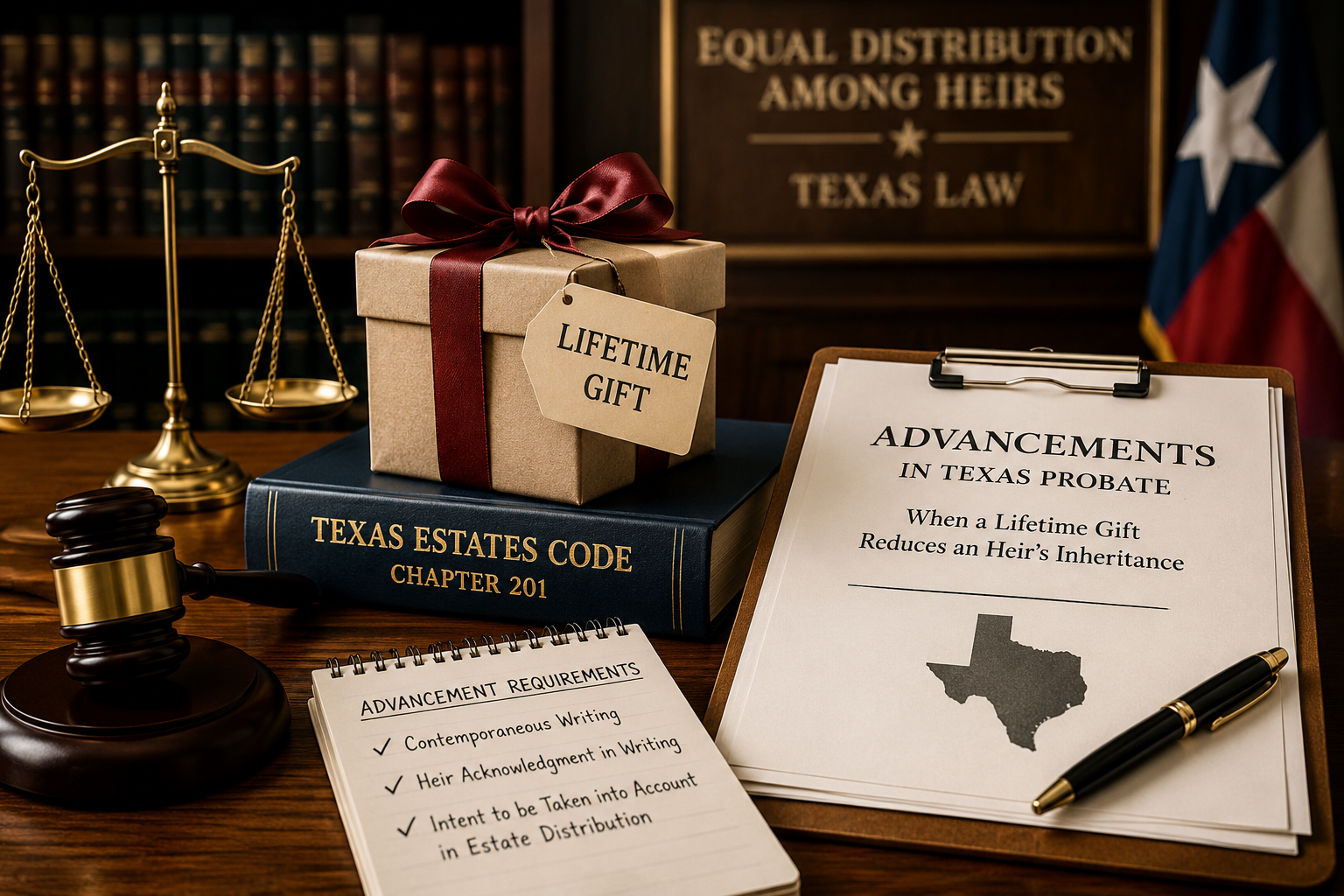
Most people assume that if a parent gives one child $100,000 during life and later dies without a will, that child gets the same share of the estate as his siblings. Under Texas law, however, that is not always true.
Texas recognizes a doctrine called an advancement, which can cause a substantial lifetime gift to be counted against an heir's eventual inheritance. Although rarely discussed outside probate circles, advancements can dramatically alter the division of an estate when someone dies intestate.
What Is an Advancement?
An advancement is a gift made during a person's lifetime that is intended to be treated as part of the recipient's future inheritance.
The concept prevents one heir from receiving a large gift during the decedent's life and then receiving a full equal share of the estate after death.
Historically, courts frequently litigated whether a gift was intended as an advancement. Texas now requires written evidence before a gift will be treated this way.
The Texas Statute
Texas Estates Code § 201.151 provides:
"If a person dies intestate as to all or part of the person's estate, property the decedent gave during the decedent's lifetime to an heir is treated as an advancement against the heir's share of the estate only if:
(1) the decedent declared in a contemporaneous writing or the heir acknowledged in writing that the gift is an advancement; or
(2) the decedent's contemporaneous writing or the heir's written acknowledgment otherwise indicates that the gift is to be taken into account in computing the division and distribution of the decedent's intestate estate."
This statute significantly limits disputes because oral statements alone are generally insufficient.
Why the Writing Requirement Matters
Consider a common scenario.
A father gives one daughter $75,000 to help purchase a home. Years later, he dies without a will, leaving three children and an estate worth $300,000.
The other siblings may insist that the home-payment gift should count against the daughter's inheritance. The daughter may respond that it was simply a gift.
Without the required written evidence, Texas law will generally treat the transfer as a gift rather than an advancement.
As a result, the daughter could potentially receive both the lifetime gift and an equal share of the remaining estate.
How an Advancement Is Calculated
Texas does not simply deduct the amount from the estate.
Instead, the value of the advancement is often added back into a hypothetical estate calculation for purposes of determining proportional shares.
For example:
- Estate at death: $300,000
- Prior advancement: $75,000
- Hypothetical estate: $375,000
- Three heirs: $125,000 share each
The heir who already received the $75,000 advancement would generally receive only an additional $50,000 from the estate, while the other heirs would receive $125,000 each.
The result is an equalized distribution among the heirs.
Valuation of the Advancement
Texas Estates Code § 201.152 governs valuation and provides that the property is valued:
"as of the time the heir came into possession or enjoyment of the property or as of the time of the decedent's death, whichever first occurs."
This rule prevents heirs from arguing about subsequent appreciation or depreciation.
If a parent transferred land worth $50,000 twenty years ago that is now worth $500,000, the statute generally looks to the earlier valuation date.
What Happens If the Recipient Dies First?
Another interesting aspect of the doctrine is that an advancement can still affect the inheritance rights of the recipient's descendants.
Texas Estates Code § 201.153 provides:
"If the recipient of property treated as an advancement fails to survive the decedent, the property is not taken into account in computing the intestate share to be received by the recipient's descendants unless the declaration or acknowledgment provides otherwise."
In plain English, grandchildren generally are not penalized for an advancement their parent received unless the required writing expressly says they should be.
Why Advancements Create Litigation
Advancement disputes often arise because families rarely document gifts with probate consequences in mind.
Parents may:
- Help a child buy a house;
- Transfer business interests;
- Forgive loans;
- Pay off substantial debts; or
- Transfer real estate before death.
Years later, siblings may disagree about whether those transfers were gifts, loans, or advancements.
The existence—or absence—of a properly drafted writing frequently determines the outcome.
The Best Way to Avoid Advancement Disputes
The easiest way to avoid litigation is careful estate planning.
A will can expressly state whether lifetime transfers should be counted against an heir's share. Likewise, contemporaneous written documentation can clarify whether a transfer is intended as a gift, loan, or advancement.
When families fail to document their intentions, probate courts are often left to untangle competing narratives years after the fact.
Final Thoughts
Advancements are one of the lesser-known doctrines in Texas probate law, but they can substantially affect who receives what after a person dies without a will. Texas has largely eliminated uncertainty by requiring written proof before a lifetime gift will reduce an heir's inheritance. Even so, disputes continue to arise when families make significant transfers without documenting their intent.
Whether you are administering an estate, expecting to inherit property, or planning your own estate, understanding the law of advancements can help prevent costly probate litigation and preserve family relationships.
At David C. Barsalou, Attorney at Law, PLLC, we help clients navigate business, family, tax, estate planning, and real estate matters ranging from document drafting to litigation with clarity and confidence. If you’d like guidance on your situation, schedule a consultation today. Call us at (713) 397-4678, email barsalou.law@gmail.com, or reach us through our Contact Page. We’re here to help you take the next step.
