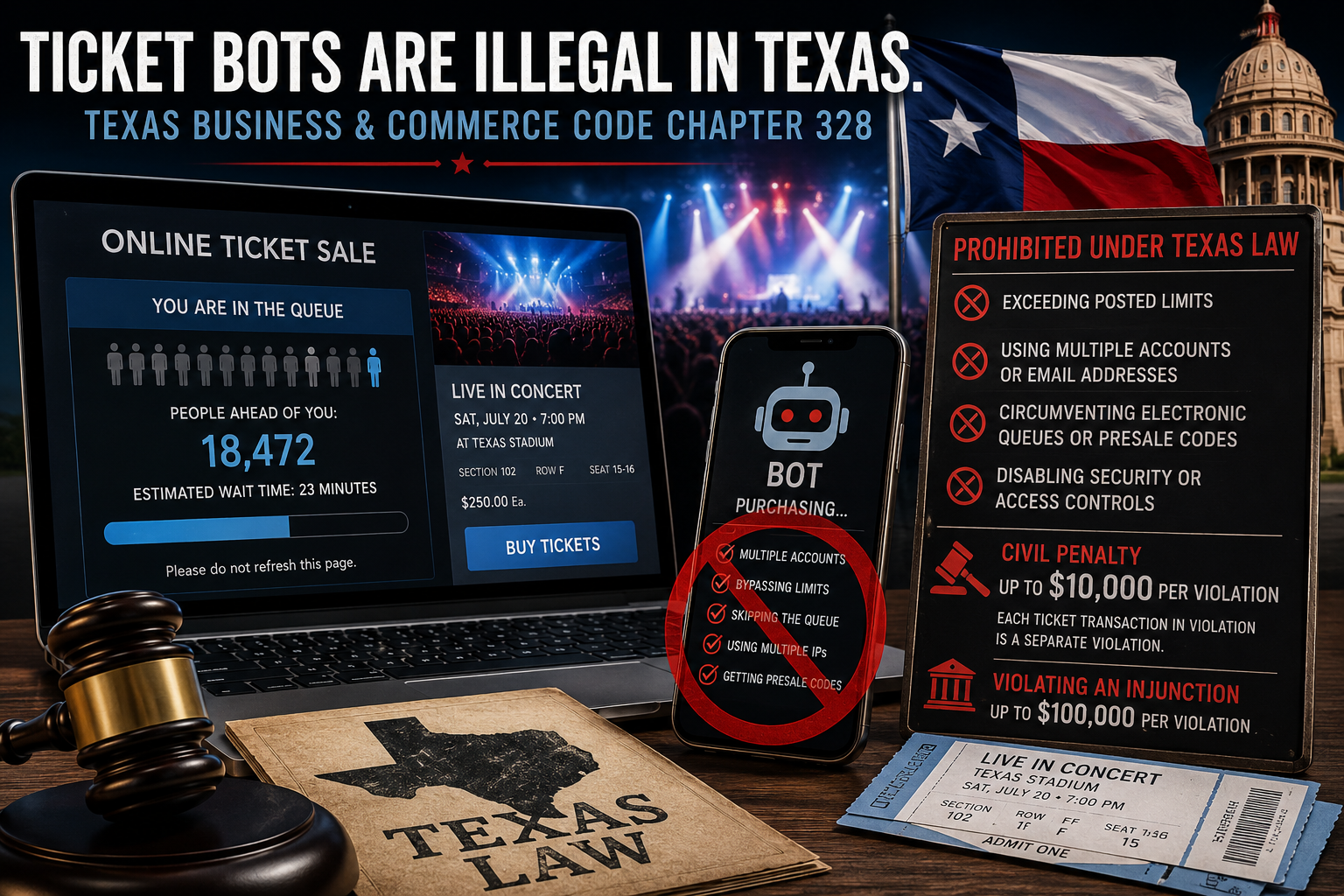
Anyone who has tried to buy tickets to a popular concert or sporting event knows the experience.
Tickets go on sale at 10:00 a.m. You enter the website immediately. Thousands of people are supposedly ahead of you. By the time you reach the purchase screen, the best seats are gone—and some of those same tickets may already be appearing for resale at dramatically higher prices.
Texas law specifically addresses part of this problem.
Under Texas Business & Commerce Code Chapter 328, state law prohibits certain uses of automated software, commonly known as bots, in connection with online event ticket sales.
The law is surprisingly specific. It regulates purchasing limits, electronic queues, presale codes, multiple accounts, and even the technological measures used to control entry into an event.
What Is a "Bot" Under Texas Law?
Texas Business & Commerce Code § 328.001 defines a bot as:
"any automated software program that performs automatic and repetitive tasks and is designed to impersonate or replicate human activity online."
Importantly, the definition does not include ordinary autofill or password-management features built into a browser or provided through separate software.
The distinction makes sense. The statute is not aimed at someone whose browser automatically enters a mailing address or credit-card information. It is aimed at software designed to imitate human purchasing activity and defeat restrictions placed on online ticket sales.
What Types of Events Are Covered?
Chapter 328 applies broadly to tickets for public events requiring paid admission.
Under § 328.001, an "event" includes a concert, theatrical performance, sporting event, exhibition, show, or similar scheduled activity that is open to the public, occurs at a public or private venue, and requires payment for admission.
That means the law can potentially apply to everything from a major stadium concert to a sporting event or theatrical production.
What Are Ticket Bots Prohibited From Doing in Texas?
Texas Business & Commerce Code § 328.002 provides that a person may not use or create a bot to engage in several specified practices.
Among them is using a bot to:
"purchase tickets in excess of posted limits for an online ticket sale."
That addresses one of the most obvious uses of automated ticket-buying technology. If a seller limits customers to four tickets, for example, a purchaser cannot simply use automation to defeat that limit and acquire dozens or hundreds.
But the Texas statute goes considerably further.
Using Multiple Accounts or IP Addresses Can Also Violate the Law
Section 328.002 also prohibits using a bot to use multiple IP addresses, purchaser accounts, or email addresses to purchase tickets in excess of the posted limits.
This is important because simply imposing a numerical purchasing limit would be relatively ineffective if automated purchasers could create numerous identities and repeat the transaction.
Texas law therefore focuses not merely on the final number of tickets purchased, but also on the technological methods used to evade the seller's restrictions.
Texas Law Protects the Online Queue
Perhaps the most interesting part of the statute concerns the dreaded online waiting room.
Texas Business & Commerce Code § 328.002 prohibits using or creating a bot to:
"circumvent or disable an electronic queue, waiting period, presale code, or other sales volume limitation system associated with an online ticket sale."
In other words, the electronic queue that tells you there are 18,472 people ahead of you is not merely a feature of the ticket seller's website.
Texas law expressly prohibits certain automated efforts to jump around it.
The statute also prohibits using bots to circumvent or disable security measures, access-control systems, or other controls used to facilitate authorized entry to an event.
Is Reselling Event Tickets Illegal in Texas?
Chapter 328 should not be confused with a general prohibition against reselling tickets.
The statute targets particular automated methods used to acquire tickets or circumvent sales restrictions. A person does not necessarily violate Chapter 328 merely because the person purchases a ticket and later resells it.
That distinction is important.
The regulated conduct is the use or creation of a bot for the purposes specifically identified in § 328.002. Whether a particular ticket transaction violates some other contract, policy, ordinance, or applicable law is a separate question.
The Penalties Can Become Significant Very Quickly
The enforcement provisions are where Chapter 328 becomes particularly serious.
Under Texas Business & Commerce Code § 328.003, the Texas Attorney General may investigate suspected violations and bring an action in the name of the State to restrain or enjoin violations.
The Attorney General may also seek restitution and civil penalties.
Most importantly, § 328.003(d) provides:
"A person who knowingly violates Section 328.002 is liable for a civil penalty of not more than $10,000 for each violation."
For a large-scale ticket operation, that number can become substantial.
Each Ticket Transaction Can Be a Separate Violation
Texas law does not necessarily treat a large bot operation as one violation.
Section 328.003(e) provides:
"Every ticket transaction in which a ticket is acquired to be sold in violation of Section 328.002 constitutes a separate violation for purposes of assessing a civil penalty."
Consider the practical significance.
If unlawful automated activity results in numerous separate ticket transactions, potential penalties are not necessarily limited to a single $10,000 assessment. The statute expressly permits separate violations to be associated with separate transactions.
That gives the law considerably more enforcement power against large-scale operations than a single flat penalty would provide.
Violating an Injunction Can Be Even More Expensive
There is another layer.
Under § 328.003(f), the civil penalty for violating a court order or injunction issued to enforce the statute may be as much as $100,000.
The Attorney General may also recover reasonable costs associated with bringing an enforcement action, including court costs, reasonable attorney's fees, and investigation costs.
Accordingly, what may initially look like clever software designed to obtain scarce tickets can create substantial legal exposure when the conduct falls within the statutory prohibitions.
Why Does Texas Have a Law Specifically About Ticket Bots?
Online ticket sales create an unusual commercial problem.
Ordinarily, being faster than another customer is not illegal. If two people walk into a store looking for the last item on a shelf, the person who reaches it first generally gets to buy it.
Automation changes the scale of that competition.
Software can potentially perform purchasing activity at speeds and volumes impossible for an ordinary consumer. It can also be designed to evade limits that a seller deliberately imposed to distribute scarce tickets among more purchasers.
Texas law responds by regulating the methods used to defeat those restrictions rather than simply prohibiting ticket resale altogether.
Texas Also Regulates Automated Purchasing of Ordinary Goods
The ticket statute is part of a broader Texas effort to address automated online purchasing.
Texas Business & Commerce Code Chapter 329 separately regulates certain technologies used in the online sale of goods. That statute addresses software or technology that can bypass purchasing processes, disguise a purchaser's identity, exceed quantity limits, improperly access gift-card information, or circumvent security and access controls.
This means Texas law now recognizes automated purchasing as a distinct commercial issue extending beyond concert and sporting-event tickets.
For businesses operating online sales platforms—and for individuals operating automated purchasing or resale businesses—the details matter.
The Bottom Line
Yes, certain ticket bots are illegal under Texas law.
Texas Business & Commerce Code Chapter 328 specifically prohibits using or creating bots to exceed ticket limits, evade those limits through multiple accounts or addresses, bypass electronic queues or presale restrictions, and circumvent certain security or access controls.
The consequences can also be significant. A knowing violation can result in a civil penalty of up to $10,000 per violation, and individual offending ticket transactions can constitute separate violations.
The statute is a good example of an old legal problem appearing in a very modern form. Commerce has always involved people competing for scarce goods. Texas law now has rules for what happens when one of those "people" standing in line is actually a computer program capable of standing in thousands of lines at once.
Anyone operating an online resale business, developing automated purchasing software, or facing a dispute involving online ticket transactions should carefully evaluate the applicable statutes and contractual terms.
This article is for general informational purposes only and does not constitute legal advice. The application of Texas law depends on the specific facts and circumstances of each matter.
At David C. Barsalou, Attorney at Law, PLLC, we help clients navigate business, family, tax, estate planning, and real estate matters ranging from document drafting to litigation with clarity and confidence. If you’d like guidance on your situation, schedule a consultation today. Call us at (713) 397-4678, email barsalou.law@gmail.com, or reach us through our Contact Page. We’re here to help you take the next step.