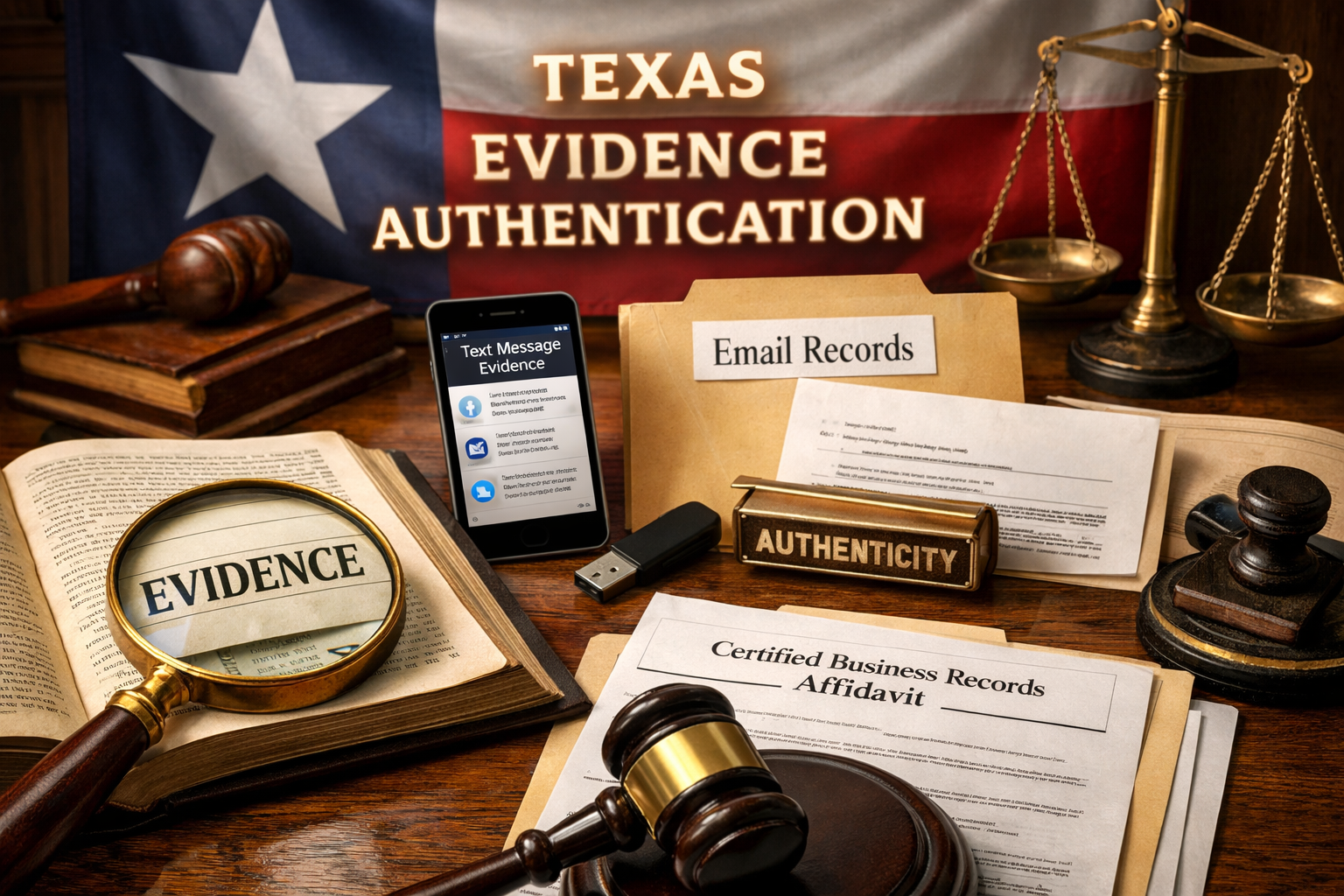
If you can’t authenticate it, you can’t use it. That’s the quiet reality of litigation in Texas courts. While many attorneys focus on hearsay or relevance, authentication is often the first—and sometimes fatal—gatekeeper to admissibility. This post walks through the technical framework of authentication under the Texas Rules of Evidence and how it plays out strategically in real cases.
Importantly, this topic does not appear in your current blog index , making it a strong addition to your growing library of procedural and evidentiary content.
What Is Authentication?
Authentication is the process of proving that a piece of evidence is what the proponent claims it to be.
Governing Rule: Texas Rule of Evidence 901(a)
“To satisfy the requirement of authenticating or identifying an item of evidence, the proponent must produce evidence sufficient to support a finding that the item is what the proponent claims it is.”
— Tex. R. Evid. 901(a)
This is a threshold standard, not a conclusive one. You do not have to prove authenticity beyond doubt—only enough for a reasonable juror to believe it is genuine.
Methods of Authentication Under TRE 901(b)
Texas Rule of Evidence 901(b) provides non-exhaustive examples of how evidence can be authenticated.
1. Testimony of a Witness with Knowledge
“Testimony that an item is what it is claimed to be.”
— Tex. R. Evid. 901(b)(1)
This is the most common method. A witness simply says:
- “Yes, I took this photo.”
- “Yes, that’s the contract I signed.”
2. Distinctive Characteristics and Circumstances
“The appearance, contents, substance, internal patterns, or other distinctive characteristics of the item, taken together with all the circumstances.”
— Tex. R. Evid. 901(b)(4)
This is where things get interesting—especially with:
- Text messages
- Emails
- Social media posts
Courts routinely allow authentication through contextual clues, even without direct testimony from the sender.
3. Comparison by Trier or Expert
“A comparison with an authenticated specimen by an expert witness or the trier of fact.”
— Tex. R. Evid. 901(b)(3)
Useful for:
- Handwriting disputes
- Signature verification
Self-Authenticating Evidence Under TRE 902
Some evidence doesn’t require extrinsic proof at all.
Texas Rule of Evidence 902
“The following items of evidence are self-authenticating; they require no extrinsic evidence of authenticity in order to be admitted.”
— Tex. R. Evid. 902
Key categories include:
- Certified public records
- Official publications
- Newspapers and periodicals
- Certified business records (when paired with affidavit under TRE 902(10))
This is where litigation efficiency skyrockets—especially in Texas practice, where business records affidavits are heavily utilized.
Authentication vs. Admissibility: A Critical Distinction
Authentication does not equal admissibility.
Even if authenticated, evidence can still be excluded for:
- Hearsay (TRE 801–807)
- Unfair prejudice (TRE 403)
- Privilege
Think of authentication as Step 1, not the finish line.
Authentication of Digital Evidence in Texas
This is where modern litigation lives.
Common Issues:
- Who sent the message?
- Was the account hacked?
- Is the screenshot altered?
Texas courts generally allow authentication through:
- Testimony from a recipient
- Metadata or timestamps
- Contextual content (inside jokes, references, etc.)
Practical Rule:
You don’t need absolute proof—just enough evidence to support a finding of authenticity.
Strategic Use in Litigation
1. Offensive Strategy
- Use multiple authentication theories (belt and suspenders approach)
- Pair witness testimony with circumstantial evidence
- Pre-admit documents via affidavits when possible
2. Defensive Strategy
- Attack gaps in authorship or chain of custody
- Argue lack of foundation under TRE 901
- Raise concerns about alteration or fabrication
3. Timing Matters
Authentication objections should be raised:
- At trial when evidence is offered
- Or pretrial via motions in limine (though those preserve nothing alone)
Common Pitfalls
- Assuming emails authenticate themselves (they don’t)
- Failing to lay predicate before offering exhibits
- Overlooking self-authentication options under TRE 902
- Ignoring authentication challenges in summary judgment evidence
Case Law Snapshot
Texas courts have repeatedly emphasized that:
- Authentication is a low threshold
- Doubts about authenticity typically go to weight, not admissibility
This means judges often admit evidence and let the jury decide credibility.
Why This Matters in Your Practice
Whether you're:
- Handling family law disputes with text messages
- Litigating contract cases with email chains
- Pursuing post-judgment collection with financial records
Authentication is often the difference between winning and having your evidence excluded entirely.
Final Takeaway
Authentication is deceptively simple but strategically powerful. The lawyer who understands how to get evidence in—and how to keep the other side’s evidence out—has a significant advantage in Texas courts.
At David C. Barsalou, Attorney at Law, PLLC, we help clients navigate business, family, tax, estate planning, and real estate matters ranging from document drafting to litigation with clarity and confidence. If you’d like guidance on your situation, schedule a consultation today. Call us at (713) 397-4678, email barsalou.law@gmail.com, or reach us through our Contact Page. We’re here to help you take the next step.