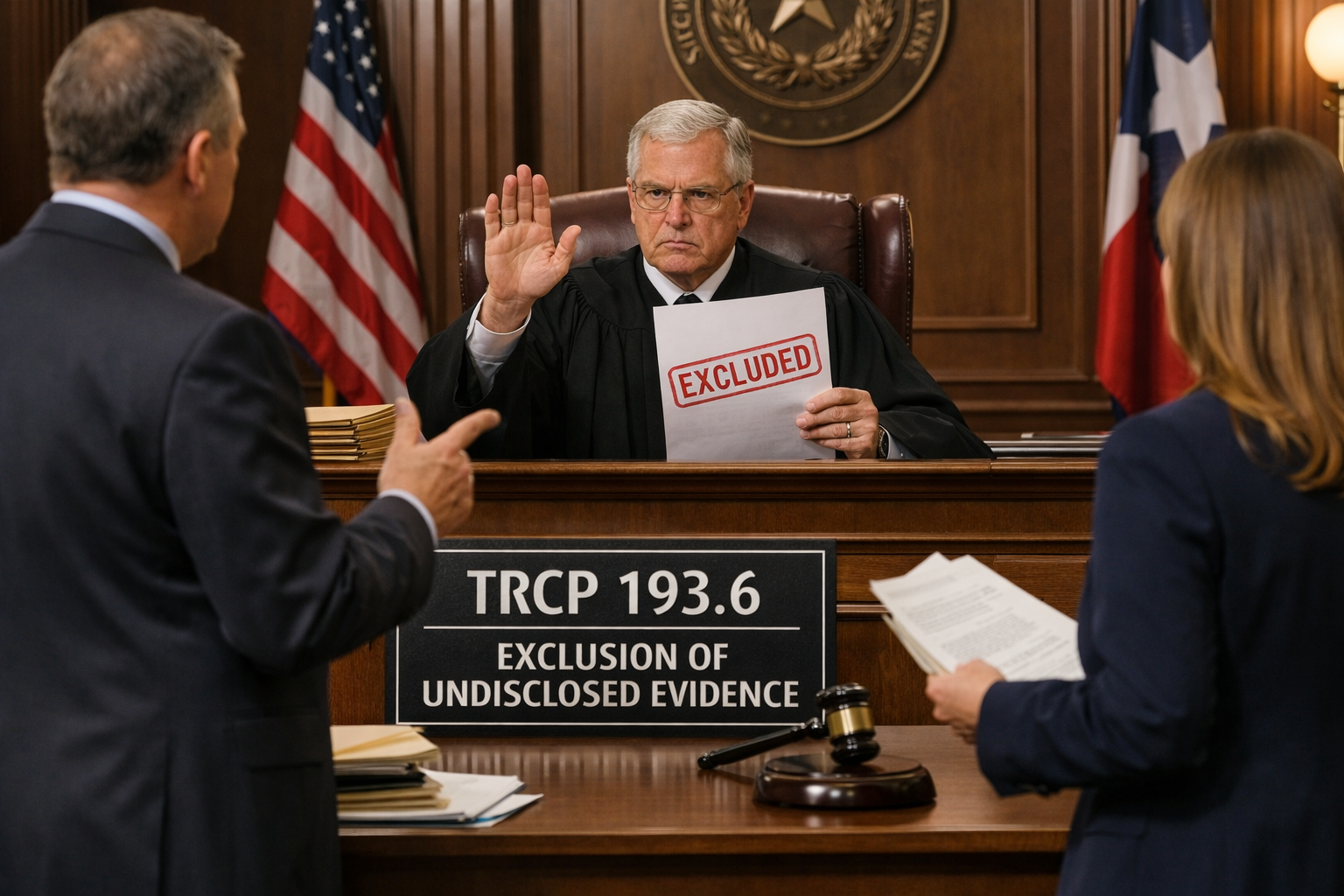
Why Rule 193.6 Might Be the Most Dangerous Rule in Texas Civil Procedure
Texas litigators often obsess over summary judgment, expert challenges, and jury charge issues—but one of the most quietly devastating rules is Texas Rule of Civil Procedure 193.6. This rule governs the automatic exclusion of evidence when a party fails to timely disclose it in discovery.
And unlike many procedural rules, TRCP 193.6 is not discretionary—it is mandatory unless a narrow exception applies.
The Rule Itself (Quoted Law)
Texas Rule of Civil Procedure 193.6(a) provides:
“A party who fails to make, amend, or supplement a discovery response in a timely manner may not introduce in evidence the material or information that was not timely disclosed, or offer the testimony of a witness (other than a named party) who was not timely identified, unless the court finds that:
(1) there was good cause for the failure… or
(2) the failure… will not unfairly surprise or unfairly prejudice the other parties.”
This is often referred to as the “automatic exclusion rule.”
What Makes Rule 193.6 So Powerful
1. The Burden Shifts to the Party Who Failed to Disclose
Unlike many evidentiary disputes, the burden is not on the opposing party to show harm.
Instead, the non-disclosing party must prove:
- Good cause, or
- Lack of unfair surprise/prejudice
If they cannot, exclusion is mandatory.
2. “Good Cause” Is a High Bar
Texas courts interpret “good cause” narrowly. It generally requires:
- Something beyond mere negligence
- Circumstances outside the party’s control
Examples that usually fail:
- “We forgot”
- “It was an oversight”
- “We didn’t think it was important”
3. “No Unfair Surprise” Is Fact-Specific—but Dangerous
Even if good cause is absent, a party can still escape exclusion by showing:
- The opposing party already knew about the evidence, or
- The evidence is cumulative
But this is risky. Courts frequently find:
- Late disclosures are inherently prejudicial when they affect trial preparation
The Trial Ambush That Rule 193.6 Eliminates
Historically, litigation allowed for “trial by ambush.” Rule 193.6 was designed to eliminate that.
Now:
- Undisclosed witnesses → excluded
- Undisclosed documents → excluded
- Late expert opinions → excluded
And critically—this can happen at trial, instantly.
Strategic Use in Litigation
Offensive Use (Sword)
You can use Rule 193.6 to:
- Strike late-designated witnesses
- Exclude surprise exhibits
- Collapse the opposing party’s case mid-trial
This is especially powerful in:
- Business disputes
- Construction cases
- Family law property disputes involving undisclosed assets
Defensive Use (Shield)
To avoid getting burned:
- Supplement discovery early and often
- Treat disclosures as trial prep, not paperwork
- Assume everything you may use must be disclosed
The Hidden Trap: “Timely” Supplementation
Under TRCP 193.5, parties must supplement discovery responses:
“reasonably promptly after the party discovers the necessity for such a response.”
Courts often interpret “reasonably promptly” as:
- Within 30 days (common benchmark, not hard rule)
Failing to supplement—even unintentionally—triggers Rule 193.6 sanctions automatically.
Case Law Reality: Courts Enforce This Rule Strictly
Texas appellate courts consistently uphold exclusion when:
- Witnesses are disclosed late
- Damages models change late
- Key documents are withheld until trial
Even when exclusion is outcome-determinative.
Practical Example
A contractor sues for unpaid work. At trial:
- They introduce a previously undisclosed invoice
- Opposing counsel objects under Rule 193.6
Unless the contractor proves:
- Good cause, or
- No unfair surprise
👉 The invoice is excluded
👉The claim may fail entirely
Why This Rule Matters for Your Practice
For a litigation-heavy practice like yours, Rule 193.6 is:
- A case-winning procedural weapon
- A risk management necessity
- A client expectation issue (especially when evidence gets excluded)
It also aligns perfectly with your style of:
- Tight procedural control
- Leveraging technical rules to shape outcomes
Final Takeaway
Rule 193.6 turns discovery into a gatekeeper for trial.
If it wasn’t disclosed, it often doesn’t exist—at least not in court.
And that’s not a technicality.
That’s the entire case.
At David C. Barsalou, Attorney at Law, PLLC, we help clients navigate business, family, tax, estate planning, and real estate matters ranging from document drafting to litigation with clarity and confidence. If you’d like guidance on your situation, schedule a consultation today. Call us at (713) 397-4678, email barsalou.law@gmail.com, or reach us through our Contact Page. We’re here to help you take the next step.
