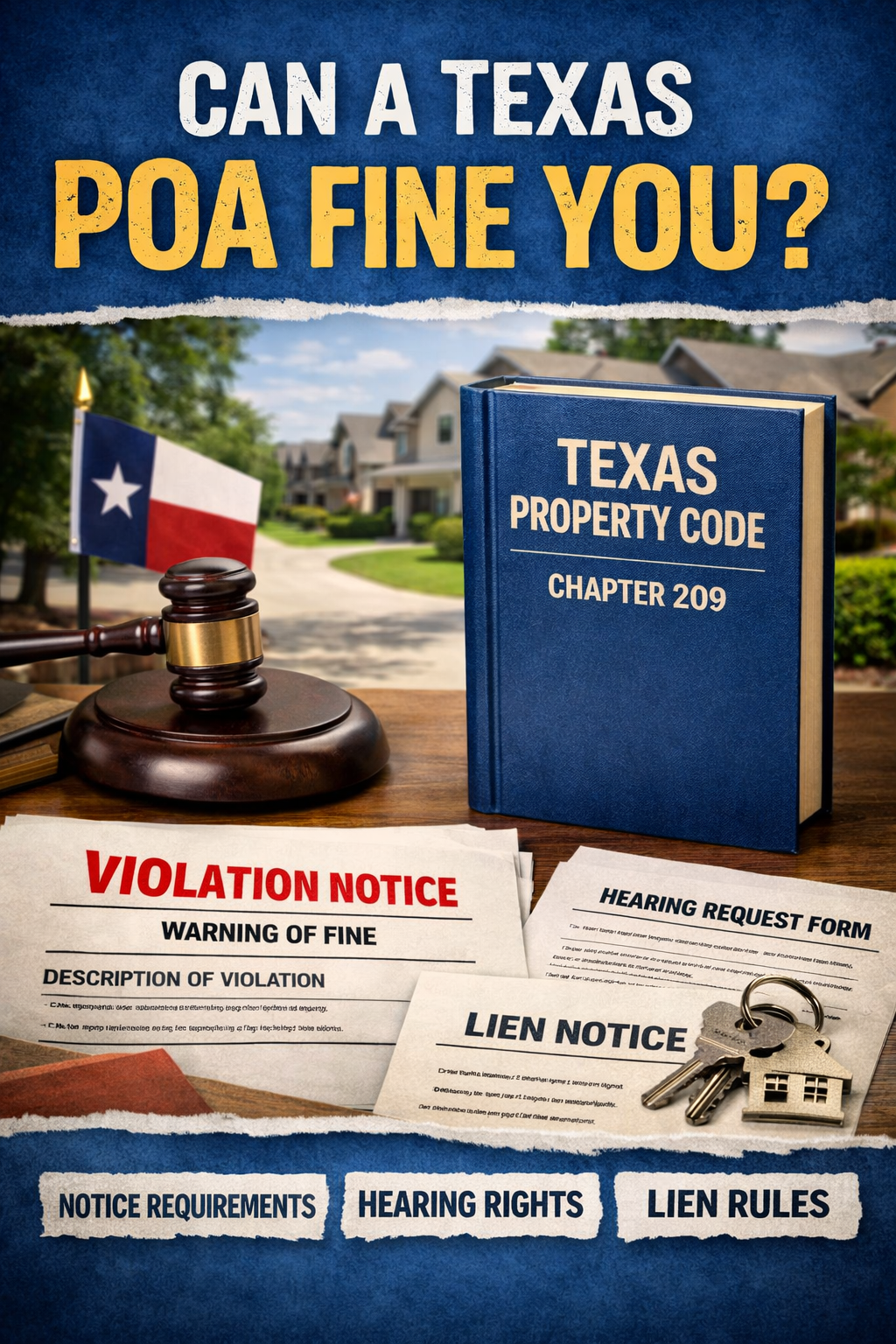
If you live in a deed-restricted community in Texas, you have probably wondered:
Can a Property Owners’ Association (POA) really fine me?
The short answer is yes — but only if they follow very specific statutory procedures under the Texas Property Code. Many disputes arise not because a POA lacks authority, but because it fails to comply with the procedural safeguards built into the law.
This article breaks down how POA fines work under Chapter 209 of the Texas Property Code, and what homeowners need to know before paying — or challenging — a fine.
1. Where Does a POA Get the Power to Fine?
In Texas, a POA’s authority usually comes from two sources:
- Recorded restrictive covenants (often called “Declarations”); and
- Statutory authority under the Texas Property Code.
Section Tex. Prop. Code § 209.002 defines a “property owners’ association” as an association that manages or regulates a residential subdivision.
But simply having covenants is not enough. To impose fines lawfully, the association must comply with Chapter 209 procedural requirements, particularly:
- § 209.006 (Notice Required Before Enforcement Action)
- § 209.007 (Hearing Before Board; Alternative Payment Schedule)
2. The Mandatory Notice Requirement – § 209.006
Before a POA can suspend rights, charge fines, or take enforcement action, it must provide written notice.
Under Tex. Prop. Code § 209.006(a), the association must give the owner:
- A description of the violation;
- The amount due (if applicable);
- A deadline to cure;
- Notice of the right to request a hearing before the board.
The statute specifically provides that the owner is entitled to a reasonable opportunity to cure the violation before further enforcement action.
If the association skips this step or sends vague notice, the enforcement action may be legally defective.
3. The Right to a Hearing – § 209.007
One of the most important homeowner protections appears in Tex. Prop. Code § 209.007(b).
If the homeowner requests a hearing within the statutory deadline, the POA must:
- Hold the hearing before the board (or a committee appointed by the board),
- Allow the owner to present evidence,
- Provide written notice of the decision.
The statute also requires the hearing to be held within a specific timeframe after the request.
Failure to provide this hearing can undermine the enforceability of the fine.
4. Can a POA File a Lien for Fines?
This is where things get serious.
Under Tex. Prop. Code § 209.0094, a POA assessment lien may secure amounts owed to the association — but the governing documents and statutory framework control what is lienable.
Not every fine automatically creates a valid lien. The association must:
- Properly levy the fine,
- Follow notice and hearing requirements,
- Comply with governing documents,
- Follow statutory lien procedures.
Improper liens can be challenged in court.
5. What If the POA Violates the Law?
Chapter 209 also includes enforcement mechanisms against associations.
Under Tex. Prop. Code § 209.0051, owners have rights to access certain records.
Under § 209.008, owners may recover attorneys’ fees in some disputes involving violations of Chapter 209.
In other words, the statute is not one-sided. Associations must comply strictly with the law.
6. Practical Takeaways for Texas Homeowners
If you receive a POA fine notice:
✔ Read the notice carefully.
✔ Calendar the deadline to request a hearing.
✔ Request the hearing in writing.
✔ Gather documents and photographs.
✔ Review the Declaration and bylaws.
✔ Consult counsel before ignoring the notice.
Ignoring a POA fine can escalate into:
- Accruing penalties,
- Collection action,
- Lien filing,
- Potential foreclosure in extreme cases.
7. Why This Matters
HOA and POA disputes are increasing across Texas, especially in fast-growing suburban communities around Houston, Montgomery County, Brazoria County, and Harris County.
As property values rise, enforcement becomes more aggressive.
But the law cuts both ways. Associations must strictly follow Chapter 209 of the Texas Property Code, and homeowners have enforceable rights.
Final Thoughts
Yes — a Texas POA can fine you.
But it must:
- Follow statutory notice requirements,
- Offer a hearing if requested, and
- Comply with lien procedures before escalating enforcement.
If those steps are not followed, the fine — or even a lien — may be legally challengeable.
If you are dealing with a POA dispute in Texas and want clarity about your rights, consult a Texas real estate attorney who understands both enforcement and defense under the Texas Property Code.
At David C. Barsalou, Attorney at Law, PLLC, we help clients navigate business, family, tax, estate planning, and real estate matters ranging from document drafting to litigation with clarity and confidence. If you’d like guidance on your situation, schedule a consultation today. Call us at (713) 397-4678, email barsalou.law@gmail.com, or reach us through our Contact Page. We’re here to help you take the next step.