Interest rate disputes often arise in private loans, owner-financed real estate transactions, business lending, and promissory notes. One question that occasionally surprises borrowers and lenders alike is whether a borrower can simply agree to waive Texas usury protections.
The short answer is generally no.
Texas has long treated many usury protections as matters of public policy rather than merely private contract rights. As a result, contractual provisions attempting to eliminate statutory usury protections may not be enforceable.
Understanding these rules can help both lenders and borrowers avoid expensive litigation.
What Is Usury?
Usury occurs when a lender contracts for, charges, or receives interest greater than what Texas law permits.
Texas has numerous statutes governing permissible interest depending upon the type of transaction involved. While many commercial loans permit higher rates than consumer loans, every lender should ensure that loan documents comply with applicable law.
Texas Finance Code Chapter 305
Texas Finance Code Chapter 305 addresses remedies and protections involving usurious interest.
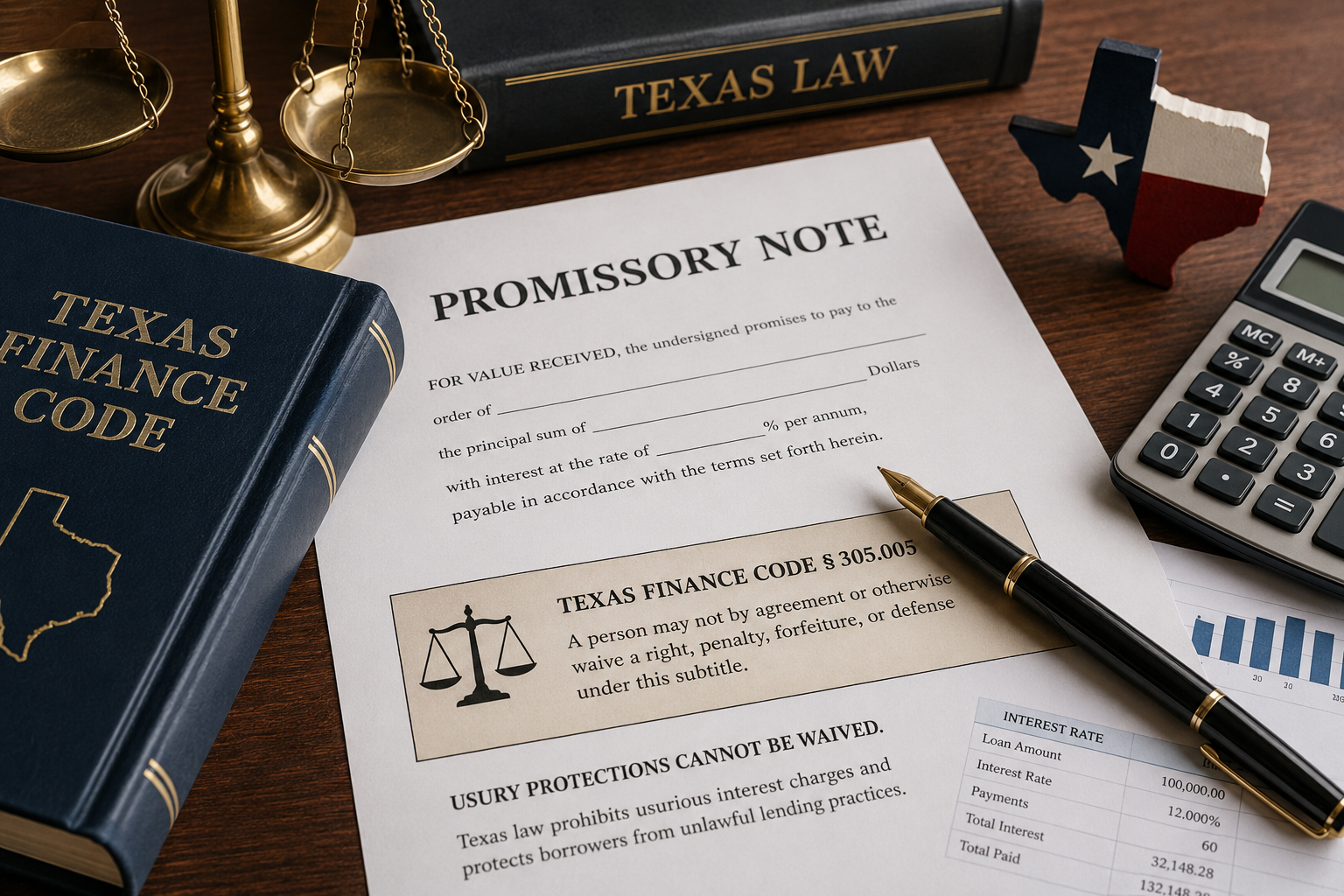
One particularly important provision is Texas Finance Code § 305.005, which provides:
"A person may not by agreement or otherwise waive a right, penalty, forfeiture, or defense under this subtitle."
This language is remarkably broad.
Rather than allowing parties to "contract around" usury statutes, the Legislature expressly prohibits waiving many of the protections created by the Finance Code.
Why Does Texas Prohibit Waivers?
Texas usury laws are designed not only to protect individual borrowers but also to discourage abusive lending practices generally.
If borrowers could simply sign away their statutory protections, lenders could include boilerplate waiver provisions in nearly every loan agreement.
The Legislature chose instead to prohibit many such waivers entirely.
What Happens if a Loan Contains a Waiver?
Suppose a promissory note states:
"Borrower waives any claim for usury under Texas law."
Including this language does not necessarily make it enforceable.
If the loan actually violates Texas usury statutes, the borrower may still possess statutory remedies despite having signed the agreement.
Likewise, courts generally examine the substance of the transaction rather than simply accepting contractual labels.
This Does Not Mean Every High Interest Rate Is Illegal
One common misunderstanding is that Texas has one universal maximum interest rate.
It does not.
Instead, Texas establishes different rules for different types of loans, including:
- Consumer loans
- Commercial loans
- Credit sales
- Open-end credit
- Certain business financing
- Loans involving licensed lenders
Determining whether a particular loan is usurious often requires reviewing multiple provisions of the Texas Finance Code.
Common Situations Where Usury Issues Arise
Although many people associate usury with banks, disputes frequently arise in private transactions, including:
- Seller-financed real estate
- Promissory notes between individuals
- Business acquisition financing
- Settlement agreements
- Loan modifications
- Commercial lending transactions
Even sophisticated parties occasionally overlook how default interest, late fees, prepaid finance charges, or other contractual provisions affect the effective interest rate.
Why Drafting Matters
Properly drafted loan documents often include "usury savings clauses."
These provisions generally state that the parties do not intend to charge interest exceeding the maximum lawful amount and that any excess will automatically be reduced to comply with Texas law.
While such clauses are not a cure-all, they can help demonstrate the parties' intent to comply with applicable law.
When Should You Speak with an Attorney?
Questions involving usury can become technically complex because they often require calculating effective interest, identifying applicable statutory limits, and determining whether certain charges legally constitute interest.
Whether you are lending money, borrowing funds, negotiating seller financing, or enforcing a promissory note, obtaining legal advice before a dispute develops can save substantial time and expense.
Conclusion
Texas strongly protects borrowers from unlawful interest charges. Under Texas Finance Code § 305.005, parties generally cannot waive many of the statutory rights and remedies created by Texas usury law. Both lenders and borrowers should ensure that loan documents comply with the Texas Finance Code rather than assuming contractual language alone will eliminate potential liability.
When substantial amounts of money are involved, careful drafting at the outset is almost always less expensive than litigating a usury dispute later.
At David C. Barsalou, Attorney at Law, PLLC, we help clients navigate business, family, tax, estate planning, and real estate matters ranging from document drafting to litigation with clarity and confidence. If you’d like guidance on your situation, schedule a consultation today. Call us at (713) 397-4678, email barsalou.law@gmail.com, or reach us through our Contact Page. We’re here to help you take the next step.