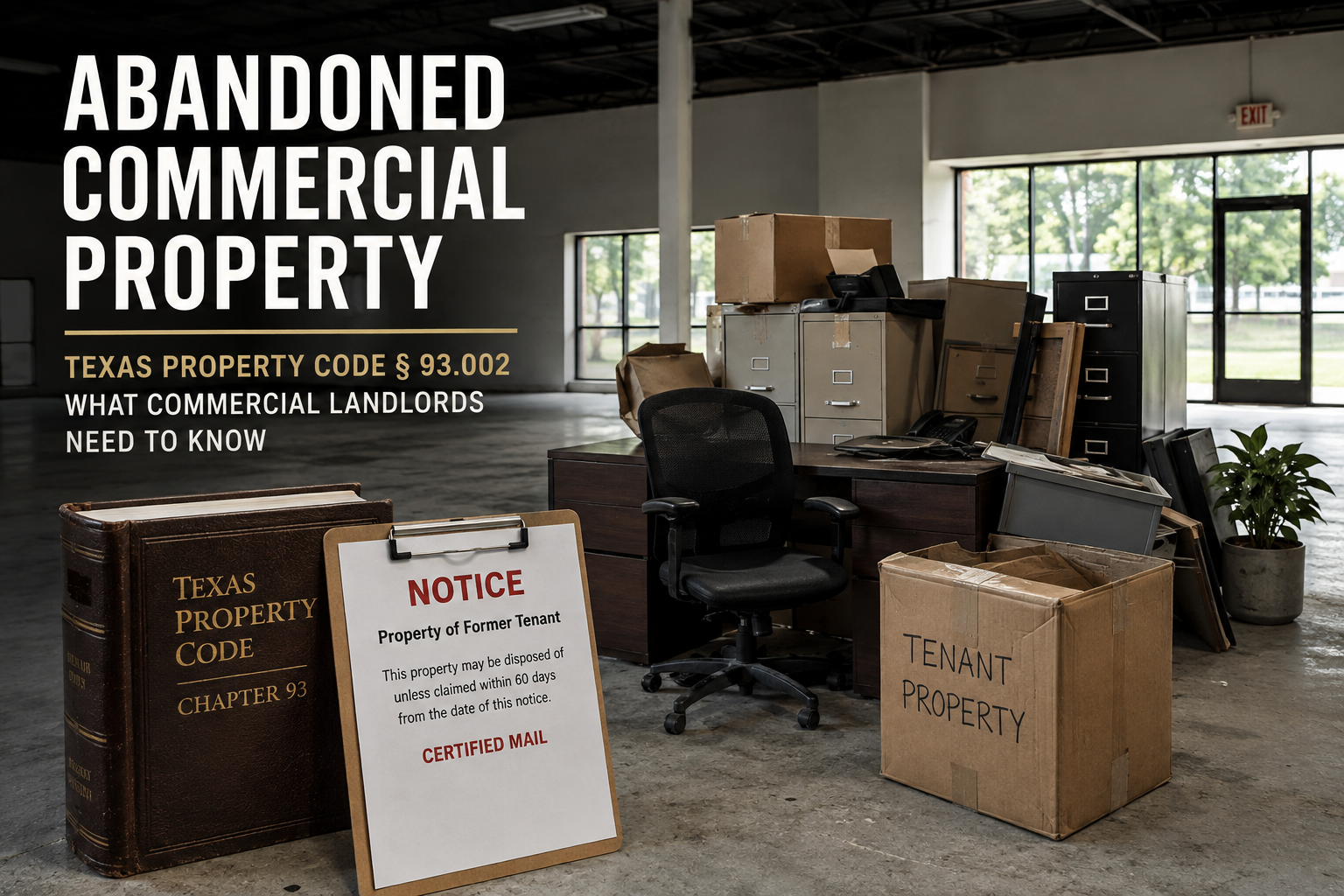
One of the most common questions commercial landlords ask after a tenant moves out is:
"Can I simply throw away everything they left behind?"
The answer is sometimes—but not immediately. Texas law provides a specific procedure that commercial landlords should understand before disposing of a tenant's property.
Texas Law on Abandoned Commercial Property
Unlike residential tenancies, commercial leases are governed primarily by Chapter 93 of the Texas Property Code.
Section 93.002 specifically addresses abandoned commercial premises.
The statute provides:
"A tenant is presumed to have abandoned the premises if goods, equipment, or other property, in an amount substantial enough to indicate a probable intent to abandon the premises, is being or has been removed from the premises and the removal is not within the normal course of the tenant's business." Tex. Prop. Code § 93.002(d). (Texas Statutes)
This is an important point. Simply being behind on rent does not necessarily mean the property has been abandoned.
Instead, courts look for objective evidence that the tenant has actually left the premises.
What Can the Landlord Do?
If the premises have been abandoned, the statute authorizes the landlord to remove and store the remaining property.
Texas Property Code § 93.002(e) provides:
"A landlord may remove and store any property of a tenant that remains on premises that are abandoned." (Texas Statutes)
However, the landlord generally cannot immediately dispose of the property.
The 60-Day Rule
Section 93.002 requires additional notice before the property may be discarded.
If the tenant does not reclaim the stored property within 60 days, the landlord may dispose of it, but only after sending notice by certified mail to the tenant's last known address explaining that the property may be disposed of if it is not claimed within that period. (Texas Statutes)
Failing to follow this procedure can expose a landlord to unnecessary legal disputes.
Why Commercial Landlords Should Document Everything
If you believe a tenant has abandoned a commercial space, good documentation can make all the difference.
Consider documenting:
- Photographs of the premises
- The condition of the property
- Utilities being disconnected
- Returned keys
- Communications with the tenant
- An inventory of property removed from the premises
- Certified mail receipts
These records may become important if the tenant later claims valuable equipment or inventory was improperly discarded.
What About the Lease?
Many commercial leases contain provisions addressing abandoned property.
Texas Property Code § 93.002 establishes statutory rights, but a carefully drafted commercial lease may address issues such as:
- storage costs,
- access to the premises,
- landlord's remedies,
- and reimbursement for removal expenses,
provided the provisions comply with applicable law.
Reviewing the lease before taking action is always advisable.
Common Mistakes Commercial Landlords Make
Some of the most common errors include:
- Assuming unpaid rent automatically equals abandonment.
- Throwing away property immediately after the tenant leaves.
- Failing to send the required certified-mail notice.
- Not documenting the property's condition before removal.
- Confusing the rules governing commercial property with the different rules applicable to residential leases.
When Should You Speak With a Texas Attorney?
Commercial landlord-tenant disputes often involve more than unpaid rent. Equipment, inventory, trade fixtures, and business records may have significant value, and disposing of them too quickly can create unnecessary litigation.
If your commercial tenant has disappeared or appears to have abandoned the premises, obtaining legal advice before disposing of the remaining property may help avoid costly mistakes.
At David C. Barsalou, Attorney at Law, PLLC, we help clients navigate business, family, tax, estate planning, and real estate matters ranging from document drafting to litigation with clarity and confidence. If you’d like guidance on your situation, schedule a consultation today. Call us at (713) 397-4678, email barsalou.law@gmail.com, or reach us through our Contact Page. We’re here to help you take the next step.
