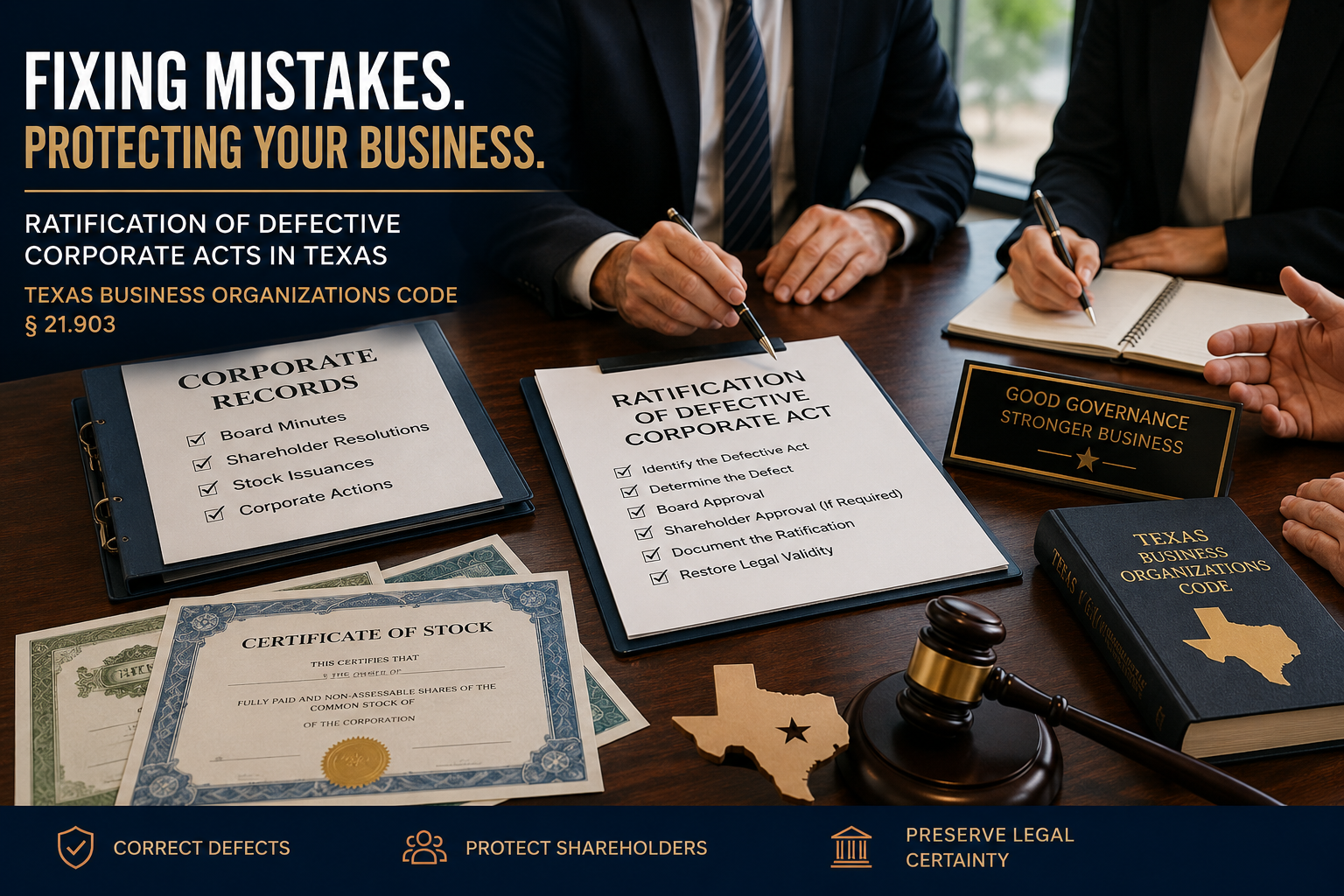
Businesses make mistakes. Directors may approve a stock issuance without proper authorization. An officer might sign a merger agreement before obtaining the required shareholder vote. A corporation may discover years later that an important corporate action was technically invalid because it failed to follow the required procedures.
Many business owners assume these mistakes are fatal. Fortunately, Texas law provides a mechanism for correcting many defective corporate acts without dissolving the company or starting over.
The Texas Business Organizations Code contains an often-overlooked statutory procedure allowing corporations to ratify defective corporate acts. While this area of law is highly technical, it can save businesses from expensive litigation and uncertainty over whether important corporate actions are legally effective.
What Is a Defective Corporate Act?
A defective corporate act is generally an action that the corporation attempted to take but that was legally ineffective because the corporation failed to comply with one or more legal requirements.
Examples include:
- Issuing shares without proper board approval
- Electing directors improperly
- Authorizing mergers without following statutory procedures
- Filing defective corporate documents
- Taking corporate actions before the corporation had legal authority to do so
These mistakes often go unnoticed for years until a lawsuit, financing transaction, acquisition, or due diligence review uncovers them.
The Texas Business Organizations Code Provides a Solution
Chapter 21 of the Texas Business Organizations Code authorizes corporations to ratify certain defective corporate acts.
Section 21.903 provides:
"A corporation may ratify one or more defective corporate acts in accordance with this subchapter."
That deceptively short sentence creates an extremely powerful legal remedy.
Instead of treating every technical mistake as permanently invalid, Texas law allows corporations to correct many defects after the fact.
Why Would This Matter?
Imagine a corporation issued stock to an early investor in 2018.
Five years later, another company wants to purchase the business.
During due diligence, the buyer discovers the board minutes never actually approved the stock issuance.
Without ratification, questions immediately arise:
- Does the investor actually own shares?
- Were later shareholder votes valid?
- Were dividends properly paid?
- Is the capitalization table accurate?
Those questions can delay—or completely derail—a major transaction.
Ratification allows the corporation to repair many of these defects before they become catastrophic.
Ratification Does Not Mean "Anything Goes"
Texas law does not allow corporations simply to ignore statutory requirements.
Instead, the corporation generally must follow formal procedures, including identifying:
- the defective corporate act;
- when it occurred;
- why it was defective; and
- the action being taken to ratify it.
Depending upon the circumstances, board approval, shareholder approval, or both may be required.
Notice May Be Required
When shareholders are entitled to vote on the ratification, notice requirements apply.
The notice generally informs shareholders about:
- the defective act;
- the proposed ratification;
- the basis for the defect; and
- the meeting at which approval will be considered.
These procedural safeguards help protect shareholder rights while allowing corporations to fix honest mistakes.
Court Review Is Also Available
Not every dispute can be resolved internally.
If disagreements arise over whether a ratification was effective, Texas law also authorizes judicial proceedings to determine the validity of the corporate action.
This provides certainty for:
- lenders,
- investors,
- purchasers,
- directors,
- officers, and
- shareholders.
Instead of years of uncertainty, a court can determine whether the corrective process satisfied the statute.
Why This Matters for Small Businesses
Many closely held Texas corporations operate informally.
Owners frequently:
- forget annual meetings;
- fail to maintain minutes;
- neglect written consents;
- issue stock without proper documentation; or
- discover years later that corporate records are incomplete.
Although these problems should be avoided, Texas law recognizes that technical mistakes happen.
The statutory ratification process provides a structured way to correct many defects before they become expensive litigation problems.
Practical Advice
If your corporation discovers a procedural mistake, resist the temptation simply to "backdate" documents or pretend the issue never happened.
Instead:
- identify exactly what occurred;
- determine whether the act qualifies for statutory ratification;
- comply with the Texas Business Organizations Code's procedures;
- obtain any necessary board or shareholder approvals; and
- maintain complete records of the ratification.
Properly correcting a defect today can prevent significant legal disputes years later.
Conclusion
Corporate law is full of technical requirements, but Texas recognizes that businesses occasionally make procedural mistakes. The ratification provisions in the Texas Business Organizations Code offer an important mechanism for correcting many defective corporate acts while preserving legal certainty for corporations, shareholders, and third parties.
If your corporation has discovered irregularities in its corporate records, stock issuances, governance procedures, or historical approvals, consulting experienced counsel early can often prevent far more expensive problems later.
At David C. Barsalou, Attorney at Law, PLLC, we help clients navigate business, family, tax, estate planning, and real estate matters ranging from document drafting to litigation with clarity and confidence. If you’d like guidance on your situation, schedule a consultation today. Call us at (713) 397-4678, email barsalou.law@gmail.com, or reach us through our Contact Page. We’re here to help you take the next step.
