Property boundary disputes are among the oldest types of lawsuits in Texas. While many people assume these cases are simply disagreements between neighbors, they often involve technical legal issues regarding deeds, surveys, historical monuments, fences, adverse possession, and competing chains of title.
One interesting—but frequently overlooked—feature of Texas law is that courts possess statutory authority to appoint a surveyor during litigation. In the right case, an independent survey can become one of the most persuasive pieces of evidence presented to the judge or jury.
If you own rural acreage, inherited family property, or land that has been subdivided multiple times over the decades, understanding this procedure can be invaluable.
Why Boundary Disputes Become So Complicated
Contrary to popular belief, property lines are not determined by fences.
Instead, Texas courts generally attempt to determine where the original legal boundary was intended to be. That inquiry may involve:
- Original deeds
- Recorded plats
- Survey field notes
- Natural monuments
- Artificial monuments
- Existing improvements
- Historical occupation
- Prior surveys
- Testimony from licensed surveyors
Sometimes two qualified surveyors arrive at completely different conclusions.
When that happens, the court may decide additional surveying is necessary.
Texas Law Allows Courts to Appoint Surveyors
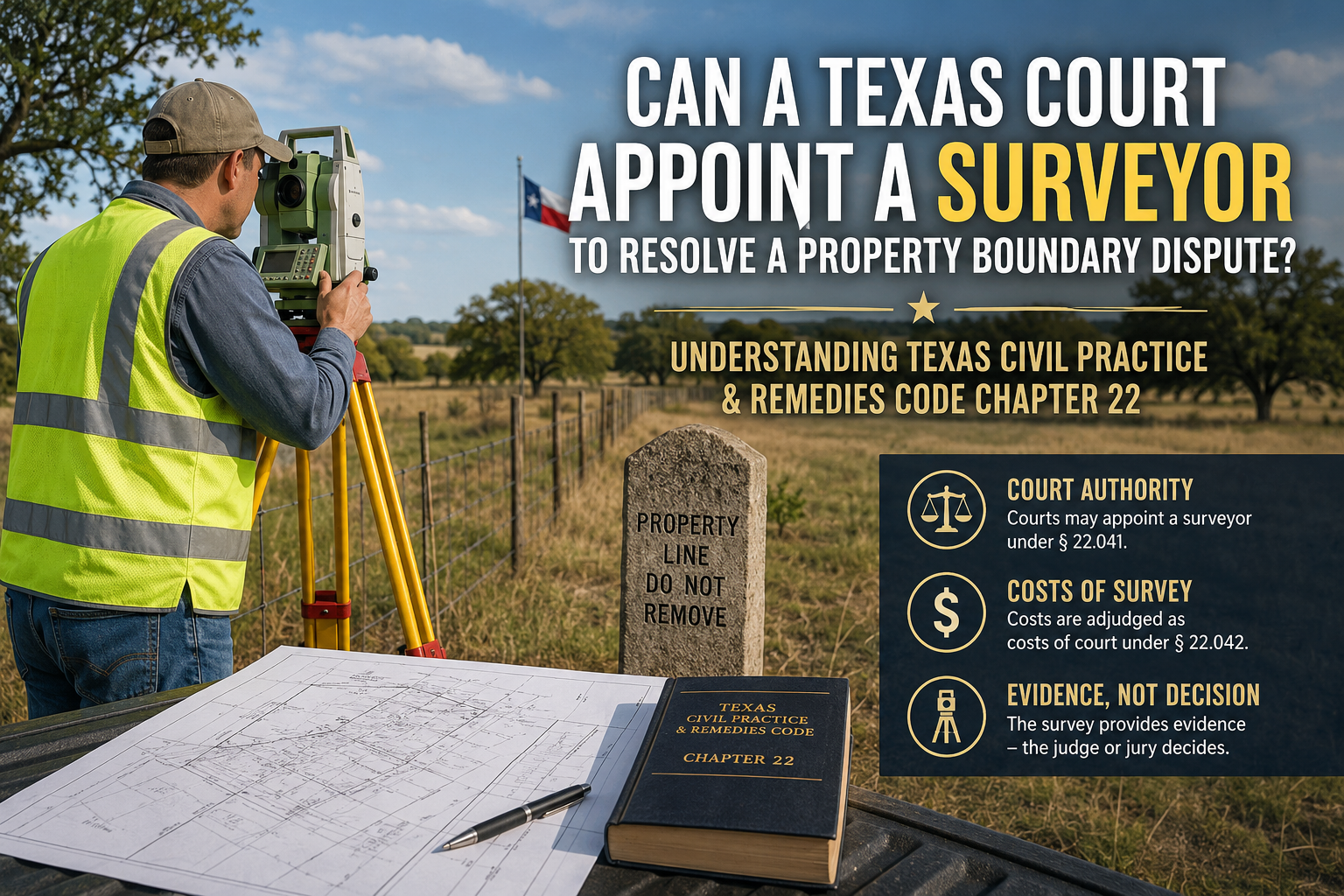
Texas Civil Practice and Remedies Code § 22.041 provides:
"The court may appoint a surveyor to survey the premises or any part of the premises."
This statute gives trial courts flexibility to obtain an impartial survey when the evidence is conflicting or incomplete.
Unlike surveyors hired by either party, a court-appointed surveyor is intended to assist the court in understanding the true location of the disputed boundary.
Who Pays for the Survey?
Texas Civil Practice and Remedies Code § 22.042 states:
"The court shall adjudge the costs of the survey as costs of court."
That means the expense of the survey becomes part of the litigation costs rather than automatically falling on one party.
Ultimately, the court may allocate costs when entering final judgment.
When Might a Court Order a Survey?
A court-appointed survey may become useful when:
- Competing surveys reach opposite conclusions.
- Original boundary monuments have disappeared.
- Deeds contain inconsistent legal descriptions.
- Older surveys were performed using outdated methods.
- Improvements appear to cross property lines.
- Multiple adjoining owners claim overlapping acreage.
Although not every case requires one, courts have discretion to use this procedure when it will assist in resolving the controversy fairly.
Court-Appointed Surveyors Do Not Decide Ownership
One common misconception is that a survey settles the lawsuit.
It does not.
A survey simply provides evidence.
The judge or jury must still determine:
- ownership,
- superior title,
- adverse possession claims,
- boundary by acquiescence (where applicable),
- deed interpretation,
- and any equitable issues raised during litigation.
The survey becomes one piece of the overall evidentiary picture.
Practical Considerations for Property Owners
If you discover that a neighbor's fence appears to cross onto your property, immediately commissioning your own survey may not always be enough.
Instead, consider:
- preserving historical evidence,
- locating prior surveys,
- obtaining title records,
- reviewing deed descriptions,
- photographing monuments,
- avoiding self-help removal of fences,
- consulting an experienced Texas real estate attorney before litigation escalates.
Many disputes that appear straightforward actually involve decades-old conveyances that require careful legal analysis.
Why This Matters
Boundary litigation often concerns far more than a few feet of land.
Disputed property lines can affect:
- home additions,
- driveways,
- fences,
- wells,
- septic systems,
- commercial development,
- easements,
- mineral interests,
- and marketable title.
A properly conducted survey—particularly one ordered by the court—can provide an objective framework that helps resolve otherwise intractable disputes.
Final Thoughts
Texas law recognizes that boundary disputes frequently involve technical surveying issues beyond the ordinary knowledge of judges and juries. By authorizing courts to appoint independent surveyors under Chapter 22 of the Texas Civil Practice and Remedies Code, the Legislature created a practical tool for resolving difficult property controversies.
If you are involved in a boundary dispute, do not assume the location of a fence or an old verbal agreement controls ownership. Property rights are determined by law, evidence, and, in many cases, careful surveying.
Consulting an attorney early can help protect your rights before a disagreement turns into expensive litigation.
Disclaimer: This article is provided for informational purposes only and does not constitute legal advice. Reading this article does not create an attorney-client relationship. If you are involved in a property boundary dispute or other real estate litigation in Texas, consult a qualified attorney regarding the specific facts of your situation.
At David C. Barsalou, Attorney at Law, PLLC, we help clients navigate business, family, tax, estate planning, and real estate matters ranging from document drafting to litigation with clarity and confidence. If you’d like guidance on your situation, schedule a consultation today. Call us at (713) 397-4678, email barsalou.law@gmail.com, or reach us through our Contact Page. We’re here to help you take the next step.