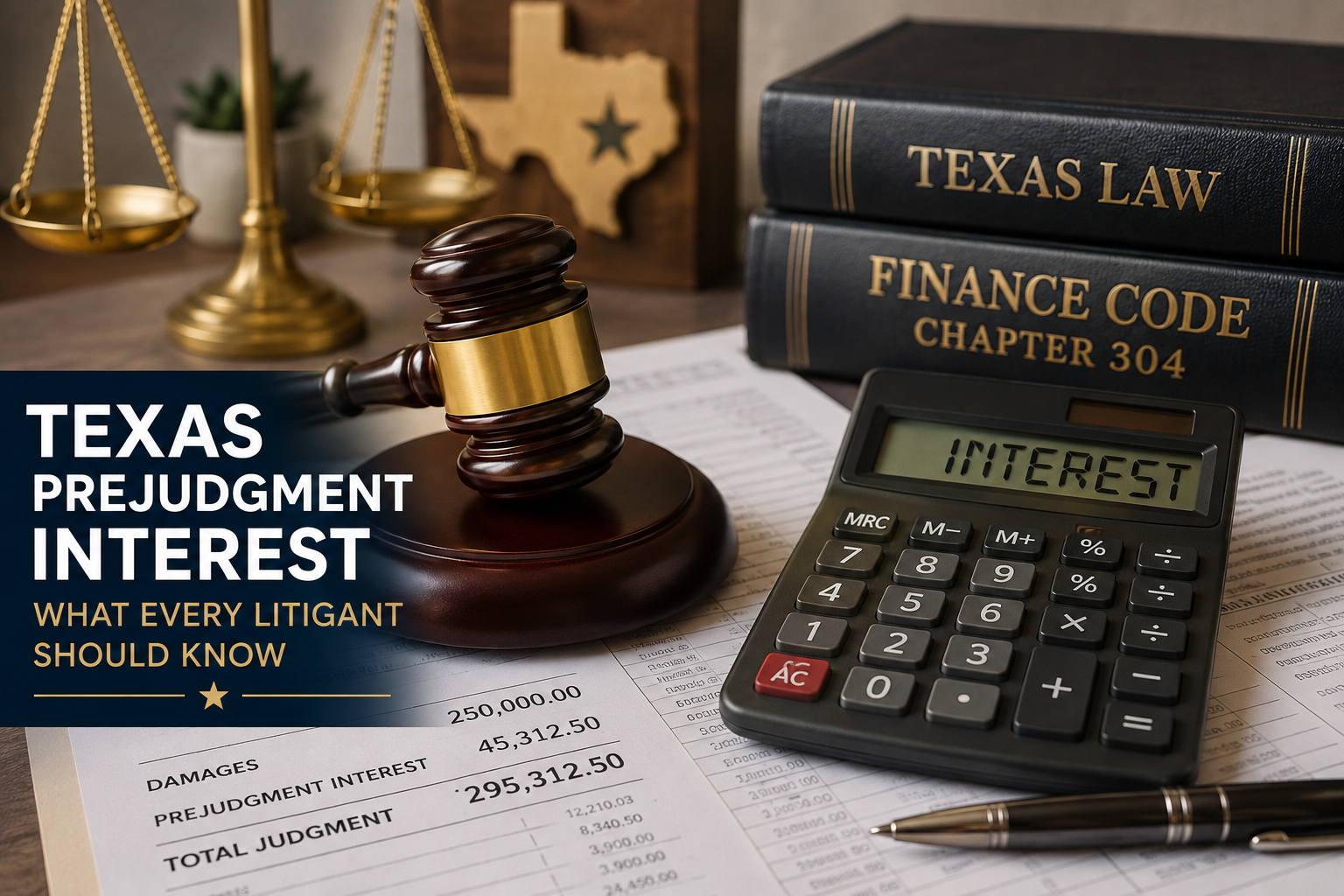
Many people focus only on the amount of damages they may recover in a lawsuit. However, another significant issue often receives far less attention: prejudgment interest. In many Texas cases, a prevailing plaintiff may recover not only damages but also interest that accrued before judgment was entered.
Prejudgment interest can substantially increase the value of a successful lawsuit, particularly when litigation lasts several years.
As a Texas attorney, I frequently explain that prejudgment interest is intended to compensate an injured party for the lost use of money that should have been paid earlier—not to punish the defendant.
What Is Prejudgment Interest?
Prejudgment interest is interest that accrues before the court signs the final judgment.
After judgment is entered, post-judgment interestbegins accruing under a different set of rules.
The purpose of prejudgment interest is to fully compensate an injured party for being deprived of money that should have been paid earlier.
Where Does Texas Law Come From?
Texas prejudgment interest law is governed primarily by:
- Texas Finance Code Chapter 304
- Texas Supreme Court case law
For wrongful death, personal injury, and property damage cases, Texas Finance Code § 304.104 provides:
"Prejudgment interest accrues on the amount of a judgment during the period beginning on the earlier of:
(1) the 180th day after the date the defendant receives written notice of a claim; or
(2) the date suit is filed."
This statutory rule establishes precisely when prejudgment interest begins to accrue.
When Does Interest Stop?
Interest generally stops accruing on the day before judgment is signed.
Once judgment is entered, post-judgment interest begins under Texas Finance Code Chapter 304.
The transition from prejudgment to post-judgment interest is automatic.
Does Every Lawsuit Receive Prejudgment Interest?
No.
Whether prejudgment interest is available depends upon the type of claim.
Examples include:
- breach of contract
- personal injury
- wrongful death
- property damage
- certain equitable claims
Different legal rules apply depending upon the cause of action.
Some statutes expressly authorize prejudgment interest, while other claims rely upon common law principles developed by Texas courts.
How Is Prejudgment Interest Calculated?
The calculation depends on several factors:
- the amount of recoverable damages
- the applicable interest rate
- the date interest begins
- whether any statutory exclusions apply
Texas law generally uses simple interest, not compound interest.
This distinction can significantly affect the amount ultimately recovered.
Why Does Prejudgment Interest Matter?
Many lawsuits remain pending for several years.
Consider a $250,000 judgment.
If prejudgment interest accrues over several years, the plaintiff may recover tens of thousands of dollars beyond the damages themselves.
Likewise, defendants evaluating settlement should account for the continuing accrual of prejudgment interest while the case remains pending.
Can the Parties Contract Around Prejudgment Interest?
Sometimes.
Commercial contracts frequently contain provisions governing:
- default interest
- contractual interest
- attorney's fees
- payment obligations
Texas courts often enforce contractual interest provisions unless prohibited by statute or public policy.
Accordingly, the terms of the parties' agreement may significantly affect the analysis.
Common Misconceptions
Many people mistakenly believe:
- interest begins when the lawsuit is filed;
- every lawsuit earns prejudgment interest;
- prejudgment interest compounds annually; or
- post-judgment and prejudgment interest are calculated the same way.
Each of these statements may be incorrect depending upon the type of case and applicable law.
Why This Matters
Prejudgment interest can materially affect both settlement negotiations and trial strategy.
Plaintiffs should understand that delay may increase the value of certain claims through accrued interest. Defendants, meanwhile, should recognize that postponing resolution may increase potential liability beyond the damages alone.
Because prejudgment interest depends upon statutory provisions, common law, and the nature of the underlying claim, careful legal analysis is often required.
Need Help With a Texas Civil Lawsuit?
If you have questions regarding a Texas lawsuit involving breach of contract, business disputes, real estate litigation, or other civil claims, consulting an experienced attorney early in the process can help you evaluate both your damages and any potential entitlement to prejudgment interest.
At David C. Barsalou, Attorney at Law, PLLC, we help clients navigate business, family, tax, estate planning, and real estate matters ranging from document drafting to litigation with clarity and confidence. If you’d like guidance on your situation, schedule a consultation today. Call us at (713) 397-4678, email barsalou.law@gmail.com, or reach us through our Contact Page. We’re here to help you take the next step.
