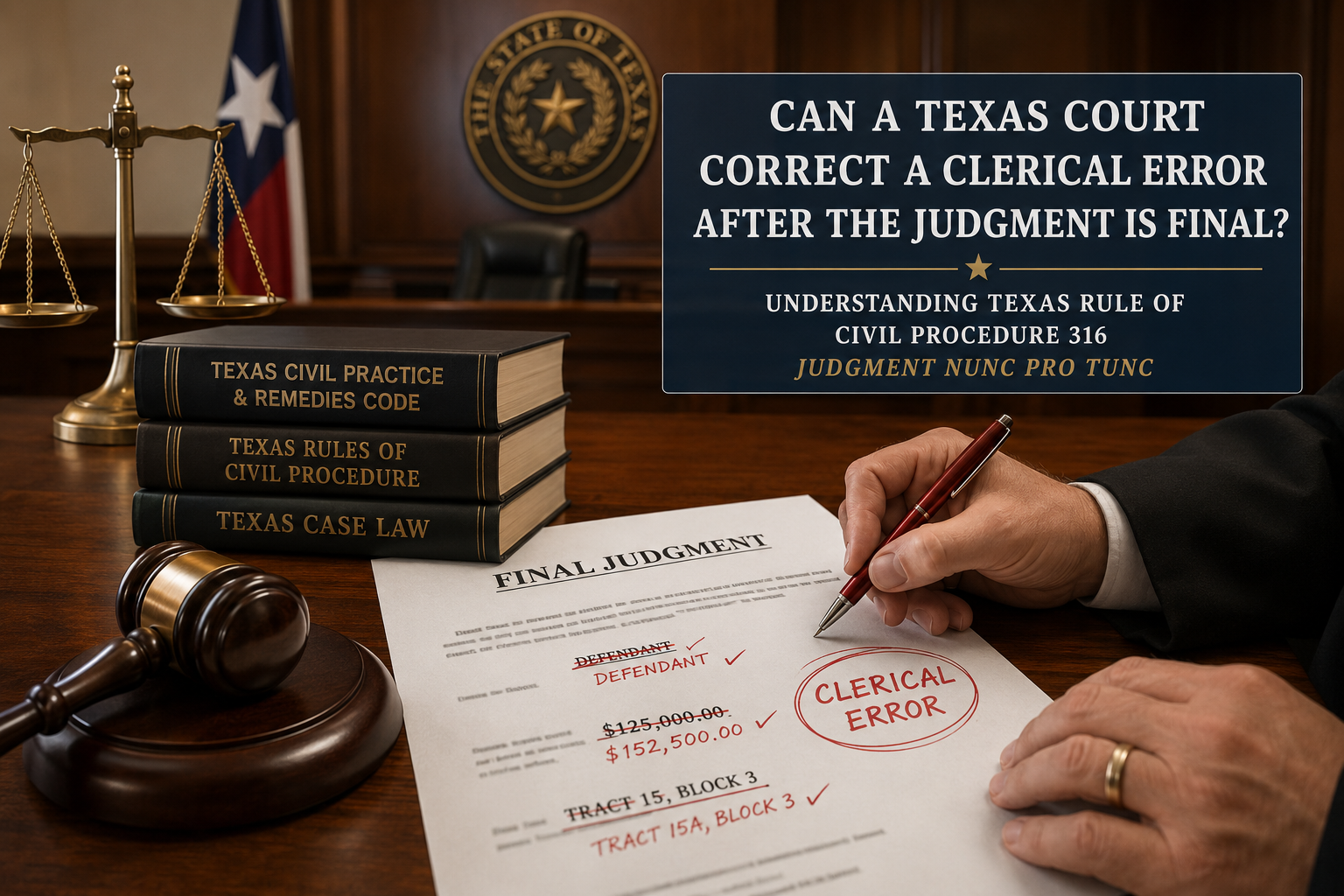
Few things are more frustrating than discovering that a final judgment contains a mistake. Perhaps the judgment misspells a party's name, omits a legal description, contains an incorrect dollar amount due to a transcription error, or simply fails to reflect what the judge actually pronounced in open court.
Many people assume that once a judgment becomes final, nothing can be changed.
That is not entirely true.
Texas law recognizes an important distinction between clerical errors and judicial errors, and that distinction can determine whether a court retains authority to correct its judgment years—even decades—after it becomes final.
Understanding this distinction requires a look at Texas Rule of Civil Procedure 316.
What Does Rule 316 Say?
Texas Rule of Civil Procedure 316 provides:
"Mistakes in the record of any judgment may be corrected by the judge in open court according to the truth or justice of the case after notice of the application therefor has been given to the parties interested in such judgment, as provided for in Rule 21a, and thereafter the execution shall conform to the judgment as amended."
Although the rule is short, it grants courts an important continuing power.
What Is a Judgment Nunc Pro Tunc?
A correction made under Rule 316 is typically accomplished through a judgment nunc pro tunc.
"Nunc pro tunc" is Latin for "now for then."
The purpose is not to create a new judgment.
Instead, the court enters an order today that accurately reflects what the court actually decided earlier.
Clerical Errors Versus Judicial Errors
The distinction between these two concepts is critical.
Clerical Error
A clerical error occurs when the written judgment fails to accurately reflect what the court actually rendered.
Examples include:
- Mathematical transcription mistakes
- Incorrect legal descriptions
- Misspelled party names
- Wrong cause number
- Omitted language that was actually rendered
- Incorrect recording of the court's ruling
These errors may generally be corrected by nunc pro tunc.
Judicial Error
A judicial error occurs when the judge later decides that the original ruling itself was incorrect.
Examples include:
- Changing damages awarded
- Reconsidering liability
- Altering custody decisions
- Changing legal conclusions
- Awarding relief that was intentionally omitted
These are not clerical mistakes.
Instead, they involve changing the substance of the judgment.
Once plenary power expires, courts generally cannot make these changes.
Why Does This Matter?
Texas trial courts lose plenary jurisdiction after the deadlines established by the Rules of Civil Procedure.
Many litigants believe this means every aspect of the judgment becomes untouchable.
That is incorrect.
Even after plenary power expires, courts retain limited authority to correct clerical mistakes so that the written judgment accurately reflects what actually occurred.
Evidence of the Clerical Error
Because the court is reconstructing what actually happened, evidence often becomes important.
Possible evidence may include:
- Court reporter transcripts
- Docket entries
- Court minutes
- Signed findings
- Prior written rulings
- Other parts of the court record
The goal is to determine what judgment the court originally rendered—not what it wishes it had rendered.
Notice Is Required
Rule 316 requires notice to interested parties.
This protects due process by allowing anyone affected by the correction to contest whether the alleged mistake is truly clerical.
Often, hearings focus almost entirely on whether the error was clerical or judicial.
Can a Court Correct Any Mistake?
No.
Rule 316 is not an opportunity to relitigate the case.
A party cannot use a nunc pro tunc proceeding to argue:
- "The judge got it wrong."
- "The damages should have been higher."
- "The judge misunderstood the evidence."
Those arguments generally belong in:
- Motions for new trial;
- Motions to modify the judgment;
- Appeals; or
- Other post-judgment remedies.
Rule 316 exists only to ensure the written judgment accurately records what was actually rendered.
Common Examples
Proper uses of Rule 316 may include:
- Correcting a typographical error in a legal description.
- Correcting an omitted middle initial that affects title records.
- Correcting an incorrect interest calculation caused by transcription.
- Correcting a judgment that mistakenly identifies the wrong defendant due to clerical oversight.
- Correcting a judgment that accidentally omits relief that was orally rendered in open court.
Improper uses include:
- Increasing damages after reconsidering the evidence.
- Awarding attorney's fees that were previously denied.
- Changing custody rulings.
- Modifying property division because the court later believes it was unfair.
- Changing legal conclusions after the judgment becomes final.
Practical Importance
These issues arise more frequently than many people realize.
Real estate transactions, judgment liens, title examinations, probate proceedings, and enforcement actions often uncover clerical mistakes that have remained unnoticed for years.
Knowing whether a mistake is clerical or judicial can determine whether the judgment can still be corrected—or whether the only remaining remedy is appeal or another extraordinary proceeding.
Conclusion
Texas Rule of Civil Procedure 316 provides an important but limited mechanism for correcting mistakes in final judgments. While courts generally lose the power to change the substance of their decisions once plenary jurisdiction expires, they retain authority to ensure that the written judgment accurately reflects what was actually rendered.
Because the line between a clerical error and a judicial error is often heavily litigated, parties should carefully evaluate the court record before seeking a judgment nunc pro tunc. An experienced Texas attorney can help determine whether Rule 316 provides an available remedy or whether another procedural avenue is required.
Disclaimer: This article is for informational purposes only and does not constitute legal advice. Every case presents unique facts, and you should consult a qualified Texas attorney regarding your specific circumstances.
At David C. Barsalou, Attorney at Law, PLLC, we help clients navigate business, family, tax, estate planning, and real estate matters ranging from document drafting to litigation with clarity and confidence. If you’d like guidance on your situation, schedule a consultation today. Call us at (713) 397-4678, email barsalou.law@gmail.com, or reach us through our Contact Page. We’re here to help you take the next step.
