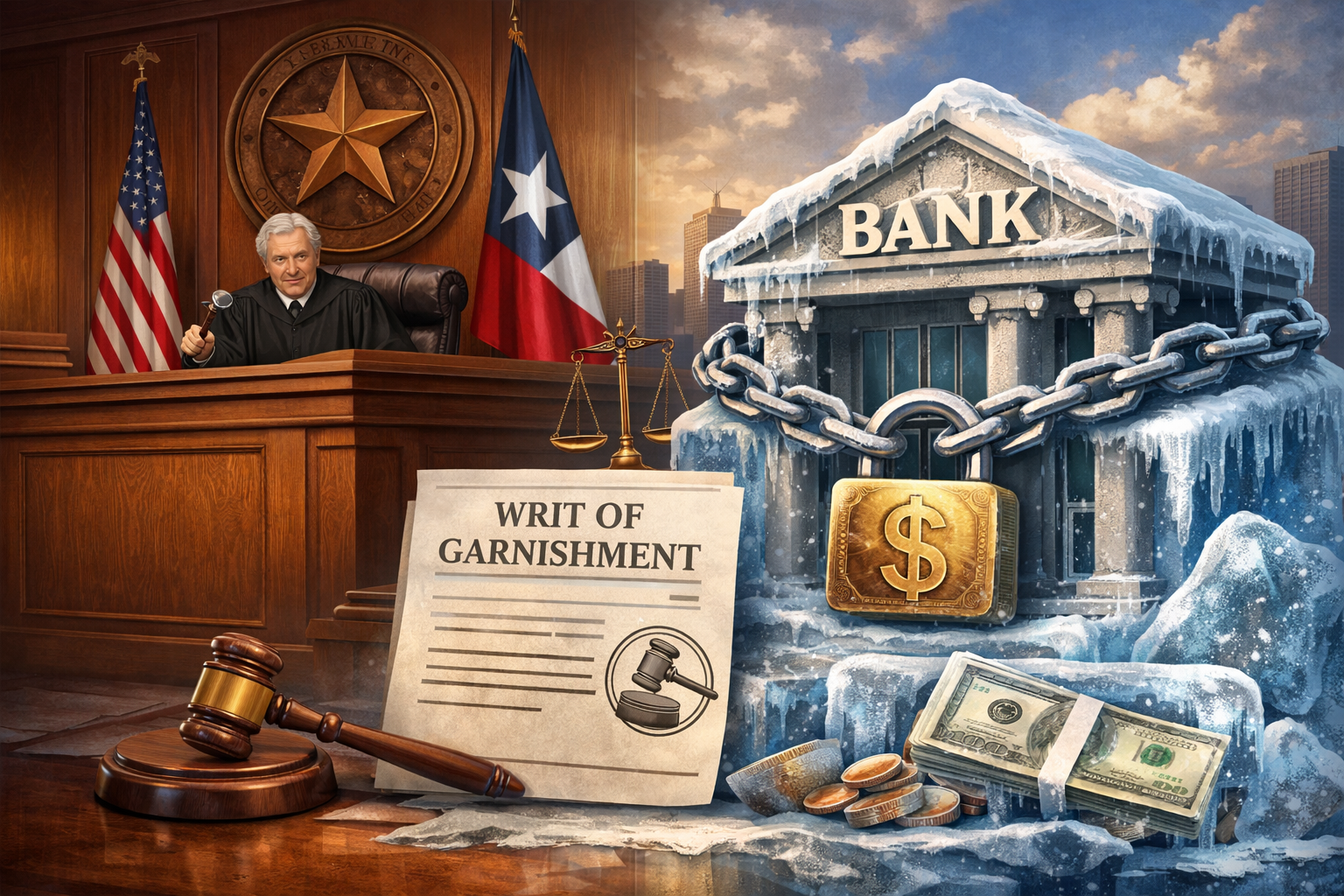
When most people think about lawsuits, they imagine trials and judgments. What they don’t expect is waking up one day and discovering that their bank account has been frozen—sometimes without warning.
In Texas, this happens through a powerful legal tool called garnishment. If you owe a judgment, a creditor may be able to reach your bank funds before you even know what is happening.
This article explains how garnishment works under Texas law, when it is allowed, and how to protect yourself.
What Is a Writ of Garnishment in Texas?
A writ of garnishment is a court order that allows a creditor to seize money or property held by a third party—usually a bank—on behalf of a debtor.
Under the Texas Civil Practice and Remedies Code:
“A writ of garnishment is available if… the plaintiff has a valid, subsisting judgment and makes an affidavit that the defendant does not possess property in Texas subject to execution sufficient to satisfy the judgment.”
Tex. Civ. Prac. & Rem. Code § 63.001
In practical terms, garnishment allows a judgment creditor to intercept your money before it reaches you.
Most commonly, this involves:
- Bank accounts
- Brokerage accounts
- Certain contract payments
Texas law generally does not allow wage garnishment for ordinary debts, but bank accounts are fair game.
When Can a Creditor Garnish Your Bank Account?
1. There Must Be a Valid Judgment
Before garnishment is allowed, the creditor must usually win a lawsuit and obtain a judgment.
Texas law provides:
“A writ of garnishment may not be issued before final judgment except in limited circumstances.”
Tex. Civ. Prac. & Rem. Code § 63.001
In most consumer and business cases, garnishment happens afterjudgment.
2. The Creditor Must File a Sworn Application
The creditor must file an affidavit stating that:
- You owe a valid debt, and
- You do not have sufficient property subject to execution
See Tex. Civ. Prac. & Rem. Code § 63.002.
False or inaccurate affidavits can sometimes be challenged.
3. A Judge Must Approve the Writ
A writ is not automatic. A court must authorize it.
Once signed, the writ is served on your bank, not on you.
How Bank Account Garnishment Actually Works
Here’s how it usually unfolds:
Step 1: Writ Served on the Bank
The creditor serves the writ on your financial institution.
At that moment, the bank must freeze the account.
Step 2: Funds Are “Impounded”
Texas law requires the garnishee (the bank) to hold the funds:
“The garnishee shall answer under oath and hold the property subject to further court order.”
Tex. R. Civ. P. 665
You may suddenly lose access to:
- Checking funds
- Savings accounts
- Joint accounts (sometimes)
Step 3: You Receive Notice Afterward
You are notified after the freeze occurs.
This surprises many people, but it is legal.
Step 4: Court Determines Who Gets the Money
If no valid defense exists, the court orders the bank to release funds to the creditor.
What Property Is Exempt from Garnishment in Texas?
Texas provides strong protections for certain assets.
Under the Texas Property Code:
“Current wages for personal services… are exempt from garnishment.”
Tex. Prop. Code § 42.001(b)(1)
Common exemptions include:
✔ Exempt Assets
- Wages (most debts)
- Social Security
- Disability benefits
- Retirement accounts (often)
- Certain pensions
- Veterans benefits
❌ Usually Not Exempt
- Savings accounts
- Business accounts
- Investment accounts
- Rental income
- Settlement proceeds
Once exempt funds are mixed into regular accounts, protection can become complicated.
Can Joint Accounts Be Garnished?
Yes—sometimes.
If your name appears on the account, creditors may attempt garnishment.
However, Texas courts recognize “ownership interests.” If some funds belong to a non-debtor, they may be protected.
This often requires filing a formal challenge.
How Do You Challenge a Garnishment?
You have the right to contest improper garnishment.
Under Texas rules:
“The defendant may replevy the property or controvert the garnishee’s answer.”
Tex. R. Civ. P. 664a
Common grounds include:
1. Exempt Funds
Social Security and retirement benefits may be protected.
2. Improper Judgment
Invalid or expired judgments can invalidate garnishment.
3. Procedural Errors
Missing affidavits, improper service, or incorrect filings.
4. Third-Party Ownership
Funds belonging to someone else.
Timing matters. Delays can cost you permanently frozen funds.
How Long Can a Judgment Creditor Garnish Accounts?
Texas judgments are valid for:
“Ten years from the date of rendition.”
Tex. Civ. Prac. & Rem. Code § 34.001
Judgments can often be renewed.
This means garnishment risk may last decades if not addressed.
Practical Tips to Avoid Garnishment Problems
1. Do Not Ignore Lawsuits
Default judgments are the most common cause of garnishment.
2. Keep Exempt Funds Separate
Maintain dedicated accounts for Social Security or retirement deposits.
3. Monitor Old Debts
Old judgments may still be enforceable.
4. Get Legal Advice Early
Waiting until funds are frozen limits your options.
Why Garnishment Law Is So Strict in Texas
Texas balances two interests:
- Enforcing court judgments
- Protecting basic living income
That is why wages are protected but bank accounts are not.
Once money enters an account, it loses many statutory protections.
When You Should Talk to a Lawyer
You should consult counsel if:
- Your account has been frozen
- You received garnishment papers
- You suspect improper procedures
- Your exempt funds were seized
Early action can often recover protected money.
Final Thoughts: Garnishment Is Serious—but Not Hopeless
Bank account garnishment is one of the most aggressive collection tools in Texas law. It can disrupt businesses, families, and personal finances overnight.
But it is also highly technical.
Many garnishments fail when properly challenged.
If you are facing a frozen account or a pending judgment, understanding your rights under Texas law is the first step toward protecting your assets.
At David C. Barsalou, Attorney at Law, PLLC, we help clients navigate business, family, tax, estate planning, and real estate matters ranging from document drafting to litigation with clarity and confidence. If you’d like guidance on your situation, schedule a consultation today. Call us at (713) 397-4678, email barsalou.law@gmail.com, or reach us through our Contact Page. We’re here to help you take the next step.