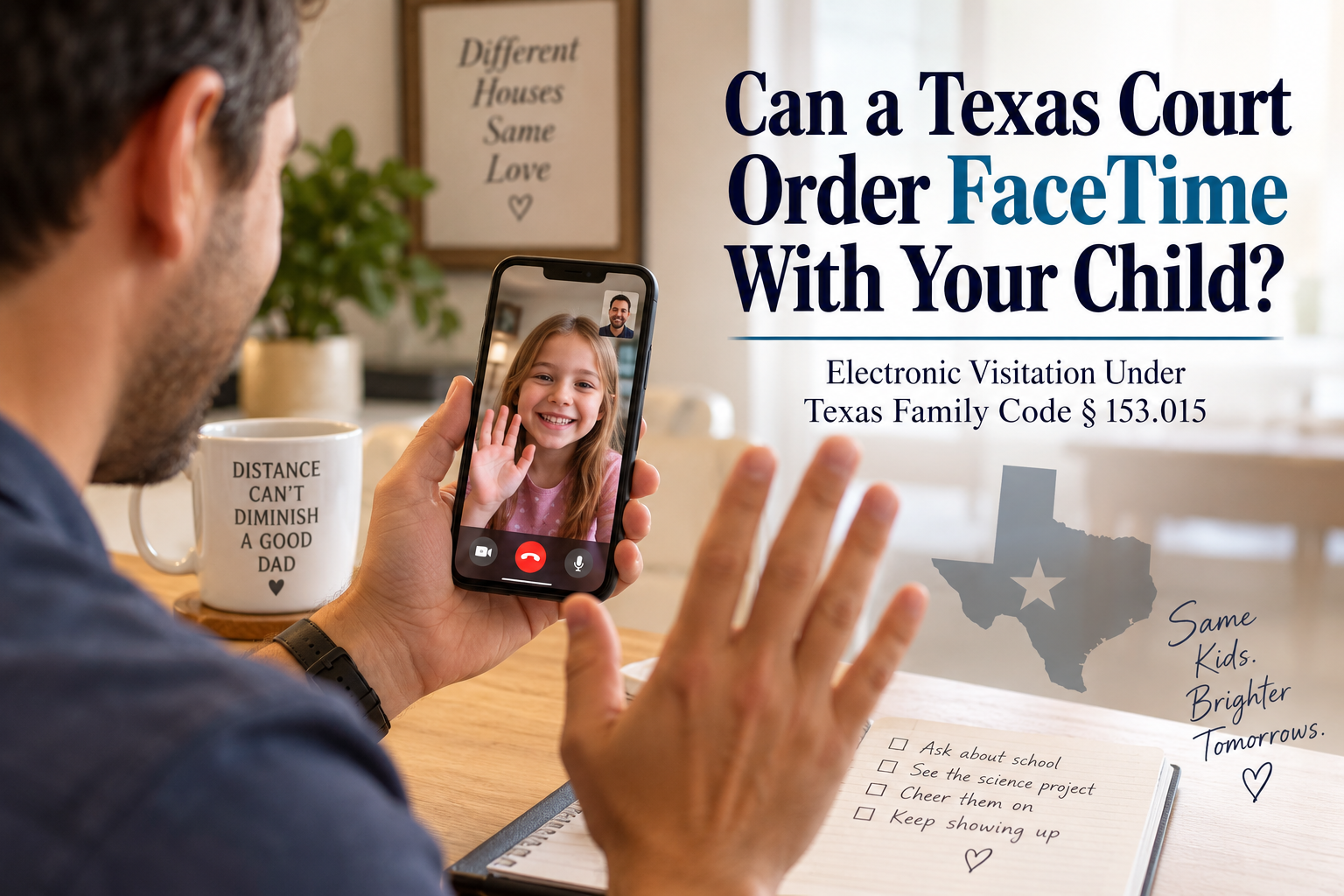
Divorced and separated parents increasingly communicate with their children through FaceTime, Zoom, text messages, telephone calls, and other electronic methods. For parents who live far apart—or who simply spend several days at a time away from their children under a possession schedule—video calls can provide an important way to stay connected.
But does a Texas parent actually have a legal right to FaceTime or call a child while the child is staying with the other parent?
Not necessarily.
Texas law does, however, expressly authorize family courts to order electronic communication between a parent and child. Texas Family Code § 153.015 gives courts considerable flexibility to permit electronic contact as a supplement to ordinary periods of possession.
The statute also contains an important limitation: electronic visitation is not supposed to replace real visitation.
Texas Law Specifically Recognizes Electronic Communication With Children
Texas Family Code § 153.015 defines electronic communication broadly. The statute provides:
“Electronic communication” means any communication facilitated by the use of any wired or wireless technology via the Internet or any other electronic media.
The statute expressly includes communication by telephone, email, instant messaging, videoconferencing, or webcam. Tex. Fam. Code § 153.015(a).
The terminology is slightly amusing in 2026. A statute referring to “instant messaging” and “webcam” sounds a little like someone is about to sign onto AOL.
But the definition is broad enough to encompass the technology families actually use today. FaceTime, Zoom, WhatsApp video calls, and similar services would generally fit comfortably within the statutory concept of electronic communication.
Can a Judge Order FaceTime or Video Calls?
Yes.
If a conservator asks the court to order electronic communication with a child, § 153.015(b) provides that:
“the court may award the conservator reasonable periods of electronic communication with the child to supplement the conservator's periods of possession of the child.”
Tex. Fam. Code § 153.015(b).
The word “may” is important. The statute does not create an automatic entitlement to a nightly FaceTime call.
Instead, the court determines whether electronic communication is appropriate.
The statute directs the court to consider three things:
- whether electronic communication is in the best interest of the child;
- whether the equipment necessary for the communication is reasonably available to everyone subject to the order; and
- any other factor the court considers appropriate.
As with so many issues involving conservatorship and possession in Texas, the child's best interest remains central.
Electronic Visitation Is Supposed to Supplement Possession—not Replace It
This is perhaps the most interesting part of the statute.
A parent cannot ordinarily be told, in effect, “You don't need to see your child this weekend. You can FaceTime instead.”
Section 153.015(d) expressly states:
“The availability of electronic communication under this section is not intended as a substitute for physical possession of or access to the child where otherwise appropriate.”
Tex. Fam. Code § 153.015(d).
That distinction matters.
Electronic communication is intended to supplement a parent's relationship with the child. It is not intended to transform a physical possession schedule into a virtual one.
A video call may help a parent stay involved during the other parent's week. It ordinarily does not replace that parent's weekend, holiday, summer possession, or other court-ordered physical access.
The Other Parent May Have an Affirmative Duty to Cooperate
A court order providing electronic communication can impose real obligations on both parents.
If electronic communication is ordered, § 153.015(c) generally requires each conservator subject to the order to provide the other conservator with the child's electronic access information and to provide notice when that information changes.
More importantly, when the necessary equipment is reasonably available, the statute requires the conservator to:
“accommodate electronic communication with the child, with the same privacy, respect, and dignity accorded all other forms of access, at a reasonable time and for a reasonable duration subject to any limitation provided by the court in the court's order.”
Tex. Fam. Code § 153.015(c)(3).
That language can become important in a contentious co-parenting relationship.
A parent who has the child cannot necessarily satisfy an electronic-access provision by turning on a video call for thirty seconds while standing over the child, interrupting constantly, or making meaningful communication impossible.
The statute expressly refers to privacy, respect, and dignity.
Does That Mean a Parent Can Call Whenever He or She Wants?
No.
The statute uses the words “reasonable time” and “reasonable duration.”
That is deliberately flexible, but flexibility can also create disputes.
Suppose a possession order simply says that a parent is entitled to “reasonable electronic communication.” What happens when one parent believes a 30-minute nightly FaceTime call is reasonable, while the other believes three calls per week for ten minutes each is sufficient?
Or suppose the child has soccer practice, homework, dinner, and an 8:00 p.m. bedtime.
Neither parent necessarily gets unilateral control over what “reasonable” means.
For that reason, a carefully drafted order may be more useful than a vague entitlement to electronic communication. Depending on the circumstances, an order can address matters such as frequency, approximate calling times, duration, the method of communication, and reasonable adjustments when a child has another activity.
Can the Other Parent Listen to the Call?
Section 153.015(c)(3)'s reference to communication being afforded the same “privacy, respect, and dignity” as other forms of access is significant.
That does not necessarily mean that every electronic conversation between a parent and child must occur behind a locked door with absolute secrecy. The child's age, safety, technology, court orders, and circumstances all matter.
A three-year-old, for example, may need another adult to operate the device.
A teenager ordinarily does not need a parent holding the telephone six inches from his face.
As children become older and more technologically independent, the practical meaning of reasonable privacy may change.
What If the Child Does Not Want to Talk?
This is another area where electronic-visitation disputes can become unnecessarily difficult.
An order requiring one parent to accommodatecommunication does not magically give that parent control over a child's mood or behavior.
There can be an enormous factual difference between:
- a parent intentionally preventing communication;
- a parent making no reasonable effort to facilitate it;
- a young child becoming distracted after two minutes;
- a teenager refusing to participate; and
- a child simply being unavailable because of an ordinary activity.
Family courts deal with conduct and circumstances, not just screenshots showing unanswered calls.
A recurring pattern of interference may be much more significant than one missed FaceTime call.
Electronic Communication Does Not Reduce Child Support
Texas law also closes off another potentially strange argument.
Section 153.015(d) states:
“The court may not consider the availability of electronic communication as a factor in determining child support.”
Tex. Fam. Code § 153.015(d).
In other words, a parent does not pay less child support because he or she can FaceTime the child.
Possession, electronic access, and child support are related to the same parent-child relationship, but Texas law does not treat a video call as some sort of credit against a support obligation.
Electronic Visitation Can Be Particularly Useful When Parents Live Far Apart
The statute can be especially useful when physical distance makes frequent possession difficult.
Imagine that one parent lives in Houston while the other lives several hours away. Even if the parents follow a normal possession schedule, there may be long stretches when the child does not physically see one parent.
A brief scheduled video call can allow that parent to remain involved in ordinary life:
“How was school?”
“Show me your science project.”
“Did you win your game?”
“Where is the other shoe?”
That last question may constitute approximately 40% of parenting.
Electronic communication cannot recreate physical parenting, but it can preserve some of the ordinary, mundane contact that otherwise disappears when parents live separately.
Electronic Communication Can Also Become a Tool for Conflict
Technology does not automatically make co-parenting easier.
In a high-conflict case, electronic communication can itself become the battleground.
One parent may call repeatedly. Another may refuse to answer. A parent may schedule calls during dinner or bedtime. Someone may insist that a child remain on camera far longer than the child wants. Parents may argue over whether the child must use a particular device or application.
That is precisely why the statutory concept of reasonablenessmatters.
Electronic access should generally facilitate the parent-child relationship—not provide another mechanism for one adult to supervise, inconvenience, or antagonize the other.
Can an Existing Texas Custody Order Be Modified to Add Electronic Communication?
Potentially.
If an existing order does not adequately address electronic communication, a parent may seek modification of the order when the requirements of Texas law are satisfied.
But requesting a modification is different from simply announcing:
“The Family Code says I get FaceTime.”
It does not.
Section 153.015 gives a court authority to award reasonable electronic communication. The precise rights of the parents still depend heavily on the existing order and the circumstances of the particular case.
That distinction is important before accusing another parent of violating a right that the current order may never have created.
Practical Considerations for Texas Parents
Parents dealing with electronic access should first read the actual possession order. Do not assume that general expectations about co-parenting are identical to enforceable court-ordered obligations.
Where electronic communication is included in an order, clarity can prevent unnecessary disputes. The parties may benefit from knowing approximately when calls occur, how long they last, what happens when a child has an activity, and whether reasonable rescheduling is permitted.
Most importantly, electronic communication should remain focused on the child.
A ten-minute call in which a parent asks about school may be beneficial. A forty-five-minute interrogation about what the other parent did over the weekend is something very different.
The Bottom Line
Texas law specifically recognizes that a parent's relationship with a child does not have to disappear whenever the child goes to the other parent's house.
Under Texas Family Code § 153.015, a court may order reasonable electronic communication—including telephone calls and video communication—to supplement a parent's periods of physical possession. The court considers the child's best interest, the availability of necessary technology, and other appropriate circumstances.
But the statute draws an equally important line: electronic communication is a supplement, not a substitute, for actual possession and access.
FaceTime may be part of modern Texas co-parenting.
It does not replace being there.
At David C. Barsalou, Attorney at Law, PLLC, we help clients navigate business, family, tax, estate planning, and real estate matters ranging from document drafting to litigation with clarity and confidence. If you’d like guidance on your situation, schedule a consultation today. Call us at (713) 397-4678, email barsalou.law@gmail.com, or reach us through our Contact Page. We’re here to help you take the next step.