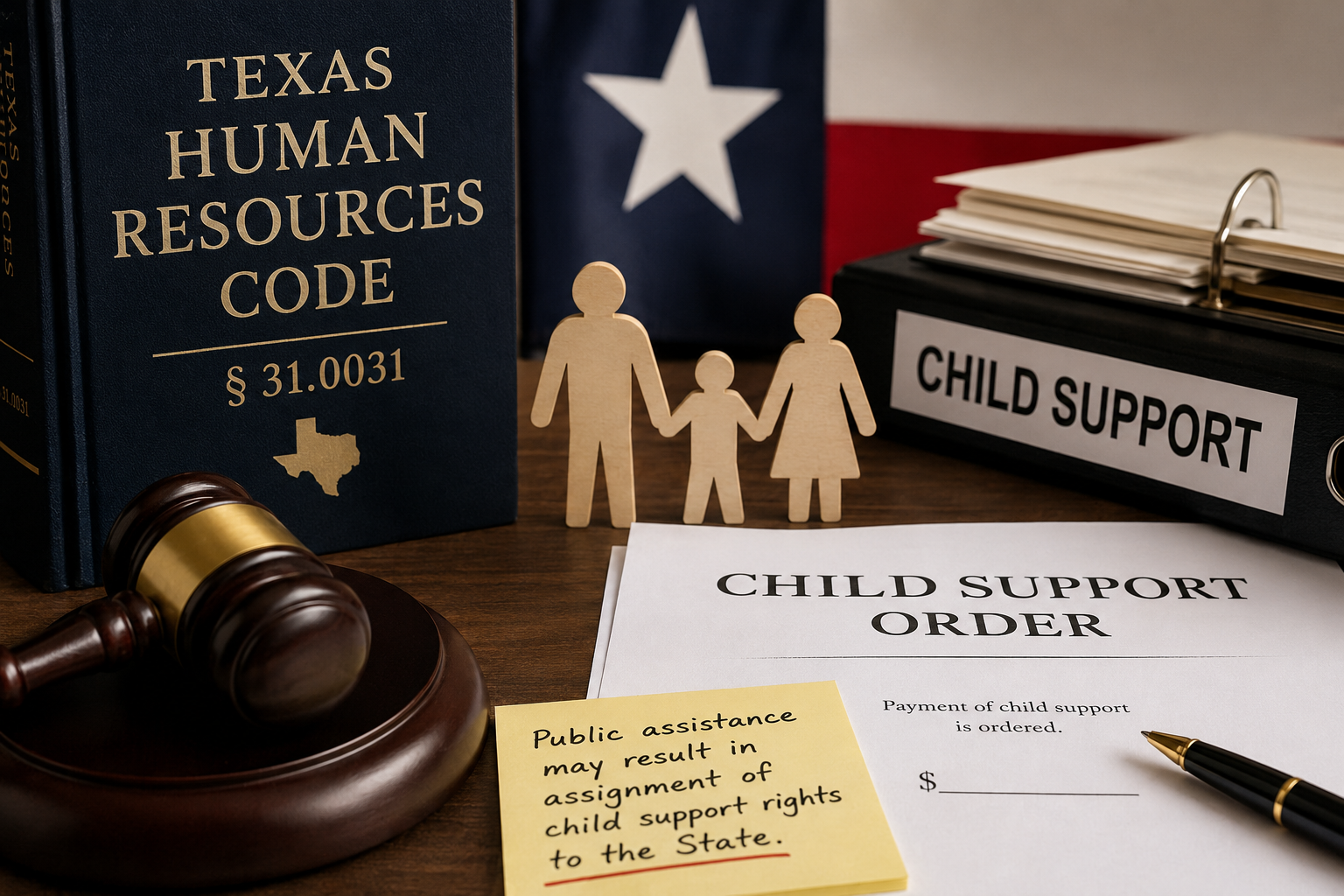
When parents receive certain forms of public assistance in Texas, many are surprised to learn that the State may acquire important legal rights relating to child support. Although most people think of child support as an issue solely between parents, the Texas Human Resources Code creates circumstances in which the State itself becomes financially interested in collecting support.
This often becomes relevant years after benefits have been received, particularly when a parent is attempting to resolve child support arrearages or modify an existing support order.
Public Assistance Can Affect Child Support Rights
Under Texas Human Resources Code § 31.0031, acceptance of certain public assistance benefits generally results in an assignment of certain child support rights to the State of Texas. In practical terms, this means that the State may seek reimbursement for assistance that it has provided through its public assistance programs.
The statute provides in part:
"As a condition of eligibility for financial assistance, an applicant or recipient assigns to the Title IV-D agency any rights to support from any other person the applicant or recipient may have in the applicant's own behalf or on behalf of any other family member for whom the applicant is applying for or receiving assistance."
Tex. Hum. Res. Code § 31.0031(a).
This assignment exists because taxpayer funds are being used to provide assistance that another legally responsible parent may have been obligated to provide.
Why This Matters in Family Law Cases
This provision can create unexpected complications during:
- Child support enforcement actions
- Modification proceedings
- Settlement negotiations
- Arrearage calculations
- Payment allocation disputes
For example, two parents might privately agree on how they wish to resolve unpaid child support. However, if support rights have previously been assigned to the State because public assistance was received, the parents may discover that they cannot simply negotiate away money that is owed to the State.
The Office of the Attorney General May Become Involved
Texas operates its child support enforcement program through the Title IV-D agency, which is administered by the Office of the Attorney General.
Many parents mistakenly believe the Attorney General represents whichever parent filed the case. In reality, the Attorney General generally represents the State's interests in administering the child support program.
That distinction becomes especially important when public assistance has been involved.
A Quirky Aspect of Texas Family Law
One interesting feature of this statutory scheme is that a child support case can gradually evolve from a dispute between two parents into a matter involving three separate interests:
- The custodial parent.
- The noncustodial parent.
- The State of Texas.
The State's interest is not simply academic. If public assistance has created an assignment of support rights under the Human Resources Code, the government may have an independent financial interest that survives even after the parents have resolved many of their personal disagreements.
This is one reason experienced family law attorneys often request a complete payment history and carefully determine whether any governmental claims exist before attempting to negotiate a global settlement.
Every Case Is Different
Not every public assistance program creates the same legal consequences, and the interaction between state and federal child support laws can become highly technical. The timing of benefits, the nature of the assistance received, and subsequent court orders may all affect how support is calculated and collected.
If you are attempting to settle a child support case involving prior public assistance, it is worth understanding whether the State has acquired any statutory rights before finalizing an agreement.
Need Help With a Texas Family Law Matter?
Whether you are seeking to establish child support, modify an existing order, enforce unpaid support, or resolve complicated arrearage issues, understanding the interaction between the Texas Human Resources Codeand the Texas Family Code can be critical.
An experienced Texas family law attorney can review the history of your case, determine whether any assignment of support rights exists, and help you evaluate your available legal options.
Disclaimer: This article is provided for informational purposes only and does not constitute legal advice. Reading this article does not create an attorney-client relationship. Every case depends on its own facts and applicable law.
At David C. Barsalou, Attorney at Law, PLLC, we help clients navigate business, family, tax, estate planning, and real estate matters ranging from document drafting to litigation with clarity and confidence. If you’d like guidance on your situation, schedule a consultation today. Call us at (713) 397-4678, email barsalou.law@gmail.com, or reach us through our Contact Page. We’re here to help you take the next step.