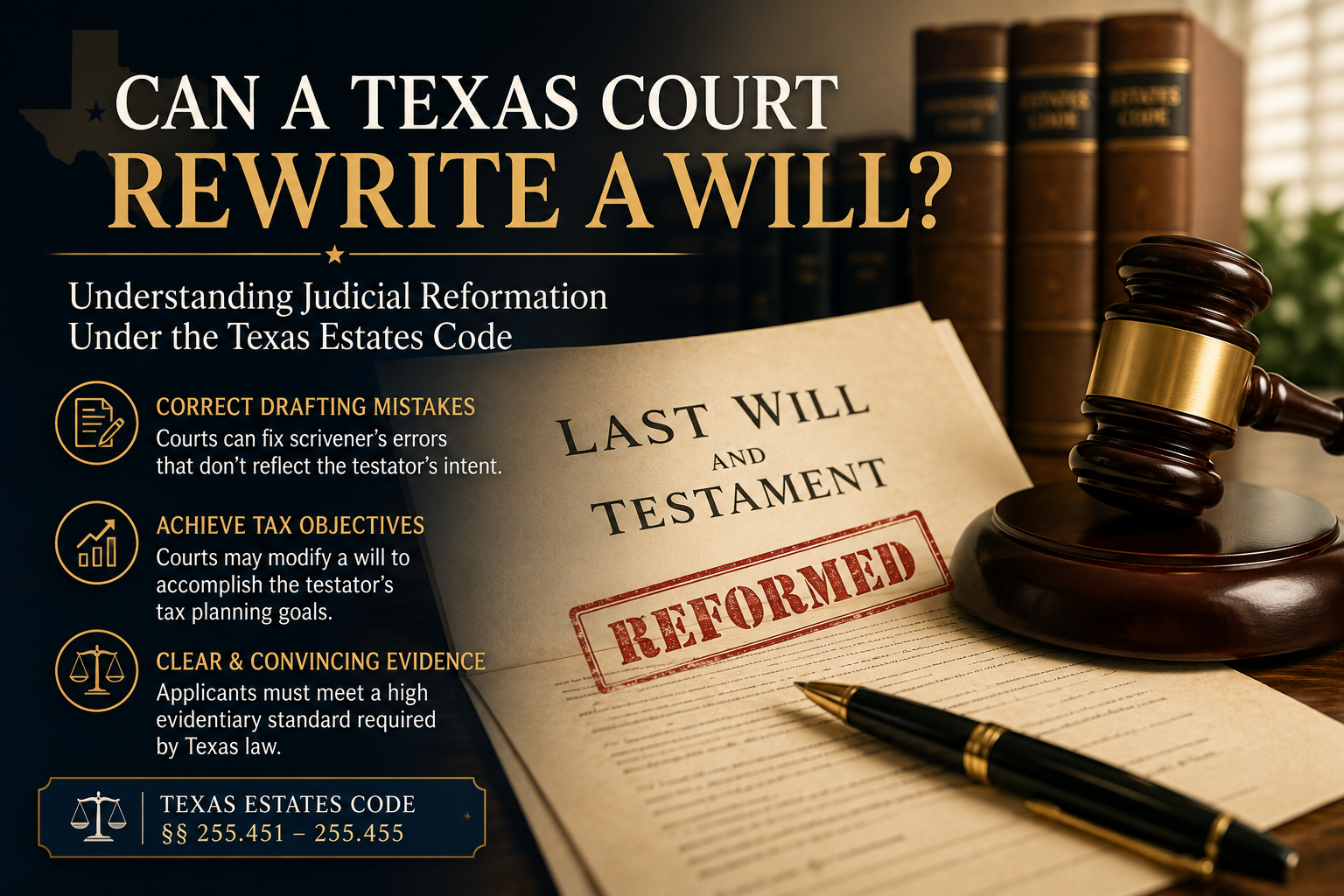
When most people think about a will, they assume the document is set in stone. After all, if a person carefully signs a will and later passes away, shouldn't the courts simply follow what the document says?
Generally, yes. However, Texas law recognizes that mistakes happen. Drafting errors, ambiguous language, and unintended tax consequences can sometimes defeat the very goals the deceased person was trying to accomplish. To address those situations, the Texas Legislature has authorized courts to modify or reform certain testamentary documents under limited circumstances.
For families, beneficiaries, and executors, understanding this little-known area of probate law can make the difference between carrying out a loved one's intentions and becoming trapped by a drafting mistake.
The General Rule: Courts Follow the Written Will
Texas courts begin with the principle that a testator's intent controls.
The Texas Estates Code provides:
"The court shall ascertain the testator's intent from the language found within the four corners of the will." Tex. Estates Code § 255.451.
This means courts generally look first to the written language itself rather than outside evidence.
However, what happens when the written language contains a mistake?
Texas Allows Judicial Reformation of Certain Testamentary Documents
The Texas Legislature created a statutory mechanism allowing courts to reform wills under specific circumstances.
Texas Estates Code § 255.451 provides in relevant part:
"On the petition of a personal representative, a trustee, or any other interested person, a court may order that the terms of a will be modified or reformed, that the administration of the estate be modified, or that a trustee be directed or permitted to do acts that are not authorized or are prohibited by the terms of the will if the court determines that the modification or reformation is necessary or appropriate to achieve the testator's tax objectives or to correct a scrivener's error in the governing instrument."
This statute creates two particularly important grounds for judicial intervention:
- Tax-motivated modifications; and
- Correction of scrivener's errors.
What Is a Scrivener's Error?
A scrivener's error is essentially a drafting mistake.
Examples might include:
- Incorrect legal descriptions of property;
- Mistaken names;
- Omitted words;
- Transposed numbers;
- Clerical drafting mistakes that do not reflect the testator's actual intent.
Suppose a will leaves property located at "Lot 12" when every piece of evidence shows the testator intended to leave "Lot 21." Under appropriate circumstances, a court may be able to reform the document to correct the mistake.
Importantly, judicial reformation is not a license to rewrite a will merely because someone dislikes the outcome.
The objective is to carry out the testator's actual intent—not to substitute the court's judgment for the decedent's wishes.
The Evidentiary Standard Is High
The Estates Code does not permit casual modifications.
Texas Estates Code § 255.452 provides:
"A court may order a modification or reformation under this subchapter only if the applicant establishes by clear and convincing evidence" the facts supporting the requested relief.
The "clear and convincing" standard is significantly higher than the ordinary civil standard of proof.
Evidence commonly offered may include:
- Attorney drafting files;
- Correspondence with the decedent;
- Prior estate planning documents;
- Testimony from the drafting attorney;
- Tax analyses;
- Related trust instruments.
The burden rests on the person seeking reformation.
Tax Planning After Death
One of the most interesting aspects of the statute is that it permits modifications designed to achieve a testator's tax objectives.
Estate plans are often drafted years before death. Tax laws, family circumstances, and asset values may change dramatically during that time.
The Legislature recognized that rigid adherence to document language can sometimes frustrate legitimate tax planning goals.
As a result, courts may approve modifications that better accomplish the tax objectives reflected in the overall estate plan.
These cases frequently arise when:
- Federal estate tax issues emerge;
- Trust provisions create unintended consequences;
- Marital deduction planning is jeopardized;
- Generation-skipping transfer tax concerns arise.
What Reformation Cannot Do
Judicial reformation is not a tool for disappointed heirs.
Courts generally will not:
- Rewrite a will because a beneficiary believes the distribution is unfair;
- Create new gifts that the testator never intended;
- Ignore clear testamentary language;
- Override competent estate planning choices merely because circumstances later changed.
The focus remains on implementing the decedent's actual intent.
Why This Matters
Many people assume that discovering a mistake in a will after death means the error is permanent. Texas law provides a more nuanced answer.
When clear and convincing evidence demonstrates that a drafting error occurred—or when modification is necessary to accomplish the testator's tax objectives—the Estates Code may allow a court to intervene.
For executors and beneficiaries, that means a flawed document is not always the final word.
For estate planners, it serves as a reminder that even carefully prepared documents can benefit from periodic review before they are ever presented to a probate court.
Final Thoughts
Texas probate law contains many hidden remedies that are rarely discussed outside specialized estate planning circles. Judicial reformation of wills is one of them.
Although courts remain reluctant to alter testamentary documents, the Texas Estates Code recognizes that mistakes happen. When those mistakes can be proven by clear and convincing evidence, judicial reformation may provide a path to carrying out the testator's true intentions rather than allowing a drafting error to dictate the outcome.
If you are serving as an executor, trustee, or beneficiary and believe a will contains a drafting mistake, obtaining experienced legal advice early in the probate process can be critical. Once estate administration progresses, correcting the problem often becomes significantly more difficult and expensive.
At David C. Barsalou, Attorney at Law, PLLC, we help clients navigate business, family, tax, estate planning, and real estate matters ranging from document drafting to litigation with clarity and confidence. If you’d like guidance on your situation, schedule a consultation today. Call us at (713) 397-4678, email barsalou.law@gmail.com, or reach us through our Contact Page. We’re here to help you take the next step.
