Many Texas employees are surprised to discover that an employer cannot simply deduct money from a paycheck because equipment was damaged, a cash register came up short, or an employee resigned without notice. Likewise, many employers mistakenly believe they have broad authority to recover losses directly from payroll.
The Texas Payday Law places significant limits on wage deductions, and employers who fail to follow those rules may expose themselves to wage claims before the Texas Workforce Commission.
What Does Texas Labor Code § 61.018 Say?
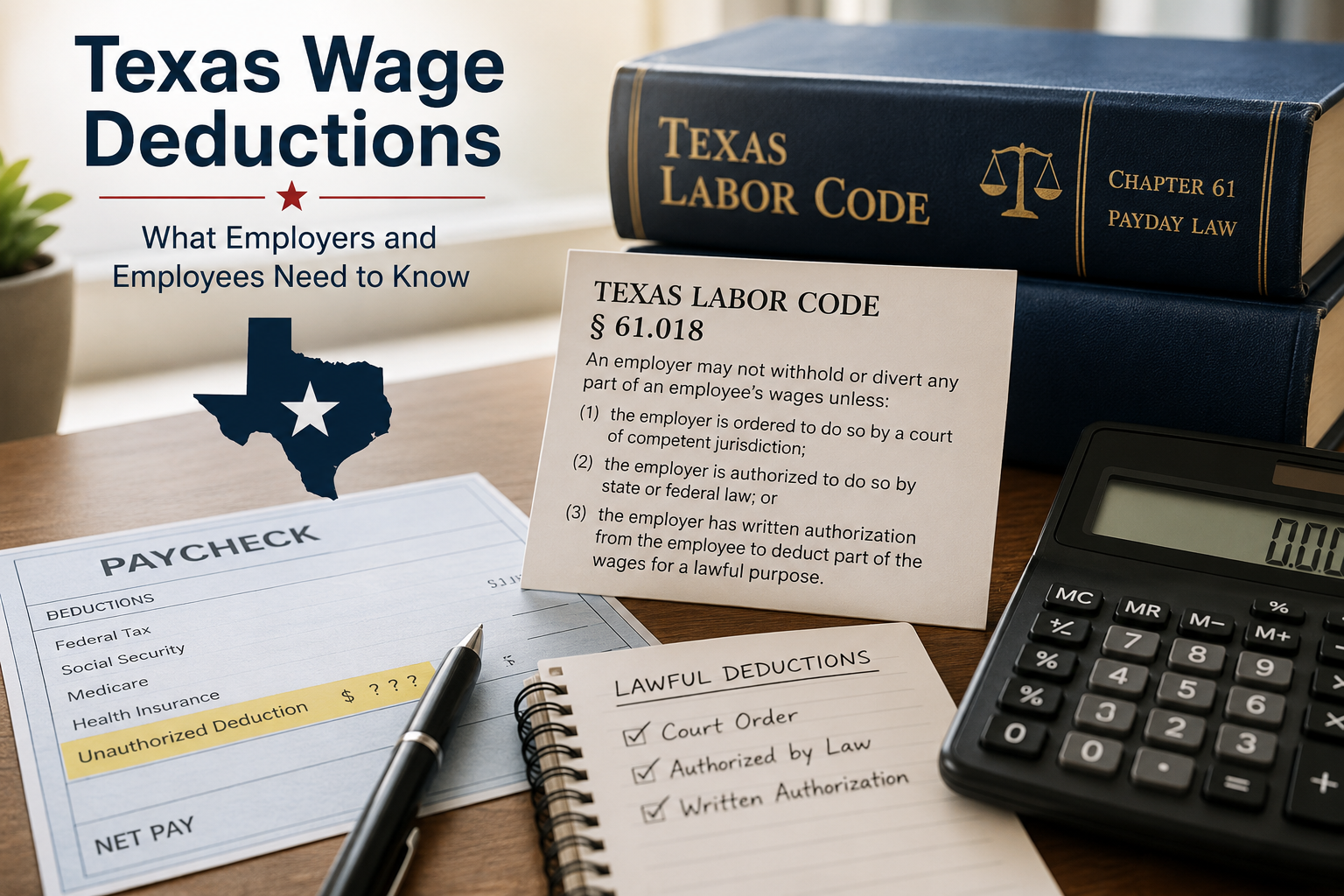
Texas Labor Code § 61.018 provides:
"An employer may not withhold or divert any part of an employee's wages unless:
(1) the employer is ordered to do so by a court of competent jurisdiction;
(2) the employer is authorized to do so by state or federal law; or
(3) the employer has written authorization from the employee to deduct part of the wages for a lawful purpose."
Although this language appears straightforward, it creates important legal distinctions that affect both employers and employees.
Common Situations Where Wage Deductions Become a Problem
Disputes frequently arise after an employer deducts money for:
- Cash register shortages
- Broken equipment
- Lost company property
- Uniform costs
- Customer walkouts
- Inventory shortages
- Training expenses
- Alleged overpayments
Many employers assume these deductions are permissible simply because the employee caused the loss. Texas law is more restrictive.
Written Authorization Matters
One of the most important aspects of the statute is the requirement for written authorization.
A verbal agreement generally is not enough.
Many employers include payroll deduction provisions in:
- Employment agreements
- Employee handbooks with signed acknowledgments
- Separate payroll authorization forms
- Equipment checkout agreements
Even then, the deduction must generally be for a lawful purpose, and the authorization should clearly identify the type of deduction being permitted.
Court Orders and Legal Requirements
Not every deduction requires employee consent.
Certain deductions are specifically authorized by law, including examples such as:
- Federal income tax withholding
- Social Security and Medicare taxes
- Child support withholding
- IRS levies
- Certain bankruptcy orders
- Other legally mandated garnishments
Likewise, employers must comply with valid court orders directing wage withholding.
Can an Employer Deduct Money for Damaged Property?
Sometimes—but not automatically.
The answer often depends upon whether the employee previously signed a valid written authorization covering that type of loss and whether the deduction otherwise complies with Texas law.
Simply believing the employee caused damage does not necessarily permit an employer to deduct wages unilaterally.
What Happens If an Employer Makes an Unauthorized Deduction?
Employees may have the right to file a wage claim under the Texas Payday Law.
Depending upon the circumstances, the dispute may involve questions such as:
- Whether the money deducted actually constituted "wages"
- Whether valid written authorization existed
- Whether the deduction served a lawful purpose
- Whether another statute independently authorized the deduction
These cases frequently turn on documentation rather than disputed facts.
Practical Advice for Employers
Employers can reduce risk by:
- Using carefully drafted written deduction authorizations.
- Reviewing payroll practices regularly.
- Avoiding "self-help" deductions when legal authority is uncertain.
- Maintaining documentation supporting every deduction.
Preventive documentation is usually far less expensive than defending a wage claim.
Practical Advice for Employees
If money unexpectedly disappears from your paycheck:
- Request an itemized explanation.
- Review anything you signed when hired.
- Determine whether the deduction was required by law.
- Preserve pay stubs and payroll records.
Unauthorized deductions can sometimes be challenged through administrative proceedings or litigation, depending upon the circumstances.
Conclusion
Texas Labor Code § 61.018 strikes a balance between allowing employers to administer payroll and protecting employees from unauthorized deductions. Because wage disputes often involve technical statutory requirements and written employment documents, both employers and employees benefit from understanding the limits imposed by the Texas Payday Law before a disagreement escalates.
At David C. Barsalou, Attorney at Law, PLLC, we help clients navigate business, family, tax, estate planning, and real estate matters ranging from document drafting to litigation with clarity and confidence. If you’d like guidance on your situation, schedule a consultation today. Call us at (713) 397-4678, email barsalou.law@gmail.com, or reach us through our Contact Page. We’re here to help you take the next step.