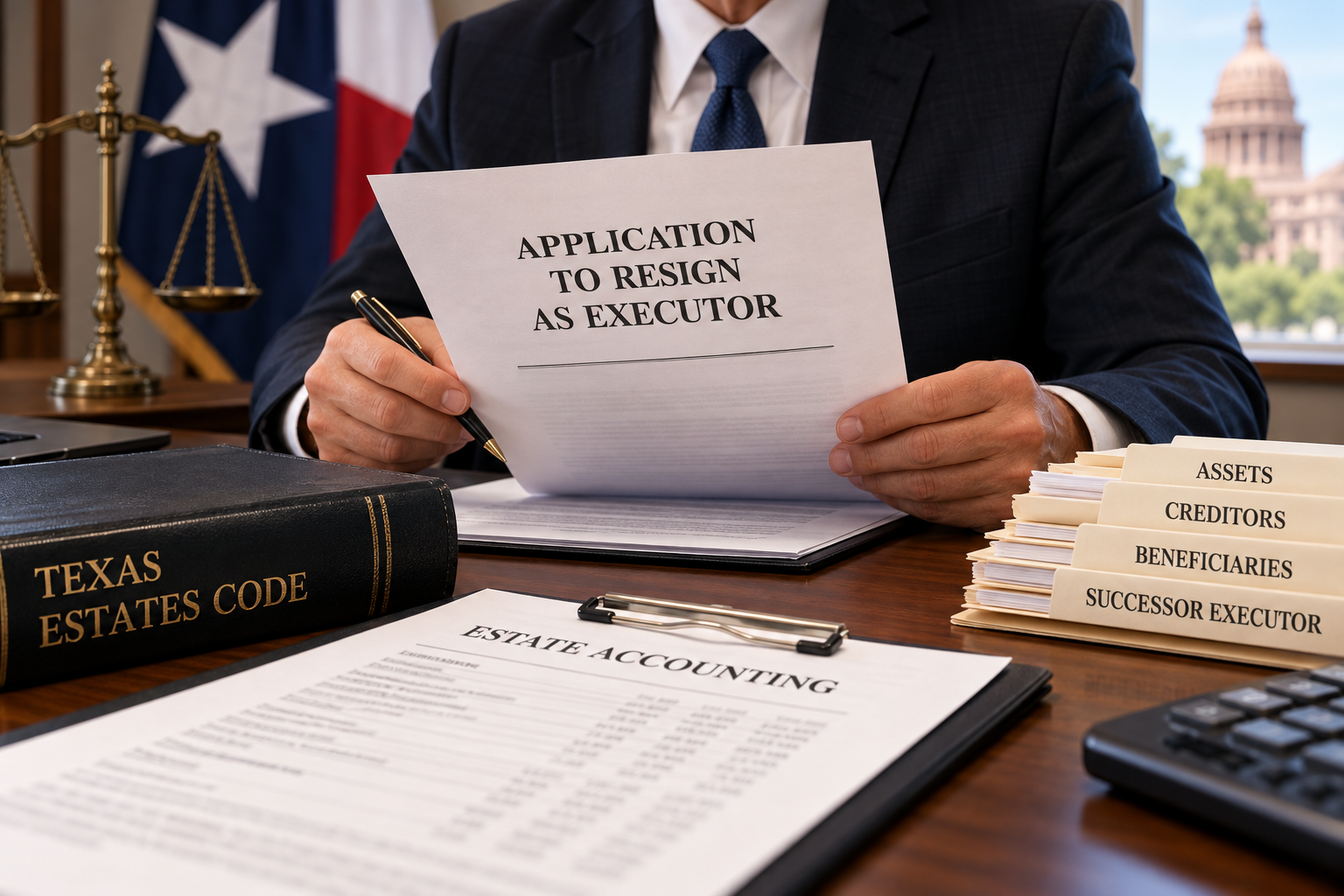
Being named the executor of a loved one's estate is often considered an honor. However, serving as an executor can also involve substantial legal responsibilities, financial recordkeeping, disputes among beneficiaries, and months or even years of administrative work.
What happens when an executor no longer wants to serve? Can an executor simply walk away from the responsibility? What happens to the estate if the executor resigns before probate is completed?
Texas law permits an executor to resign, but resignation generally requires court approval and a formal accounting of the estate. An executor cannot necessarily escape responsibility merely by announcing an intention to quit.
Texas Estates Code Chapter 361 establishes procedures for resignation, discharge, and appointment of successor personal representatives.
Understanding these requirements can help executors, beneficiaries, and family members avoid unnecessary disputes and costly probate complications.
1. Can an Executor Legally Resign in Texas?
Yes. Texas law expressly recognizes an executor's right to seek resignation.
Texas Estates Code § 361.001 provides:
"A personal representative who wishes to resign the representative's trust shall file a written application with the court clerk"
The statute further requires the application to be accompanied by a complete, verified exhibit and final account showing the estate's condition.
This distinction is important.
An executor may wish to resign for any number of reasons, including illness, family obligations, relocation, disagreements with beneficiaries, or the unexpected complexity of administering an estate.
However, the desire to resign does not automatically terminate the executor's legal responsibilities.
The executor must comply with the statutory resignation process.
What if the executor has not yet accepted the appointment?
There is an important difference between declining to serve and resigning after appointment.
Someone named as executor in a will is not necessarily obligated to accept the position.
If that person has not qualified as executor, the probate court may appoint another eligible person according to the will and applicable Texas law.
Once an executor has qualified and undertaken administration of the estate, however, resignation generally requires compliance with Chapter 361.
2. What Must an Executor File to Resign?
Texas Estates Code § 361.001 requires an executor seeking resignation to file a written application accompanied by a verified exhibit and final account.
The accounting is particularly important because the executor may have exercised control over substantial estate assets.
Depending on the circumstances, the accounting may need to address:
- Estate assets received or controlled by the executor.
- Money collected on behalf of the estate.
- Payments made to creditors and beneficiaries.
- Expenses incurred during administration.
- Property sold or transferred.
- Assets remaining in the executor's possession.
- Outstanding estate obligations.
For example, suppose an executor inherited responsibility for administering an estate containing a house, two bank accounts, and several outstanding debts.
After selling the house and paying certain creditors, the executor decides to resign.
The executor generally cannot simply turn over the remaining bank account to a sibling and declare the matter finished.
Instead, the executor must properly account for the estate property and comply with the court's requirements for resignation and discharge.
The purpose is to protect the estate and ensure continuity of administration.
3. Does the Probate Court Have to Approve the Resignation?
Yes. The statutory procedure contemplates judicial review and approval.
Texas Estates Code § 361.003 establishes procedures for setting a hearing and issuing citation to interested persons.
Interested persons may appear and contest the exhibit and final account supporting the resignation.
Under § 361.004, the court examines the accounting and considers evidence concerning the executor's administration.
The court may also restate, audit, and settle the accounting when necessary.
If the court determines that the executor has properly handled and accounted for the estate, it must approve the accounting and require delivery of remaining estate property to the legally entitled recipients.
This process is not merely ceremonial.
It provides an opportunity to examine whether the executor has fulfilled the obligations undertaken during administration.
For example, beneficiaries may question unexplained withdrawals, missing property, or distributions that appear inconsistent with the will.
Those concerns may need to be addressed before the executor receives a final discharge.
4. Can an Executor Resign Without Completing the Probate?
Yes.
An executor does not necessarily have to finish administering the estate before seeking resignation.
Texas Estates Code § 361.002(a) states:
"If the necessity exists, the court may immediately accept the resignation of a personal representative and appoint a successor representative."
This provision recognizes that circumstances sometimes require an executor to leave the position before administration is completed.
For example, an executor may become seriously ill while an estate remains involved in litigation.
Requiring that executor to continue personally administering the estate could create significant practical problems.
The court may accept the resignation and appoint a successor when necessary.
However, there is an important limitation.
Under § 361.002(b), accepting the resignation does not automatically discharge the former executor or release the executor's sureties from their obligations.
The final accounting must still be addressed.
In other words, resignation and discharge are not necessarily the same event.
An executor may cease acting in the position before being fully released from responsibility for prior administration.
5. What Happens to the Estate When an Executor Resigns?
Texas law allows the probate court to appoint a successor personal representative when continued administration is necessary.
Texas Estates Code § 361.102(a) provides that when a personal representative dies, resigns, is removed, or fails to qualify, the court may appoint a successor if necessary.
The statute also allows appointment before the predecessor's final accounting has been completed.
This is especially important when an estate has ongoing obligations.
Consider an estate involving rental property.
The original executor resigns while tenants remain in possession, property taxes are coming due, and a lawsuit concerning the property is pending.
The estate cannot necessarily remain without someone authorized to handle these matters.
A successor representative may be appointed to continue administration and protect the estate's interests.
In circumstances requiring immediate action, § 361.102(b) permits the court to appoint a successor without citation or notice when the court finds immediate appointment necessary.
This exception helps prevent interruptions that could damage the estate.
6. Does the Successor Executor Start the Probate Process Over?
Generally, no.
Texas Estates Code § 361.153 addresses the rights, powers, and duties of successor representatives.
The statute generally provides that a successor representative continues administration rather than beginning an entirely new estate proceeding.
However, certain powers specifically conferred on the predecessor by the will may not automatically pass to the successor.
That distinction can matter significantly.
For example, a will might grant a particular executor special authority to make certain decisions.
A successor should not automatically assume that every power personally granted to the original executor transfers without limitation.
Nevertheless, the successor ordinarily takes responsibility for continuing administration, subject to the governing law and the terms of the will.
Can the successor executor investigate the previous executor?
Yes.
Section 361.153 gives a successor representative important rights concerning property handled by the predecessor.
These rights include accounting for estate property previously received, pursuing delivery of estate assets, and seeking appropriate judicial remedies.
The successor may also pursue certain claims concerning property that has not been properly accounted for.
This can become particularly important when the original executor resigns amid allegations of financial misconduct.
A resignation does not necessarily prevent subsequent investigation or legal action concerning the executor's previous conduct.
7. Does Resigning Protect an Executor From Liability?
Not necessarily.
One of the most significant misconceptions about probate administration is that an executor can avoid potential liability by resigning.
Texas Estates Code § 361.005 establishes requirements for discharge.
Among other things, the statute requires examination and approval of the final account and compliance with applicable orders concerning estate property.
Only after the statutory requirements have been satisfied does the court enter an order accepting the resignation and discharging the representative.
Even then, the legal effect of discharge must be evaluated in light of the particular proceedings and any applicable claims.
For example, suppose an executor improperly transferred estate funds into a personal bank account.
The executor later decides to resign.
The resignation itself does not make the prior transfer lawful or eliminate the need to account for the money.
Depending on the facts, the estate may have claims involving breach of fiduciary duty, recovery of property, or other appropriate remedies.
Resignation is a procedure for ending service, not a mechanism for automatically erasing past misconduct.
8. What If the Executor Refuses to Resign but Also Refuses to Do the Work?
This situation is different from voluntary resignation.
An executor may remain formally appointed while failing to perform required duties.
For example, the executor might refuse to communicate with beneficiaries, neglect estate property, or fail to satisfy applicable reporting requirements.
Texas Estates Code §§ 361.051 and 361.052 establish grounds and procedures for removing personal representatives under specified circumstances.
Depending on the statutory grounds, removal may involve notice, an opportunity to respond, and judicial findings.
Importantly, disagreement with an executor does not automatically justify removal.
A beneficiary's dissatisfaction with a particular decision is not necessarily proof of misconduct.
However, serious neglect, statutory noncompliance, or misapplication of estate property may support appropriate judicial intervention.
Beneficiaries should distinguish between an executor who makes unpopular but lawful decisions and an executor who actually violates legal duties.
9. Can Beneficiaries Choose the Replacement Executor?
Not automatically.
The selection of a successor depends on the will, the applicable statutory priority rules, the qualifications of proposed representatives, and the court's authority.
A will may identify an alternate executor.
For example, a testator might name a spouse as executor and an adult child as alternate executor.
If the spouse resigns, the adult child may be an appropriate successor, provided the child is eligible and properly appointed.
However, the existence of an alternate designation does not mean the replacement automatically acquires legal authority upon the first executor's resignation.
The successor generally must obtain the necessary court appointment and qualify as required by law.
Beneficiaries should therefore avoid assuming that an informal family agreement is sufficient to transfer the executor's authority.
10. Is Resigning as an Independent Executor Different?
Independent administration is common in Texas probate proceedings.
An independent executor generally operates with less routine court supervision than a dependent administrator.
However, independent administration does not mean that the executor is free from fiduciary duties or statutory requirements.
An independent executor considering resignation should carefully evaluate the applicable provisions of the Estates Code, the will, and any orders governing the administration.
The appropriate procedure may depend on the nature of the independent administration and whether a successor is necessary.
An independent executor should not assume that the ability to administer an estate without obtaining approval for every ordinary transaction also creates an unrestricted right to abandon the appointment.
Formal legal guidance can be particularly valuable when the estate contains substantial assets, unresolved creditor claims, or disagreements among beneficiaries.
11. When Does Resigning as Executor Make Sense?
Resignation is not necessarily evidence that someone has performed poorly.
In some circumstances, resignation may be the most responsible decision available.
For example, an executor may develop a serious medical condition that prevents effective administration.
Alternatively, a previously manageable estate may become involved in complicated litigation requiring substantial time and expertise.
Family disputes can also make administration unusually difficult.
An executor who recognizes an inability to continue performing the position responsibly may reasonably conclude that a successor would better protect the estate.
However, the decision should account for the costs and practical consequences of replacing the executor.
A successor may need time to reconstruct financial records, locate assets, communicate with creditors, and understand transactions completed by the predecessor.
This transition can generate additional legal fees and administrative expenses.
Before resigning, an executor should consider whether the problem can be resolved through professional assistance, improved recordkeeping, or other practical measures.
12. Frequently Asked Questions About Executor Resignation in Texas
Can I quit being an executor in Texas?
Yes. Texas Estates Code Chapter 361 establishes a procedure for resignation. An appointed executor generally must file the required application and accounting and obtain the appropriate court orders.
Can I resign as executor if the beneficiaries disagree?
Beneficiary disagreement does not necessarily prevent resignation. However, interested persons may contest the accounting, and the court must address the statutory requirements.
Does a Texas executor have to finish probate before resigning?
No. Texas law permits resignation and appointment of a successor before administration is completed when the applicable requirements are satisfied.
Can an executor resign without providing an accounting?
An executor seeking resignation under § 361.001 must submit the verified exhibit and final account required by that statute. The particular accounting requirements should be evaluated in light of the administration and applicable law.
Who becomes executor when the original executor resigns?
The probate court may appoint a qualified successor when necessary. The will's provisions and applicable Texas statutes can affect who is entitled to serve.
Can an executor resign after being accused of stealing estate money?
An executor may seek resignation, but resignation does not automatically eliminate responsibility for prior conduct. Accounting requirements and potential claims concerning estate property may remain.
Can an executor be forced to resign?
A court may remove a personal representative when legally sufficient grounds exist. Removal is different from voluntary resignation and is governed by separate statutory provisions.
13. Why Legal Assistance May Be Important
Probate administration involves more than distributing property according to a will.
Executors may be responsible for preserving assets, addressing creditor claims, maintaining records, resolving disputes, and complying with applicable statutory requirements.
When an executor resigns, those responsibilities must be addressed in an orderly manner.
Improper resignation procedures can create uncertainty concerning who has authority to act, who possesses estate property, and whether the former executor remains responsible for outstanding matters.
For beneficiaries, an executor's resignation can also raise questions about whether the estate has been properly managed.
An attorney can help evaluate the resignation process, prepare the necessary filings, address accounting issues, and seek appointment of an appropriate successor.
Conclusion: A Texas Executor Can Resign, but Cannot Simply Walk Away
Texas law recognizes that executors sometimes become unable or unwilling to continue administering an estate.
Texas Estates Code Chapter 361 provides procedures for resignation, accounting, discharge, and appointment of successor personal representatives.
The central distinction is between ending an executor's service and resolving the executor's responsibility for property previously entrusted to that person.
An executor may be permitted to resign before probate is completed, but the law generally requires appropriate accounting and judicial oversight.
For executors and beneficiaries alike, understanding these requirements can help protect estate property and prevent avoidable disputes.
Speak With a Texas Probate Attorney
David C. Barsalou, Attorney at Law, PLLC, assists clients with probate administration, estate disputes, and related legal matters in Harris County, Montgomery County, and surrounding Texas communities.
Whether you are an executor considering resignation, a beneficiary concerned about estate administration, or a family member seeking appointment of a successor representative, understanding your legal options is an important first step.
Contact David C. Barsalou, Attorney at Law, PLLC, to discuss your Texas probate matter.
Disclaimer: This article provides general information concerning Texas law and does not constitute legal advice. Probate procedures and available remedies depend on the circumstances of each estate.
At David C. Barsalou, Attorney at Law, PLLC, we help clients navigate business, family, tax, estate planning, and real estate matters ranging from document drafting to litigation with clarity and confidence. If you’d like guidance on your situation, schedule a consultation today. Call us at (713) 397-4678, email barsalou.law@gmail.com, or reach us through our Contact Page. We’re here to help you take the next step.