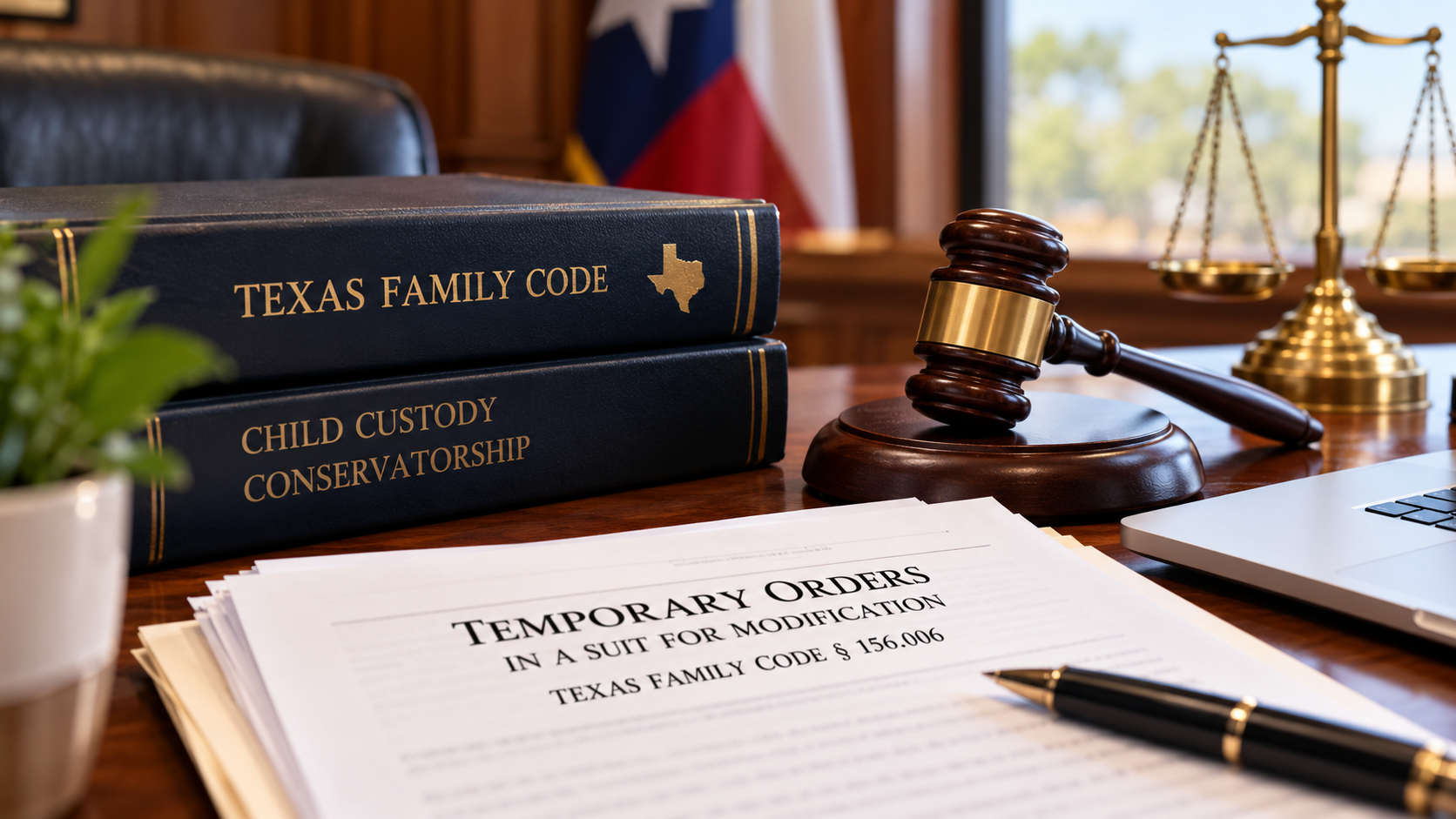
Child custody disputes do not always wait for a final trial. Sometimes a parent's circumstances change dramatically after a divorce, raising immediate questions about where a child should live and who should make important decisions concerning the child's upbringing.
Perhaps one parent has moved away, developed a substance abuse problem, or voluntarily allowed the child to live with the other parent for an extended period. Alternatively, a parent may believe the existing custody arrangement is no longer appropriate because of concerns about the child's physical safety or emotional well-being.
Can a Texas judge temporarily change custody while a modification lawsuit is pending?
The answer is yes, but Texas Family Code § 156.006 imposes important restrictions on certain temporary custody modifications.
Understanding these restrictions can help parents determine whether requesting immediate court intervention is appropriate or whether the dispute should proceed through the ordinary modification process.
1. What Are Temporary Custody Orders in Texas?
Temporary orders are court orders that govern certain aspects of a parent-child relationship while litigation remains pending.
Under Texas Family Code § 156.006(a):
"Except as provided by Subsection (b), the court may render a temporary order in a suit for modification."
This provision gives Texas family courts authority to issue temporary orders in modification proceedings.
For example, temporary orders may address:
- Possession and visitation schedules.
- Temporary child support obligations.
- Restrictions intended to protect a child's safety.
- Certain parental rights and responsibilities.
- Other matters concerning the child's welfare.
However, there is an important distinction between adjusting possession arrangements and changing the parent who possesses the exclusive right to designate the child's primary residence.
Texas law treats the latter considerably more cautiously.
2. Why Is Changing Primary Custody Before Trial Difficult?
When a Texas court enters a final custody order, it may designate one conservator as the person with the exclusive right to determine the child's primary residence.
This designation can be particularly important when parents disagree about where their child should live.
Texas Family Code § 156.006(b) generally prohibits a temporary order that creates or changes that designation, or creates, changes, or eliminates an applicable geographic restriction, unless the statutory requirements are satisfied.
The temporary order must be in the child's best interest, and at least one of three statutory circumstances must exist.
These restrictions help prevent parents from using temporary proceedings to obtain certain substantial custody changes without satisfying the additional statutory requirements.
Importantly, the statute addresses the legal effect of the temporary order, not merely the terminology used in the motion.
Calling a requested custody change a temporary adjustment does not necessarily avoid § 156.006.
3. Exception One: Significant Impairment to the Child
One of the most important exceptions appears in Texas Family Code § 156.006(b)(1).
The statute permits an otherwise restricted temporary order when it is necessary because the child's present circumstances would significantly impair the child's physical health or emotional development.
This is a demanding standard.
A parent cannot ordinarily satisfy it merely by demonstrating that the other parent has a different parenting style or that the child might enjoy a better lifestyle in another household.
Instead, the parent seeking relief must establish circumstances supporting the statutory requirement of significant impairment.
Depending on the evidence, potentially relevant circumstances might include:
Physical abuse or dangerous living conditions.Evidence that a child faces serious physical danger may support immediate judicial intervention.
Severe neglect. A parent's failure to provide necessary care, supervision, or protection may create circumstances supporting temporary relief.
Serious substance abuse. Substance abuse that creates a demonstrable risk to the child's health or development may be relevant.
Significant emotional harm. Evidence that the child's current circumstances seriously threaten emotional development may also support relief.
These circumstances are not automatic grounds for changing custody. The court must examine the particular facts, the child's present circumstances, and whether the requested temporary order is necessary.
What Evidence Might Support Significant Impairment?
Relevant evidence may include medical records, school records, communications between parents, testimony from witnesses with personal knowledge, photographs, and other admissible evidence.
General accusations are usually less persuasive than specific, verifiable facts.
For example, alleging that another parent is irresponsible is different from presenting evidence that the parent repeatedly left a young child without appropriate supervision.
The distinction can determine whether the statutory threshold is met.
4. Exception Two: Voluntary Relinquishment for More Than Six Months
Texas Family Code § 156.006(b)(2) provides another exception when the person designated in the final order has voluntarily relinquished primary care and possession of the child for more than six months.
Consider the following hypothetical situation.
A divorce decree designates the mother as the parent with the exclusive right to determine the child's primary residence.
Several months later, the mother voluntarily allows the child to live primarily with the father.
The arrangement continues for more than six months.
The father subsequently files a modification lawsuit and requests temporary orders reflecting the child's actual living arrangement.
Under these circumstances, § 156.006(b)(2) may provide a statutory basis for the requested temporary change, provided the order is also in the child's best interest.
However, several important questions remain:
- Was the relinquishment genuinely voluntary?
- Did the arrangement involve primary care and possession?
- Did it continue for more than six months?
- Would the proposed temporary order serve the child's best interest?
A brief visit, ordinary possession period, or short-term accommodation does not necessarily constitute voluntary relinquishment of primary care and possession.
The Military Service Exception
Texas Family Code § 156.006(c) creates an important limitation.
The voluntary-relinquishment exception does not apply when the designated conservator temporarily relinquished primary care and possession during qualifying military deployment, mobilization, or temporary military duty.
Consequently, a parent's qualifying military absence cannot be used to invoke this particular exception merely because the child remained with another caregiver during that absence.
5. Exception Three: A Child Who Is at Least 12 Years Old Expresses a Preference
Texas Family Code § 156.006(b)(3) provides a third possible basis for certain temporary custody changes.
The provision applies when a child is at least 12 years old and expresses to the court, in chambers under Texas Family Code § 153.009, a preference concerning who should have the exclusive right to designate the child's primary residence.
This does not mean a 12-year-old can simply choose where to live.
The child's preference must be considered within the statutory framework, and the proposed temporary order must still serve the child's best interest.
For example, a 13-year-old might express a preference to reside primarily with the father.
That preference could provide a statutory basis for considering a temporary change under § 156.006(b)(3).
Nevertheless, the judge must independently determine whether the requested order serves the child's best interest.
A child's preference is legally relevant, but it is not an automatic custody decision.
6. The Affidavit Requirement: Why Some Emergency Custody Requests Never Receive a Hearing
One of the most significant procedural requirements appears in Texas Family Code § 156.006(b-1).
When a parent requests a temporary order based on significant impairment under subsection (b)(1), the moving party must execute and attach an affidavit supporting the allegation.
The affidavit must be based on the person's personal knowledge or belief based on representations from someone with personal knowledge.
It must contain facts supporting the allegation that the child's present circumstances would significantly impair physical health or emotional development.
The statute imposes an important screening requirement.
If the court determines that the affidavit does not state adequate supporting facts, it must deny the requested relief and decline to schedule a hearing on that motion.
This means a parent may fail to obtain a hearing before presenting any live testimony.
Why Specificity Matters
Consider two hypothetical affidavits.
Affidavit A:
"The other parent is irresponsible, and I believe my child would be better off living with me."
Affidavit B:
"On three identified occasions during the preceding month, the child was left without adult supervision for several hours. I personally observed two of these incidents and have contemporaneous communications concerning the third."
The second affidavit provides substantially more factual information relevant to a possible impairment analysis.
Whether those facts ultimately justify relief depends on the surrounding circumstances and the evidence presented.
The important point is that a motion alleging significant impairment must contain adequate supporting facts before the court schedules the requested hearing.
7. Can a Judge Change Visitation Without Changing Primary Custody?
Yes. The restrictions in § 156.006(b) do not categorically prohibit every temporary modification of possession or visitation.
Texas Family Code § 156.006(a) generally authorizes temporary orders in modification proceedings, subject to subsection (b).
A court may therefore consider temporary adjustments that do not have the prohibited effect of changing the primary-residence designation or an applicable geographic restriction.
For example, a court might consider changes to:
- Weekend possession.
- Holiday arrangements.
- Exchange locations.
- Certain conditions governing possession.
- Other temporary arrangements affecting the child's welfare.
However, courts must consider the actual effect of a proposed order.
A requested possession arrangement that effectively changes the designation of the person with the exclusive right to determine primary residence may implicate § 156.006(b), regardless of how the requesting parent characterizes the relief.
The precise language of the existing order and the proposed temporary order therefore matters.
8. Does Filing a Custody Modification Lawsuit Automatically Change the Existing Order?
No.
Filing a petition to modify conservatorship or possession does not, by itself, replace the existing custody order.
Until a court enters a new order, the existing order generally remains operative.
This distinction is particularly important when one parent believes circumstances have changed substantially.
For example, a parent may believe the other parent is violating the existing possession schedule or exercising poor judgment.
Those concerns may justify seeking legal relief, but they do not automatically authorize the parent to disregard the existing court order.
Depending on the circumstances, the appropriate legal response may involve enforcement, modification, temporary orders, or another available remedy.
Parents should carefully distinguish between believing that an order should change and possessing legal authority to act as though it already has.
9. Temporary Custody Orders Are Not the Same as Final Custody Modifications
A temporary order generally governs the parties while litigation is pending.
A final modification changes the existing order through a final judicial determination.
Texas Family Code § 156.101 establishes important grounds for modifying conservatorship, possession, access, or the determination of a child's primary residence.
Among other requirements, a final modification generally must serve the child's best interest and satisfy an applicable statutory ground.
One common ground involves a material and substantial change in circumstances.
However, the standards governing final modification are not identical to the restrictions imposed by § 156.006(b) on certain temporary orders.
This distinction can produce an unusual result.
A parent may have a potentially viable lawsuit seeking a final custody modification but still be unable to obtain the particular temporary custody change requested before trial.
In other words, having grounds to pursue a final custody modification does not necessarily establish grounds for an immediate change in primary custody.
10. What Happens When a Parent Moves Away?
Relocation frequently creates disputes over custody and possession.
Suppose a divorce decree requires the child's primary residence to remain within a particular geographic area.
One parent subsequently announces plans to move outside that area.
The other parent may seek judicial intervention.
However, Texas Family Code § 156.006(b) expressly addresses temporary orders that create, change, or eliminate geographic restrictions governing the child's primary residence.
Consequently, the court must consider whether the proposed temporary order falls within the statute's restrictions and, if so, whether an exception applies.
Relocation alone does not automatically satisfy the significant-impairment exception.
The facts, existing order, requested relief, and child's best interest all matter.
Parents contemplating relocation should evaluate their existing court orders before moving, particularly when geographic restrictions are involved.
11. What If the Other Parent Is Violating the Custody Order?
Violations of an existing custody order may justify legal action.
However, enforcement and modification serve different purposes.
An enforcement proceeding generally seeks compliance with an existing order.
A modification proceeding seeks to change the order.
For example, a parent who repeatedly refuses court-ordered possession may face enforcement proceedings.
Whether those violations also justify modification depends on the applicable legal requirements.
Texas Family Code § 156.107 additionally addresses certain repeated contempt findings for denial of possession and access.
That statute identifies circumstances involving multiple prior contempt findings that constitute a material and substantial change sufficient to justify modification.
Nevertheless, parents should not assume that every violation automatically authorizes an immediate change in primary custody.
The available remedies depend on the particular facts and statutory requirements.
12. When Should a Parent Request Temporary Custody Orders?
A request for temporary custody relief may be appropriate when circumstances justify judicial intervention before the final hearing.
Examples may include serious concerns about a child's safety, a qualifying extended voluntary relinquishment of primary care, or a situation involving a child at least 12 years old who has expressed a relevant preference to the court.
However, not every disagreement requires emergency litigation.
Temporary custody proceedings can involve substantial legal expenses, contested testimony, and additional conflict between parents.
A parent should evaluate whether the requested relief is legally available, whether sufficient evidence exists, and whether the anticipated benefits justify the costs.
In some cases, negotiated adjustments or a conventional modification proceeding may provide a more appropriate solution.
The objective should be a legally sustainable arrangement that protects the child's best interest—not merely obtaining an immediate tactical advantage over the other parent.
13. Frequently Asked Questions About Temporary Custody Orders in Texas
Can I get emergency custody of my child in Texas?
Possibly. Texas courts may grant temporary relief when the applicable statutory requirements are satisfied. When the requested relief changes the primary-residence designation, § 156.006(b) imposes additional restrictions.
Can a judge change custody without a full trial?
A judge may issue temporary orders before final trial. However, certain changes to primary-residence rights require compliance with § 156.006(b). Temporary relief does not necessarily determine the final outcome.
Does my child get to choose which parent to live with at age 12?
No. A child who is at least 12 may express a preference to the judge under Texas Family Code § 153.009, but the judge remains responsible for determining the child's best interest.
Can I get temporary custody because my ex moved away?
Relocation may create grounds for requesting relief, but moving away does not automatically establish entitlement to a temporary change in primary custody. The existing order and applicable statutory requirements must be evaluated.
Do I need an affidavit to request emergency custody?
When requesting a temporary order under the significant-impairment exception in § 156.006(b)(1), the statute requires a supporting affidavit containing adequate factual allegations.
Can temporary custody orders affect child support?
Temporary orders may address support obligations where legally authorized. However, a temporary change in possession does not necessarily modify an existing child support obligation automatically.
Can a parent lose primary custody simply because the other parent has more money?
A difference in financial resources alone does not establish entitlement to a temporary change in primary-residence rights under § 156.006(b). The applicable statutory requirements and the child's best interest control.
Conclusion: Temporary Custody Changes Require More Than a Disagreement Between Parents
Texas family courts possess substantial authority to protect children while custody litigation is pending.
However, Texas Family Code § 156.006 places important limits on certain temporary changes to primary-residence rights and geographic restrictions.
A parent seeking such relief generally must establish that the proposed order serves the child's best interest and that one of the statutory exceptions applies.
These exceptions concern significant impairment, qualifying voluntary relinquishment of primary care and possession for more than six months, or the expressed preference of a child at least 12 years old under the statutory procedure.
Parents should understand that ordinary disagreements, frustration with an existing custody arrangement, or a belief that another household would be preferable do not necessarily satisfy these requirements.
The strongest approach is generally to identify the specific relief needed, evaluate the applicable statutory standard, and develop reliable evidence supporting the requested order.
Speak With a Texas Family Law Attorney About Custody Modification
David C. Barsalou, Attorney at Law, PLLC assists clients with Texas family law matters, including child custody disputes, modification proceedings, possession and access issues, and enforcement of existing court orders.
Whether you are seeking to modify an existing custody arrangement or responding to another parent's request for temporary custody relief, understanding the applicable legal requirements is essential.
Contact our office to discuss your circumstances and available legal options.
David C. Barsalou, Attorney at Law, PLLC
Serving clients in Kingwood, Houston, Harris County, Montgomery County, and surrounding Texas communities.
Disclaimer: This article provides general information concerning Texas law and does not constitute legal advice. Custody disputes are fact-specific, and applicable legal requirements may vary depending on the circumstances and existing court orders.
At David C. Barsalou, Attorney at Law, PLLC, we help clients navigate business, family, tax, estate planning, and real estate matters ranging from document drafting to litigation with clarity and confidence. If you’d like guidance on your situation, schedule a consultation today. Call us at (713) 397-4678, email barsalou.law@gmail.com, or reach us through our Contact Page. We’re here to help you take the next step.