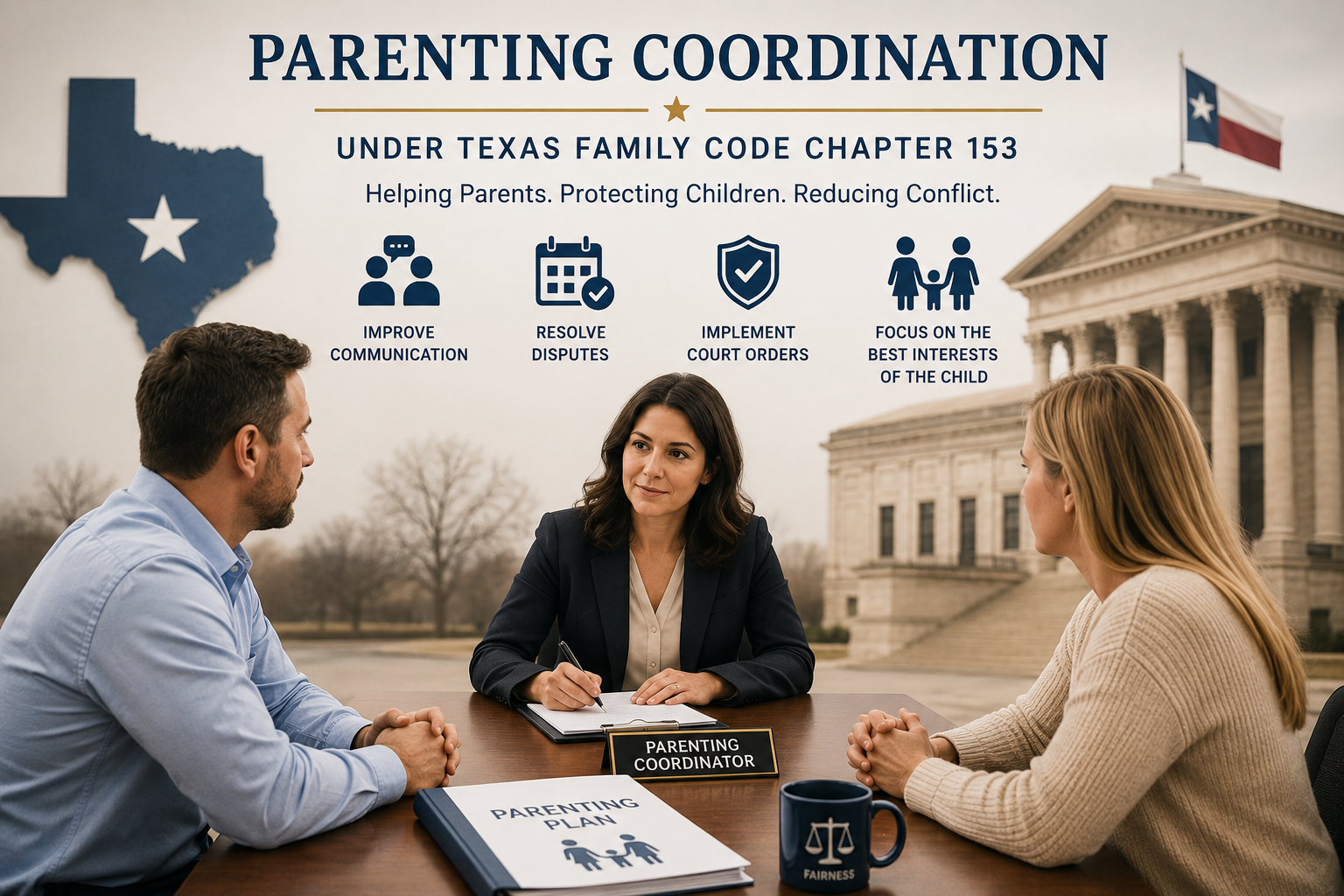
When parents continue to argue long after a divorce or custody order has been entered, the conflict often spills over into the children's daily lives. Disagreements over exchanges, extracurricular activities, medical decisions, communication, and scheduling can generate repeated trips back to court.
Many Texas parents are surprised to learn that judges have another tool available before imposing additional litigation: parenting coordination.
Although it receives far less attention than custody or child support, parenting coordination can dramatically reduce conflict in high-disagreement cases while helping parents comply with existing court orders.
What Is Parenting Coordination?
Parenting coordination is a court-authorized process in which a neutral third party helps parents resolve day-to-day disputes involving their children.
Unlike a judge, a parenting coordinator does notdecide custody issues or modify an existing court order. Instead, the coordinator helps parents improve communication, reduce conflict, and implement the court's existing orders more effectively.
Texas law expressly authorizes courts to appoint parenting coordinators in appropriate cases.
Texas Family Code § 153.601 provides:
"The court may appoint a parenting coordinator to assist parties in resolving parenting issues through confidential procedures."
This process is designed to promote cooperation—not to replace the authority of the court.
What Does a Parenting Coordinator Actually Do?
A parenting coordinator may assist parents with issues such as:
- Improving communication between parents.
- Resolving scheduling disagreements.
- Reducing conflict during possession exchanges.
- Helping implement existing custody orders.
- Encouraging compliance with parenting plans.
- Identifying recurring areas of disagreement before they escalate into litigation.
The coordinator focuses on practical solutions that keep parents out of court whenever possible.
Parenting Coordination Is Not the Same as Mediation
Many people confuse parenting coordination with mediation, but they serve different purposes.
Mediation generally occurs before a lawsuit is resolved or before a settlement is reached.
Parenting coordination, by contrast, often occurs afterfinal orders have already been entered. It is intended to help parents successfully carry out those orders over time.
Think of mediation as helping parties reach an agreement, while parenting coordination helps them live with the agreement they already have.
Is Parenting Coordination Confidential?
Generally, yes.
Texas Family Code § 153.608 states in part:
"Communications made by a party to the parenting coordinator during parenting coordination are confidential..."
This confidentiality encourages honest discussion without fear that every conversation will later become courtroom evidence.
However, the statute contains several exceptions. Communications may become discoverable or reportable in circumstances involving issues such as threats of violence, child abuse, neglect, or other matters specifically recognized by law.
Can a Parenting Coordinator Change Custody?
No.
A parenting coordinator cannot rewrite a court order, modify conservatorship rights, or change possession schedules established by the court.
Only a judge may modify custody orders through the procedures established by the Texas Family Code.
Instead, the coordinator works within the existing order to reduce unnecessary disputes.
Who Pays for the Parenting Coordinator?
The court has discretion to allocate the coordinator's fees between the parents.
Depending upon the circumstances, one parent may pay all of the fees, or the court may divide the expense between both parties in whatever manner the court considers appropriate.
When Do Courts Use Parenting Coordination?
Texas courts may consider parenting coordination when parents repeatedly return to court over relatively minor parenting disputes, including:
- Constant disagreements over visitation exchanges.
- Persistent communication problems.
- Frequent contempt or enforcement proceedings.
- High-conflict co-parenting relationships.
- Situations where the parents' inability to cooperate negatively affects the child.
The goal is not to punish either parent but to reduce conflict and promote stability for the child.
Parenting Coordination Is About the Child—Not Winning
One of the central themes of Texas family law is protecting the child's best interests. Parenting coordination reflects that philosophy by encouraging parents to solve ordinary disputes without repeated litigation.
For many families, learning better communication skills and resolving disagreements early can save thousands of dollars in attorney's fees while reducing stress on the children.
Final Thoughts
Parenting coordination is one of the lesser-known tools available in Texas family courts, but it can be remarkably effective in high-conflict custody cases. It does not change a parent's legal rights or replace the authority of the court. Instead, it helps parents implement existing orders, communicate more effectively, and minimize the ongoing conflict that often follows divorce.
If you are involved in a Texas custody dispute or are experiencing constant conflict after a final custody order has been entered, an experienced Texas family law attorney can help you determine whether parenting coordination may be appropriate—or whether another legal remedy better fits your circumstances.
Disclaimer: This article is provided for informational purposes only and does not constitute legal advice. Every family law case is unique, and you should consult an attorney regarding your specific circumstances.
At David C. Barsalou, Attorney at Law, PLLC, we help clients navigate business, family, tax, estate planning, and real estate matters ranging from document drafting to litigation with clarity and confidence. If you’d like guidance on your situation, schedule a consultation today. Call us at (713) 397-4678, email barsalou.law@gmail.com, or reach us through our Contact Page. We’re here to help you take the next step.