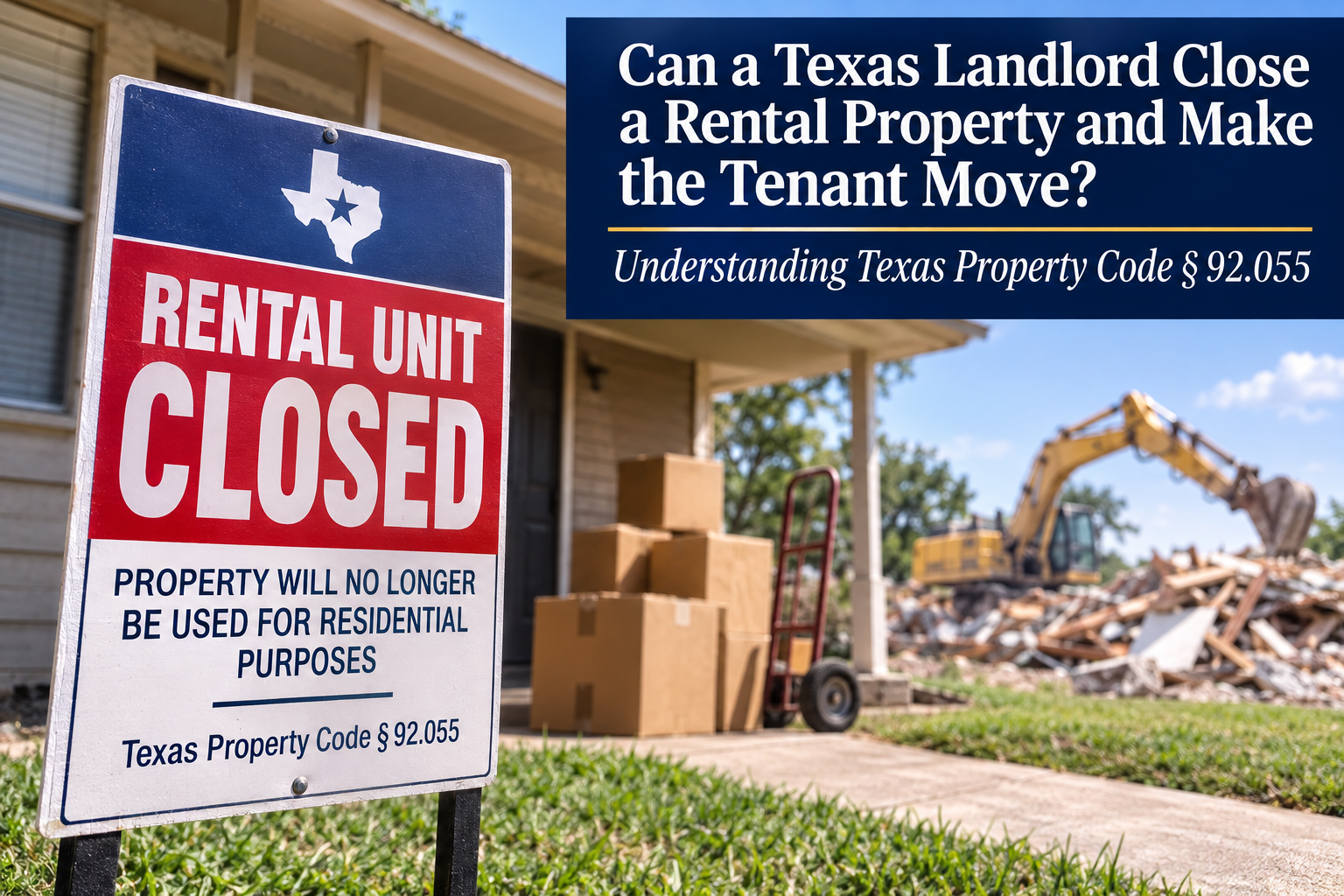
A landlord owns the rental property. A tenant, however, has the legal right to possess it during the tenancy.
So what happens when a Texas landlord decides that the property should no longer be a rental at all?
Perhaps the building is in terrible condition. Perhaps the owner intends to demolish it. Perhaps an old house is being converted into an office or other nonresidential use.
Texas has a surprisingly specific statute addressing this situation.
Texas Property Code § 92.055 allows a landlord to close a residential rental unit, but the landlord must follow particular procedures—and closing the property can create important rights for the tenant.
What Does It Mean to “Close” a Rental Unit in Texas?
Texas Property Code § 92.055(a) provides:
“A landlord may close a rental unit at any time”
but the statute immediately imposes requirements on how that is done.
The landlord must provide written notice by certified mail, return receipt requested, to the tenant. The landlord must also provide the notice to the local health officer and local building inspector, if any.
The notice must state that:
- the landlord is terminating the tenancy as soon as legally possible; and
- after the tenant moves out, the landlord will either immediately demolish the rental unit or no longer use it for residential purposes.
This is therefore considerably more specific than a landlord simply telling a tenant, “I don't want to rent this property anymore.”
Does § 92.055 Let a Landlord Immediately Evict a Tenant?
No.
The statute says that the landlord's notice must state that the landlord is terminating the tenancy “as soon as legally possible.”
Those words matter.
Section 92.055 does not give a landlord permission to throw a tenant's belongings onto the lawn, change the locks without legal authority, or otherwise disregard the lease and Texas eviction law.
The landlord's right to close the unit operates within the larger legal framework governing termination of tenancies and possession of rental property.
Exactly when a tenant must leave can therefore depend upon the lease, the nature of the tenancy, applicable notices, and other facts.
The Landlord Cannot Simply Put Another Tenant in the Unit Next Week
Here is where the statute becomes particularly interesting.
Texas Property Code § 92.055(b) provides that after the tenant receives the closing notice and moves out:
“the landlord may not allow reoccupancy or reconnection of utilities by separate meter within six months after the date the tenant moves out.”
That is an unusually concrete restriction.
In other words, § 92.055 is not designed as a convenient method for removing one tenant so that the landlord can immediately rent the same unit to somebody else.
The landlord is representing that the unit is actually being closed—either for immediate demolition or because it will no longer be used residentially.
The six-month rule gives that representation some teeth.
What Does the Building Inspector Have to Do With It?
The statute also restricts what can happen after the tenant leaves.
Under § 92.055(b)(1), the local health officer or building inspector may not allow occupancy or separately metered utility service to the unit until the officer certifies that the officer knows of no condition that materially affects the physical health or safety of an ordinary tenant.
This provision makes more sense when § 92.055 is viewed in context.
The statute appears in the portion of Chapter 92 dealing with repair and closing of residential leaseholds. It therefore addresses a situation in which closing the property may intersect with potentially serious habitability or safety problems.
What If the Tenant Had Already Complained About Needed Repairs?
This can make the situation considerably more important.
A landlord cannot necessarily use a closing notice to make an existing repair dispute disappear without consequence.
Section 92.055 distinguishes between a closing notice given beforethe tenant gives a repair notice and one given after the tenant has notified the landlord of a condition requiring repair.
If the landlord gives the closing notice before the tenant gives a repair notice, the repair remedies in that subchapter generally do not apply.
But if the tenant has already given the landlord a repair notice, additional statutory protections may apply.
Timing can therefore matter enormously.
Can the Tenant Recover Moving Expenses?
Potentially, yes.
Texas Property Code § 92.055(d) states:
“If the landlord closes the rental unit after the tenant gives the landlord a notice to repair”
and the tenant moves out on or before the end of the rental term, the landlord must pay the tenant's actual and reasonable moving expenses.
The landlord must also refund the appropriate pro rata portion of the tenant's rent from the date the tenant moves out and return the security deposit if its return is otherwise required by law.
That can create a meaningful financial distinction between:
- an owner deciding independently to close a rental property; and
- an owner closing the property after the tenant has already demanded repairs.
The sequence of events may determine what the tenant can recover.
What Happens If the Landlord Violates the Closing Rules?
Section 92.055(e) provides a statutory remedy.
A landlord who violates subsection (b) or (d) can be liable to the tenant for:
- one month's rent;
- an additional $100; and
- attorney's fees.
Depending upon the circumstances, other legal claims or remedies may also exist.
The important point is that a closing notice is not merely an informal announcement. Once a landlord invokes this statutory process, the landlord can have continuing obligations after the tenant leaves.
Can a Landlord Close Just One Apartment?
Yes.
Section 92.055(f) expressly explains that closing one rental unit does not prohibit occupancy of other apartments.
That means an apartment complex does not necessarily have to shut down an entire building or development simply because one particular unit is closed under the statute.
The law can operate at the individual-unit level.
Why Would a Landlord Use This Law?
There are several conceivable situations.
An older rental house may have deteriorated to the point that repairing it no longer makes economic sense.
An investor may purchase property intending to demolish an existing structure and redevelop the land.
A residential building may be converted to another lawful use.
Or serious repair problems may cause an owner to conclude that the property should simply be removed from the residential rental market.
Section 92.055 provides a statutory framework for genuinely closing the rental unit.
What it does not provide is an easy substitute for ordinary eviction procedures when a landlord merely wants a particular tenant gone.
A Closing Notice Can Create Evidence
There is also a practical litigation point.
A landlord who sends a § 92.055 notice is making a written representation about what is going to happen to the property.
If the landlord announces that the unit will be demolished or removed from residential use, obtains possession, and then quickly rents the same unit to a new tenant, that factual history could become important.
Texas law's six-month prohibition on reoccupancy makes the post-move-out history of the property particularly relevant.
Documents, photographs, rental advertisements, utility records, inspection records, and communications may therefore matter if a dispute develops.
The Bigger Lesson: Ownership and Possession Are Different Things
Texas landlords possess extensive rights over their property, including the ultimate ability to stop offering property for residential rental.
But ownership does not mean that a landlord can disregard an existing tenant's possessory rights.
Texas Property Code § 92.055 illustrates that distinction unusually well.
A landlord can decide:
“I am closing this rental unit.”
But Texas law then asks important follow-up questions:
How was the tenant notified? When did the tenant previously request repairs? Did the landlord pay required moving expenses? What happened to prepaid rent and the security deposit? Was the unit actually removed from residential use? And was anyone allowed to reoccupy it during the following six months?
For both landlords and tenants, those details can determine whether closing a rental property is a lawful business decision—or the beginning of a landlord-tenant dispute.
This article is for general informational purposes only and is not legal advice. Texas landlord-tenant disputes are highly fact-specific, and the applicable rights may depend on the lease, notices exchanged between the parties, the condition of the property, and other circumstances.
At David C. Barsalou, Attorney at Law, PLLC, we help clients navigate business, family, tax, estate planning, and real estate matters ranging from document drafting to litigation with clarity and confidence. If you’d like guidance on your situation, schedule a consultation today. Call us at (713) 397-4678, email barsalou.law@gmail.com, or reach us through our Contact Page. We’re here to help you take the next step.