Apartment complexes and landlords have legitimate reasons to care about crime, disturbances, and repeated problems at rental properties. A landlord may understandably become concerned when police officers repeatedly appear at the same apartment.
But Texas law draws an important line.
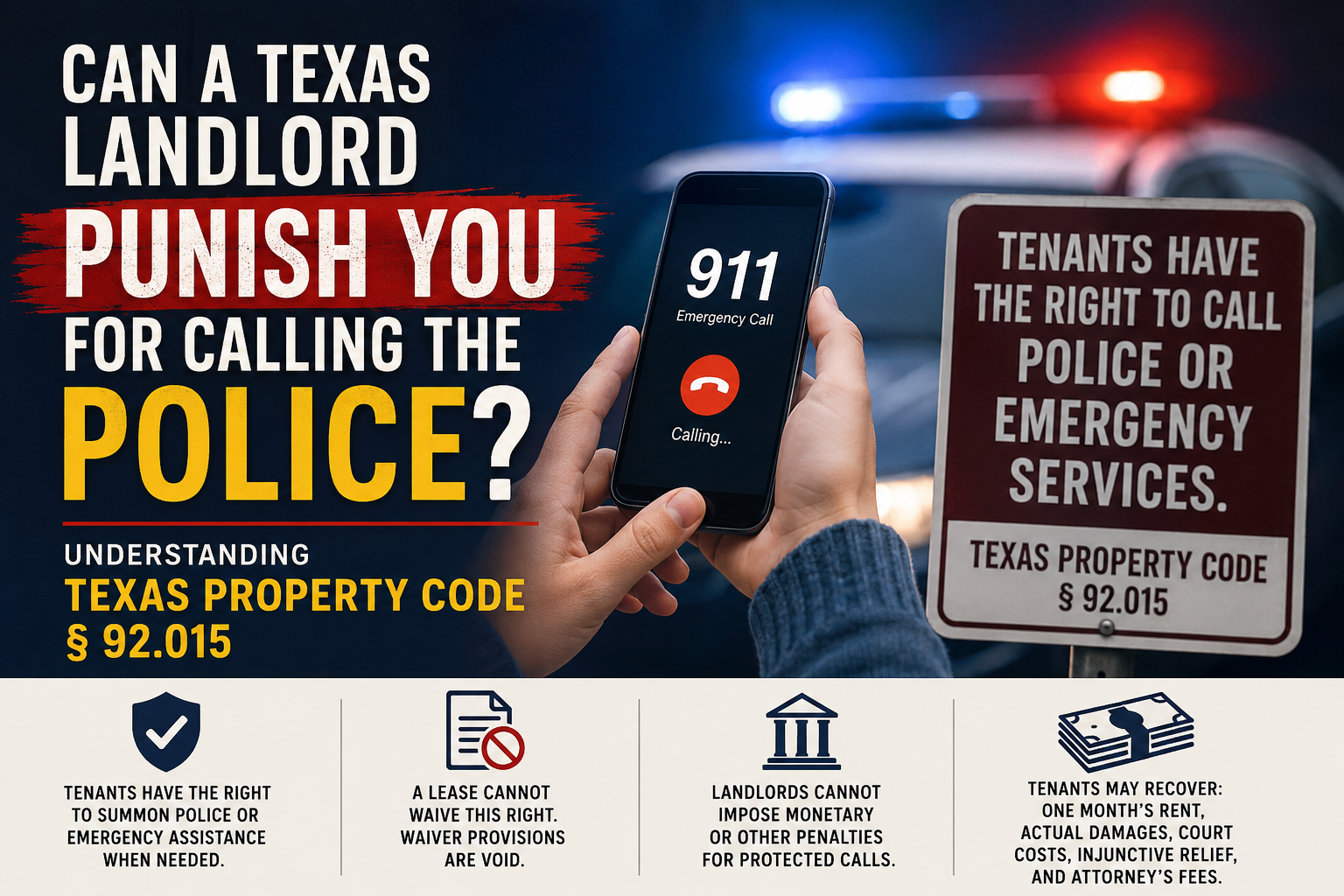
A residential landlord generally cannot prohibit a tenant from calling the police or emergency services when the tenant reasonably believes someone needs intervention or emergency assistance. Nor can the landlord impose a monetary or other penalty on a tenant for making such a call under those circumstances.
Texas Property Code § 92.015 gives tenants an express statutory right to summon help—and provides potentially significant remedies when a landlord interferes with that right.
Texas Tenants Have a Statutory Right to Call for Emergency Assistance
Texas Property Code § 92.015(a) provides in part that a landlord may not:
“prohibit or limit a residential tenant's right to summon police or other emergency assistance”
when the tenant reasonably believes that an individual needs intervention or emergency assistance.
The statute also prohibits a landlord from imposing a “monetary or other” penalty on a tenant for summoning police or emergency assistance when the request or dispatch was based on that reasonable belief. Tex. Prop. Code § 92.015(a). (Texas Legislature Online)
That language is broader than simply saying that a landlord cannot physically prevent a tenant from dialing 911.
The statute addresses both interference with the call itself and punishment afterward.
A Lease Cannot Simply Take This Right Away
One particularly important part of § 92.015 is that landlords and tenants cannot simply contract around it.
Subsection (b) provides that a lease provision is void if it purports to waive the tenant's protected right to summon police or emergency assistance.
The statute likewise makes void a provision attempting to:
“exempt any party from a liability or a duty under this section.”
Tex. Prop. Code § 92.015(b). (Texas Legislature Online)
In other words, a landlord cannot solve the problem by inserting language into the lease stating that tenants agree not to call the police, or that the landlord bears no responsibility for penalizing tenants who make protected emergency calls.
The Legislature has made the underlying right nonwaivable.
The Law Is Broader Than Domestic-Violence Calls
There is an interesting bit of legislative history behind this statute.
When § 92.015 was originally enacted in 2003, it was specifically directed at situations involving family violence. The Legislature was addressing the problem of tenants potentially facing eviction or other consequences because law enforcement had been called in response to domestic violence. (Texas Legislature Online)
But the Legislature significantly broadened the law in 2017.
House Bill 1099 removed the statutory language restricting the protection to emergency assistance requested “in response to family violence.” The statute now protects a tenant when police or other emergency assistance is summoned based on the tenant's reasonable belief that an individual needs intervention or emergency assistance. (Texas Legislature Online)
That distinction matters.
The modern statute is not merely another domestic-violence protection. Its text potentially applies to a much broader range of genuine emergencies.
What Counts as a Protected Call?
The key statutory phrase is “reasonable belief.”
The statute does not simply say that every call to law enforcement automatically immunizes a tenant from every consequence that might follow.
Instead, the protection applies when police or emergency assistance is requested or dispatched based on the tenant's reasonable belief that an individual needs intervention or emergency assistance. Tex. Prop. Code § 92.015(a). (Texas Legislature Online)
Imagine, for example, that a tenant hears what reasonably sounds like a violent assault occurring nearby and calls the police.
Or a tenant encounters someone apparently experiencing a serious medical emergency and summons emergency assistance.
The fact that the situation later turns out to be less serious than originally feared would not necessarily answer the statutory question. The statutory language focuses on the tenant's reasonable beliefwhen assistance was summoned.
That makes the circumstances surrounding the call important.
Can an Apartment Charge a Fine Because the Police Came?
Section 92.015 expressly prohibits a landlord from imposing “monetary or other penalties” for a protected request for police or emergency assistance. (Texas Legislature Online)
A direct fee imposed because a tenant made a protected emergency call therefore presents an obvious problem.
But the phrase “other penalties” is also significant. The Legislature did not limit the prohibition to a particular type of fee.
Landlords and property managers should consequently be cautious about policies that effectively punish tenants merely because they sought legitimate emergency assistance.
That does not mean tenants are immune from ordinary lease enforcement merely because police happened to become involved. A landlord may have independent grounds for action based on conduct occurring at the property. The important question under § 92.015 is whether the landlord is penalizing the tenant for the protected act of summoning assistance.
Those are not necessarily the same thing.
What Can a Tenant Recover If the Landlord Violates the Law?
This is where the statute becomes particularly consequential.
Texas Property Code § 92.015(c) provides several express remedies. A tenant may recover:
- a civil penalty equal to one month's rent;
- the tenant's actual damages resulting from the violation;
- court costs;
- injunctive relief; and
- reasonable attorney's fees incurred in enforcing the statute.
Tex. Prop. Code § 92.015(c). (Texas Legislature Online)
The attorney's-fee provision is especially important from a litigation standpoint.
A relatively modest landlord-tenant dispute can otherwise be economically difficult to litigate. An express statutory right to recover reasonable attorney's fees can materially change that calculation.
For tenants whose rent is subsidized in whole or in part by a governmental entity, the statute also contains an unusual rule: for purposes of the civil penalty, “one month's rent” means one month's fair market rent.Tex. Prop. Code § 92.015(d). (Texas Legislature Online)
Calling the Police Does Not Necessarily Excuse Other Lease Violations
Section 92.015 should not be read more broadly than its actual language.
Suppose a tenant hosts a party that violates the lease, guests damage the property, and the police eventually arrive. The mere involvement of law enforcement does not necessarily prevent the landlord from enforcing legitimate lease provisions concerning the underlying conduct.
Similarly, § 92.015 does not say that a tenant can violate a lease indefinitely so long as the tenant occasionally calls the police.
The protected conduct is the tenant's right to summon police or emergency assistance based on a reasonable belief that someone needs help.
That distinction can become extremely important in a real dispute.
A landlord might contend that an eviction, nonrenewal, fee, or other action resulted from independent lease violations. A tenant might contend that the stated reason is merely a pretext and that the real reason was repeated protected calls for assistance.
At that point, documents, notices, emails, text messages, lease-violation records, and the timing of the landlord's actions may become important evidence.
Landlords Should Be Careful With “Crime-Free” or Disturbance Policies
Landlords have legitimate interests in protecting other residents and maintaining safe rental properties.
But policies directed at disturbances or criminal activity should be drafted and enforced carefully enough that they do not effectively tell tenants:
“If you call the police, you will be fined or evicted.”
That is precisely the kind of situation that can implicate § 92.015.
Property managers should distinguish between the tenant's underlying conduct and the tenant's decision to seek legitimate emergency assistance.
A tenant should not have to choose between complying with a landlord's policy and calling for help when the tenant reasonably believes someone is in danger.
The Bottom Line
Texas Property Code § 92.015 creates a straightforward but surprisingly powerful protection for residential tenants.
A landlord generally cannot prohibit or limit a tenant's right to summon police or emergency assistance when the tenant reasonably believes someone needs intervention or assistance. A landlord likewise cannot impose a monetary or other penalty because the tenant made such a protected call.
A lease provision attempting to waive those protections is void.
And when a landlord violates the statute, the consequences can include one month's rent as a civil penalty, actual damages, court costs, injunctive relief, and reasonable attorney's fees. (Texas Legislature Online)
For landlords, the lesson is to distinguish carefully between legitimate enforcement of lease violations and punishment for seeking emergency help.
For tenants, the statute reflects a simple principle: when someone reasonably appears to need emergency assistance, fear of the landlord should not prevent a call for help.
For the current statutory text, see Texas Property Code Chapter 92 — Texas Legislature.
This article is for general informational purposes only and does not constitute legal advice. The application of Texas landlord-tenant law depends on the particular facts and circumstances of each case.
At David C. Barsalou, Attorney at Law, PLLC, we help clients navigate business, family, tax, estate planning, and real estate matters ranging from document drafting to litigation with clarity and confidence. If you’d like guidance on your situation, schedule a consultation today. Call us at (713) 397-4678, email barsalou.law@gmail.com, or reach us through our Contact Page. We’re here to help you take the next step.
