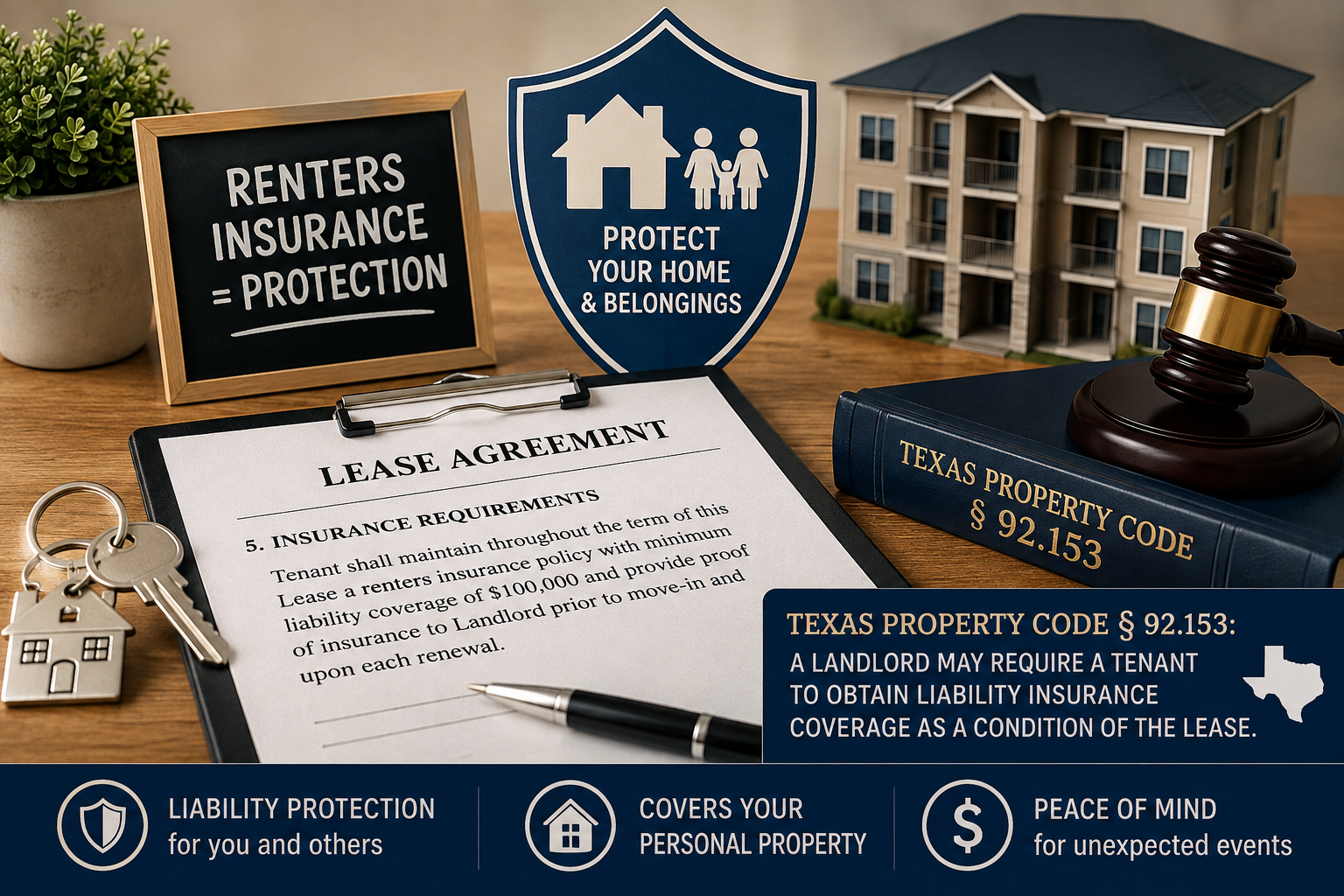
Many Texas tenants are surprised when a lease requires them to purchase renters insurance. Likewise, many landlords wonder whether they can legally require tenants to maintain insurance throughout the lease term.
The short answer is yes. Texas law generally allows landlords to require renters insurance, provided the lease clearly states the requirement.
Understanding what renters insurance does—and what it does not do—can help both landlords and tenants avoid expensive misunderstandings.
What Is Renters Insurance?
Renters insurance is a policy purchased by a tenant rather than the landlord.
It commonly provides coverage for:
- Personal property damaged by fire, theft, or certain natural disasters;
- Personal liability if someone is injured because of the tenant's negligence;
- Additional living expenses if the residence becomes temporarily uninhabitable because of a covered loss.
Importantly, renters insurance does not insure the building itself. The landlord's insurance generally covers the structure.
Does Texas Law Allow Landlords to Require Renters Insurance?
Yes.
Texas Property Code § 92.153 specifically contemplates situations in which a landlord requires a tenant to obtain liability insurance.
The statute provides, in part:
"A landlord may require a tenant to obtain liability insurance coverage as a condition of the lease."
Tex. Prop. Code § 92.153.
This provision reflects the Legislature's recognition that liability insurance requirements are generally enforceable when properly included in the lease.
Why Do Landlords Require Renters Insurance?
Landlords often require renters insurance for several reasons.
1. Protection Against Liability Claims
Suppose a tenant accidentally starts a kitchen fire that damages neighboring apartments.
The landlord's insurer may pay for portions of the damage, but liability questions often follow. A tenant's liability policy may provide coverage for claims arising from the tenant's negligence.
2. Protection for the Tenant's Personal Property
Many tenants mistakenly assume that the landlord's insurance covers their belongings.
Generally, it does not.
If a fire destroys furniture, clothing, electronics, or other personal property, the tenant may have no coverage without renters insurance.
3. Fewer Disputes After Losses
After major events such as apartment fires or water leaks, tenants sometimes attempt to hold landlords responsible for all of their losses.
Separate insurance policies often make the claims process much simpler.
Can a Landlord Purchase Insurance for the Tenant?
Sometimes.
Texas Property Code Chapter 92 permits landlords, under certain circumstances, to obtain insurance programs associated with the lease, provided statutory requirements and disclosure obligations are satisfied.
The exact arrangement depends upon the lease language and applicable statutory provisions.
What Happens If the Tenant Lets the Policy Lapse?
The answer usually depends on the lease.
Many Texas leases provide that failure to maintain required insurance constitutes a lease default.
Some leases allow the landlord to:
- issue a notice to cure;
- purchase substitute coverage and charge the tenant if authorized by law and the lease; or
- pursue other contractual remedies.
The specific rights depend on the lease agreement and applicable law.
Can a Landlord Require Any Amount of Coverage?
Generally, yes, provided the requirement is reasonable and disclosed in the lease.
Many apartment complexes require liability limits such as $100,000 or $300,000, although requirements vary by property.
Can a Tenant Refuse?
A prospective tenant may refuse to sign a lease containing an insurance requirement.
However, once the lease is executed, failure to comply with a valid insurance provision may constitute a breach of the lease agreement.
Common Misunderstandings
A few misconceptions arise repeatedly.
"The landlord's insurance covers my furniture."
Usually not.
"Renters insurance only protects the landlord."
Incorrect. Much of the policy is designed to protect the tenant.
"Texas law prohibits landlords from requiring insurance."
It does not. Texas law expressly recognizes that landlords may require liability insurance under qualifying circumstances.
Practical Advice for Texas Landlords
If you intend to require renters insurance:
- Clearly state the requirement in the lease.
- Specify minimum coverage amounts.
- Explain when proof of insurance must be provided.
- State what happens if coverage lapses.
- Ensure the lease complies with applicable provisions of the Texas Property Code.
Practical Advice for Texas Tenants
Before signing a lease:
- Read all insurance provisions carefully.
- Ask what minimum coverage is required.
- Confirm whether pets or roommates affect the policy.
- Compare insurance costs before signing the lease.
Many renters insurance policies are relatively inexpensive compared to the financial losses they may prevent.
Conclusion
Requiring renters insurance has become increasingly common in Texas residential leasing. Texas Property Code § 92.153 generally permits landlords to require liability insurance as a lease condition, and these provisions can benefit both parties by reducing financial risk after accidents or property damage.
Whether you are a landlord drafting a lease or a tenant evaluating your obligations, understanding these insurance requirements before signing can prevent costly disputes later.
David C. Barsalou, Attorney at Law, PLLC represents clients throughout Texas in landlord-tenant disputes, evictions, real estate litigation, contract matters, probate, and other civil litigation matters. If you have questions regarding a residential lease or your rights under the Texas Property Code, consider consulting with an attorney regarding your specific situation.
At David C. Barsalou, Attorney at Law, PLLC, we help clients navigate business, family, tax, estate planning, and real estate matters ranging from document drafting to litigation with clarity and confidence. If you’d like guidance on your situation, schedule a consultation today. Call us at (713) 397-4678, email barsalou.law@gmail.com, or reach us through our Contact Page. We’re here to help you take the next step.