A residential tenant stops paying rent.
The landlord is understandably frustrated. The tenant remains in possession of the property, the unpaid balance continues to increase, and an eviction may take time.
Can the landlord simply shut off the electricity, water, or gas until the tenant leaves or pays?
Generally, no.
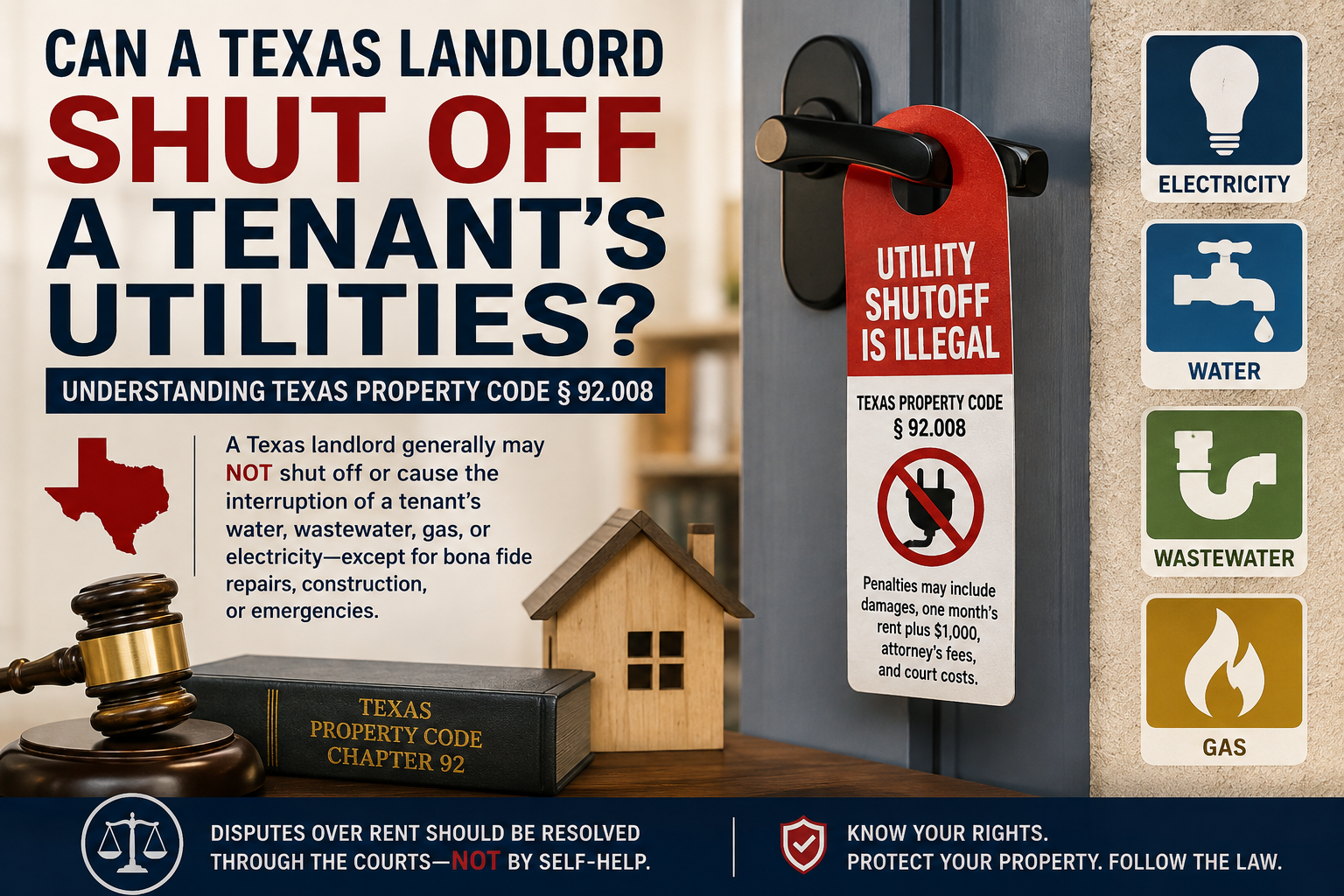
Texas law sharply limits a landlord's ability to interrupt utility service to residential rental property. Texas Property Code § 92.008prohibits certain utility shutoffs and provides substantial remedies when a landlord violates the statute.
For landlords, the rule is an important reminder that eviction and debt collection must generally proceed through lawful procedures. For tenants, it provides protection against a landlord attempting to make a rental property uninhabitable as a substitute for going to court.
Can a Texas Landlord Shut Off Utilities That the Tenant Pays Directly?
Texas Property Code § 92.008(a) addresses utility service that the tenant pays directly to the utility provider.
The statute provides:
"A landlord or a landlord's agent may not interrupt or cause the interruption of utility service paid for directly to the utility company by a tenant"
unless the interruption results from bona fide repairs, construction, or an emergency.
This covers an important practical situation.
Suppose the electric account is in the tenant's name and the tenant pays the electric company directly. A landlord generally cannot interfere with that service merely because the tenant has failed to pay rent or because the landlord wants the tenant to leave.
The fact that the landlord owns the building does not create an unrestricted right to interfere with independently supplied utilities.
What If the Landlord Provides the Utilities?
Texas law also addresses utilities furnished by the landlord as part of the tenancy.
Section 92.008(b) generally prohibits a landlord from interrupting water, wastewater, gas, or electric service furnished by the landlord as an incident of the tenancy or under another agreement, except when the interruption results from bona fide repairs, construction, or an emergency.
That distinction can matter in apartment complexes, duplexes, rental houses, and other properties where utility arrangements vary.
A landlord therefore should not assume that providing a utility through the landlord's own account gives the landlord unlimited authority to discontinue it.
What Counts as a Legitimate Utility Interruption?
The statute recognizes that not every interruption is wrongful.
Utilities sometimes must be temporarily disconnected because something actually needs to be repaired. Electrical work may require the power to be turned off. Plumbing repairs may require the water to be shut off. A gas leak may require immediate interruption of gas service.
Texas Property Code § 92.008 expressly recognizes interruptions resulting from:
- bona fide repairs;
- construction; or
- an emergency.
The important issue is the reason for the interruption.
A temporary water shutoff while a broken pipe is repaired is fundamentally different from shutting off the water because a tenant owes two months of rent.
Likewise, a landlord responding to an electrical emergency is in a very different legal position from a landlord intentionally cutting power to pressure a tenant into moving.
What If the Tenant Has Not Paid Rent?
Nonpayment of rent does not ordinarily give a residential landlord the right to use utility interruption as an informal eviction device.
Texas law provides a specific process for recovering possession of rental property. Depending on the circumstances, that process generally involves notice to vacate followed by a forcible detainer action if the tenant does not leave.
A landlord who bypasses that process and attempts to force the tenant out by making the property unlivable can create an entirely separate legal problem.
This is one reason landlords should be particularly careful about "self-help" measures.
A landlord may have an excellent underlying claim for unpaid rent and possession of the property while simultaneously exposing himself or herself to liability through an unlawful attempt to accelerate the tenant's departure.
What Can a Tenant Recover If a Landlord Illegally Shuts Off Utilities?
The consequences of violating § 92.008 can be significant.
Under § 92.008(f), a tenant may either recover possession of the premises or terminate the lease.
The tenant may also recover certain monetary relief. The statute permits recovery that can include:
- actual damages;
- one month's rent plus $1,000;
- reasonable attorney's fees; and
- court costs,
subject to an offset for delinquent rent or other amounts the tenant owes the landlord.
This creates an interesting feature of Texas landlord-tenant law.
A tenant's failure to pay rent does not necessarily eliminate the tenant's statutory rights.
The tenant might owe the landlord money while the landlord simultaneously owes the tenant money because of an unlawful utility interruption. The ultimate financial result can therefore require consideration of both sides' claims.
Can a Tenant Get the Utilities Turned Back On Quickly?
Texas law provides more than a traditional lawsuit for damages after the fact.
Texas Property Code § 92.0091 establishes a procedure through which a residential tenant may seek restoration of utility service after an unlawful interruption.
A tenant may file a sworn complaint with the justice court in the precinct where the rental premises are located and request an order directing restoration of the service.
This matters because a damages lawsuit months later may provide little practical help to someone whose electricity or water has been disconnected today.
The statutory restoration procedure is designed to address the immediate problem.
Utility Shutoffs Can Create Problems in an Otherwise Valid Eviction
For landlords, perhaps the most important practical lesson is that an unlawful utility interruption can complicate a case that otherwise should have been straightforward.
Imagine a tenant who plainly owes several months of rent.
The landlord serves the required notice, files an eviction, and has a strong claim for possession. But before the hearing, the landlord becomes impatient and disconnects the tenant's electricity.
The landlord may have transformed a relatively ordinary nonpayment case into a dispute involving statutory damages, attorney's fees, emergency restoration proceedings, and allegations of unlawful self-help.
The better approach is generally much simpler:
Use the eviction process for eviction. Use lawful collection procedures to collect money. Do not create a second dispute by trying to force the tenant out indirectly.
Tenants Should Also Distinguish Landlord Action From Utility-Company Action
Not every utility disconnection is attributable to the landlord.
A utility provider may disconnect service because the tenant failed to pay the utility bill. An outage may result from weather, infrastructure problems, repairs, or circumstances entirely outside the landlord's control.
Section 92.008 focuses on situations in which the landlord or landlord's agent interrupts or causes the interruption of the service.
That factual question can therefore become important.
Before assuming that a landlord violated the Property Code, a tenant should determine who actually caused the interruption and why.
Documentation Can Matter in a Utility-Shutoff Dispute
Both landlords and tenants should preserve evidence when a dispute develops.
Relevant evidence might include lease provisions, utility bills, text messages, emails, maintenance requests, notices from utility companies, photographs, repair invoices, and communications concerning the reason service was interrupted.
Timing can be particularly important.
If a landlord claims that water was shut off because emergency plumbing repairs were necessary, contemporaneous maintenance records may support that explanation.
Conversely, a message telling the tenant that the electricity will remain off "until you pay the rent" could create an obvious problem for the landlord.
Can a Lease Waive the Tenant's Rights?
Residential leases are heavily affected by statutory requirements, and landlords should be cautious about assuming that broad lease language eliminates protections created by Chapter 92 of the Texas Property Code.
A provision authorizing a landlord to take certain action does not automatically mean that the action is lawful under every circumstance.
Texas residential landlord-tenant law contains numerous provisions regulating remedies, security devices, repairs, utility service, security deposits, and other aspects of the rental relationship.
The lease and the statute therefore must often be read together.
The Bottom Line
A Texas residential landlord generally cannot shut off a tenant's water, wastewater, gas, or electricity merely because the tenant has not paid rent or the landlord wants the tenant to leave.
Texas Property Code § 92.008 allows utility interruptions in circumstances such as bona fide repairs, construction, and emergencies, but using a utility shutoff as a substitute for the eviction process can expose a landlord to substantial liability.
A tenant subjected to an unlawful interruption may have rights to regain possession or terminate the lease, recover actual and statutory damages, obtain attorney's fees and court costs, and potentially seek rapid restoration of utility service through justice court.
For both landlords and tenants, the central lesson is straightforward: a dispute over rent does not suspend the rules governing possession and utility service.
When rent has not been paid, landlords should use the remedies Texas law provides rather than creating new liability through self-help. Tenants facing a deliberate utility shutoff should likewise act quickly because Texas law provides remedies specifically designed for this situation.
This article is for general informational purposes only and does not constitute legal advice. The application of Texas landlord-tenant law depends on the particular facts, lease terms, type of property, and circumstances involved.
At David C. Barsalou, Attorney at Law, PLLC, we help clients navigate business, family, tax, estate planning, and real estate matters ranging from document drafting to litigation with clarity and confidence. If you’d like guidance on your situation, schedule a consultation today. Call us at (713) 397-4678, email barsalou.law@gmail.com, or reach us through our Contact Page. We’re here to help you take the next step.
