Most Texas tenants understand that failing to pay rent can eventually lead to an eviction.
Far fewer realize that Texas law also recognizes something called a residential landlord’s lien.
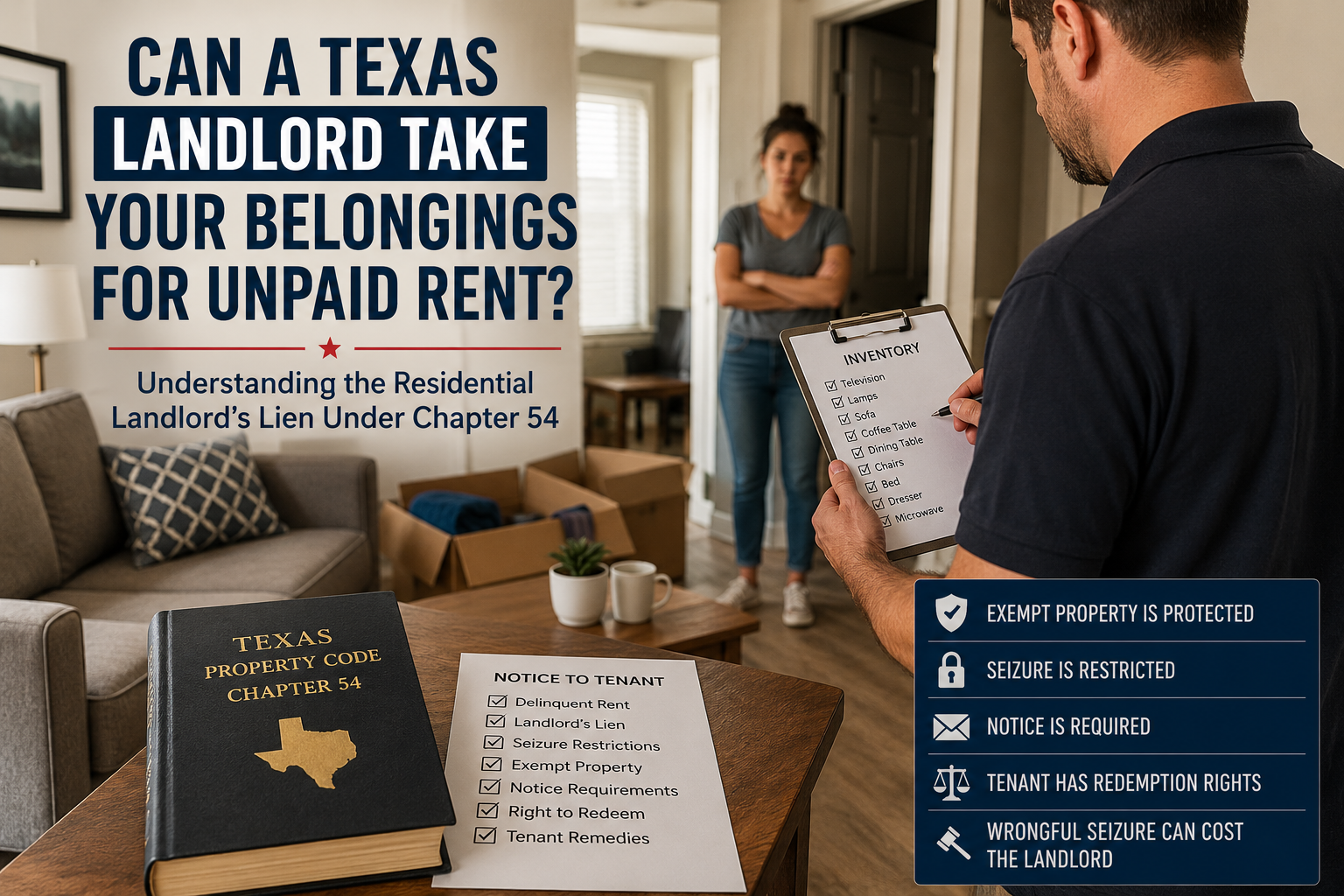
Under certain circumstances, a Texas landlord may have a lien against some of the personal property located inside a tenant’s residence for unpaid rent. Texas Property Code Chapter 54 even establishes procedures under which certain property may be seized and, eventually, sold.
That does not mean a landlord can simply walk into an apartment, grab whatever looks valuable, and sell it.
Texas Property Code §§ 54.041–54.048 impose substantial restrictions on residential landlord liens, including exemptions for many ordinary household items, special requirements for lease provisions, restrictions on seizure, notice requirements, and remedies for tenants when landlords violate the law.
Texas Law Creates a Residential Landlord’s Lien for Unpaid Rent
Texas Property Code § 54.041 begins with a relatively straightforward rule:
“A landlord of a single or multifamily residence has a lien for unpaid rent that is due.”
The statute further provides that the lien attaches to nonexempt property located in the residence or stored by the tenant in a storage room.
This is important because a landlord’s lien is different from an eviction.
An eviction concerns the landlord’s right to recover possession of the rental property.
A landlord’s lien concerns the landlord’s potential rights in certain personal property belonging to the tenant.
The existence of a lien also does not mean that every item inside the residence can legally be seized.
In fact, Texas law specifically protects a surprisingly broad collection of property.
What Property Is Protected From a Texas Residential Landlord’s Lien?
Texas Property Code § 54.042 contains a detailed list of property to which the residential landlord’s lien does not attach.
Among the exempt property are:
- wearing apparel;
- tools, apparatus, and books used in a trade or profession;
- schoolbooks;
- a family library;
- family portraits and pictures;
- one couch;
- two living-room chairs;
- a dining table and chairs;
- beds and bedding;
- kitchen furniture and utensils;
- food;
- medicine and medical supplies;
- one automobile and one truck;
- agricultural implements; and
- children’s toys not commonly used by adults.
The statute also protects certain property that the landlord knows belongs to someone other than the tenant or an occupant of the residence.
This produces an unusual result.
Texas law recognizes a landlord’s lien, but it simultaneously removes many of the items most essential to ordinary life from the lien’s reach.
A landlord therefore should not assume that simply because property is physically located inside a tenant’s apartment, the property can legally be taken to satisfy unpaid rent.
Yes, Texas Law Specifically Protects the Tenant’s Couch
One of the more memorable provisions of the statute is its treatment of furniture.
Texas Property Code § 54.042 exempts:
“one couch, two living room chairs, and a dining table and chairs”
from the residential landlord’s lien.
Beds and bedding are separately protected, as are kitchen furniture and utensils.
The statute therefore draws a distinction between basic household necessities and other nonexempt property that might potentially be subject to a properly enforceable lien.
The distinction can become important if a landlord attempts to exercise self-help remedies against a tenant’s possessions.
The Lease Language Matters
Even where property is theoretically subject to a landlord’s lien, the landlord does not automatically have unrestricted authority to seize it.
Texas Property Code § 54.043(a) provides:
“A contractual landlord's lien is not enforceable unless it is underlined or printed in conspicuous bold print in the lease agreement.”
That is an unusually specific statutory formatting requirement.
A landlord relying on a contractual lien should therefore examine the actual lease language rather than assuming that a generic remedies provision is sufficient.
Section 54.043(b) also limits the ability of the parties to contract around the statutory protections. A lease provision purporting to waive or diminish a right, liability, or exemption created by the residential-landlord-lien subchapter is void to the extent prohibited by the statute.
In other words, signing a lease does not necessarily allow a tenant to waive every protection provided by Chapter 54.
Can a Texas Landlord Actually Enter the Residence and Take Property?
Texas Property Code § 54.044 addresses seizure.
The statute provides that the landlord or landlord’s agent:
“may not seize exempt property”
and may seize nonexempt property only when the seizure is authorized by a written lease and can be accomplished without a breach of the peace.
Those limitations are critical.
The statutory lien should not be interpreted as a general license to use force, create a confrontation, or seize protected property.
Additionally, immediately after property is seized, the landlord or agent must leave written notice of the entry and an itemized list of the property removed in a conspicuous place inside the dwelling.
The notice must include the amount of delinquent rent and contact information for the person the tenant may contact concerning the debt.
It must also inform the tenant that the seized property will be promptly returned upon full payment of the delinquent rent.
Can the Landlord Charge the Tenant for Removing the Property?
Not automatically.
Texas Property Code § 54.044(c) provides that unless the written lease authorizes the charge, the landlord is not entitled to collect a charge for:
- packing;
- removing; or
- storing
property seized under the statute.
This is another reason the exact language of the lease matters.
The statute does not merely ask whether the lease mentions a landlord’s lien. Different provisions can determine what remedies and charges are actually available.
What If the Tenant Has Already Abandoned the Apartment?
Chapter 54 separately addresses abandonment.
Texas Property Code § 54.044(d) provides:
“If the tenant has abandoned the premises, the landlord or the landlord's agent may remove its contents.”
That provision should not be confused with the landlord’s ability to sell property under the lien.
Removing property from an abandoned residence and selling property to satisfy unpaid rent are legally distinct acts, and additional requirements apply before seized property may be sold.
A Landlord Cannot Immediately Sell the Tenant’s Property
Texas Property Code § 54.045 regulates the sale of property seized under the residential landlord’s lien provisions.
First, the sale or other disposition must be authorized by the written lease.
Second, the landlord must provide advance notice to the tenant.
The statute generally requires the landlord to give notice at least 30 days before the sale, sent to the tenant’s last known address by both first-class mail and certified mail, return receipt requested.
The notice must provide information including the date, time, and place of the sale, an itemized account of the amount owed, and contact information concerning the sale and the tenant’s redemption rights.
The statutory process therefore looks very different from a landlord simply deciding that a television or other valuable item will be sold because the tenant owes rent.
Can the Tenant Get the Property Back Before It Is Sold?
Yes.
Texas Property Code § 54.045 gives the tenant a right to redeemseized property before it is sold.
The tenant generally may redeem the property by paying the delinquent rent and, if the written lease authorizes them, reasonable packing, moving, storage, and sale costs.
The purpose of the lien is to secure the unpaid obligation—not simply to transfer ownership of the tenant’s possessions to the landlord.
What Happens to the Money If the Property Is Sold?
The landlord does not simply receive an unrestricted windfall from the sale.
Chapter 54 regulates the sale process and the application of proceeds. The tenant may also request an accounting concerning the proceeds of the sale.
This becomes particularly important where the property sells for more than the amount legitimately owed to the landlord.
A landlord exercising a statutory lien should therefore maintain careful records of the property seized, the amounts owed, notices provided, expenses incurred, sale proceeds, and how those proceeds were applied.
What Happens If a Texas Landlord Wrongfully Seizes Property?
The consequences can be substantial.
Texas Property Code § 54.046 provides remedies when a landlord or the landlord’s agent willfully violates the residential-landlord-lien provisions.
Depending on the circumstances, a tenant may be entitled to actual damages, return of property that has not been sold, return of sale proceeds, a statutory monetary recovery, and reasonable attorney’s fees, subject to the offsets specified by the statute.
That means an attempt to collect a relatively modest amount of unpaid rent can potentially create a much larger dispute if the landlord seizes property that is exempt or ignores the required procedures.
For landlords, the lesson is straightforward: self-help remedies should be exercised carefully.
For tenants, the equally important lesson is that a landlord’s statement that “the lease gives me a lien” does not end the legal analysis.
Can a Tenant Go to Court to Recover Seized Property?
Texas law also provides a mechanism for recovering possession of seized property while a rent dispute remains unresolved.
Texas Property Code § 54.048 permits a tenant, under specified circumstances, to replevy property before judgment in a suit for unpaid rent by posting a bond approved by the court.
Replevin is a legal procedure used to recover possession of personal property while the parties’ underlying rights are still being determined.
This provision reinforces an important feature of Chapter 54: seizure does not necessarily determine ultimate ownership or permanently deprive the tenant of the property.
Residential Landlord Liens Are Different From Commercial Landlord Liens
Texas landlords and tenants should also be careful not to assume that the same rules apply to every lease.
Texas Property Code Chapter 54 contains separate provisions governing different types of landlord liens.
Commercial leasing, agricultural leasing, and residential leasing can involve materially different rules.
A remedy that may be available in a commercial lease therefore should not automatically be imported into a residential landlord-tenant dispute.
Residential property receives specific statutory protections, particularly concerning exempt household property and the procedures required before property may be seized or sold.
Practical Lessons for Texas Landlords
Before attempting to exercise a residential landlord’s lien, a landlord should determine:
- whether rent is actually delinquent;
- whether the lease contains an enforceable landlord-lien provision;
- whether the provision satisfies the statutory formatting requirements;
- whether the particular property is exempt;
- whether seizure can occur without a breach of the peace;
- whether all required notices can be properly provided; and
- whether the lease actually authorizes sale or disposition of the property.
Because an improper seizure can expose a landlord to damages and attorney’s fees, aggressive self-help can sometimes create more liability than it resolves.
Practical Lessons for Texas Tenants
A tenant whose property has been seized should not assume that the seizure was necessarily lawful merely because rent is owed.
Important questions include:
- Was the property exempt under Texas Property Code § 54.042?
- Did the written lease authorize the seizure?
- Was the landlord-lien provision properly emphasized in the lease?
- Did the landlord leave the required written notice and itemized inventory?
- Was the seizure accomplished without a breach of the peace?
- Has the landlord complied with the notice requirements before attempting a sale?
The answers can determine whether the landlord was exercising a lawful remedy or creating a potential claim for the tenant.
The Bottom Line
Texas law does recognize a residential landlord’s lien for unpaid rent.
But that statement is only the beginning of the analysis.
Texas Property Code §§ 54.041–54.048 protect numerous categories of personal property, regulate the language used in residential leases, restrict when property may be seized, require notice after seizure, provide redemption rights before sale, and create remedies when landlords willfully violate the law.
The most memorable example may be the statute’s protection of one couch and two living-room chairs, but the larger principle is serious:
A Texas landlord may have rights against a tenant’s property, but those rights are limited by detailed statutory protections that both landlords and tenants should understand before taking action.
This article is for general informational purposes only and does not constitute legal advice. The application of Texas landlord-tenant law depends on the lease, the property involved, and the particular facts of the dispute.
At David C. Barsalou, Attorney at Law, PLLC, we help clients navigate business, family, tax, estate planning, and real estate matters ranging from document drafting to litigation with clarity and confidence. If you’d like guidance on your situation, schedule a consultation today. Call us at (713) 397-4678, email barsalou.law@gmail.com, or reach us through our Contact Page. We’re here to help you take the next step.