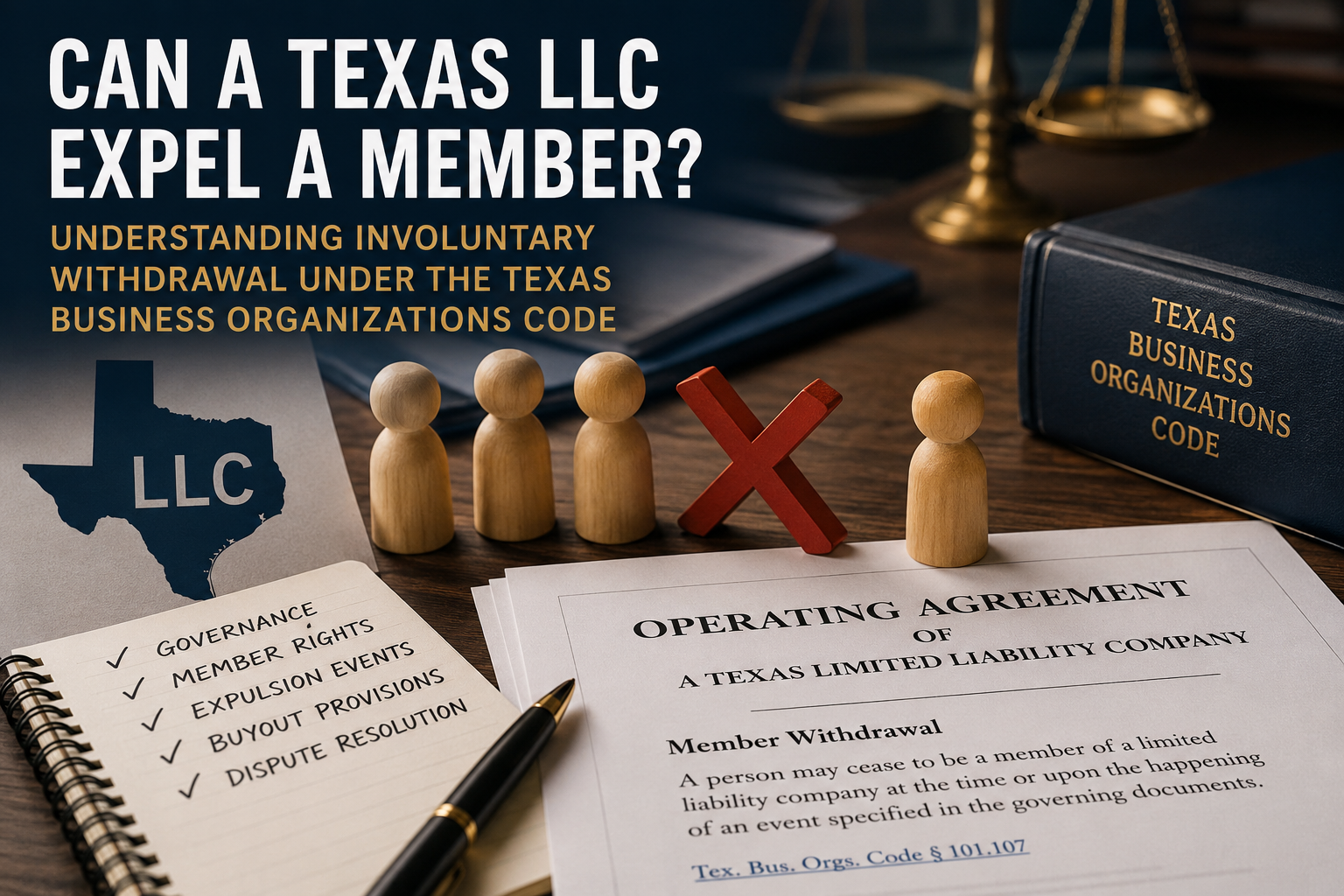
Can a Texas LLC Force Out One of Its Owners?
Many people assume that once someone becomes a member of a Texas limited liability company (LLC), that person can never be removed unless they voluntarily leave or sell their ownership interest.
That is not always true.
While Texas law generally favors freedom of contract, the Texas Business Organizations Code ("TBOC") allows LLC members to agree in advance that certain events will automatically terminate a person's membership or management rights. Depending upon the company agreement, a member may be expelled after bankruptcy, criminal conduct, loss of a professional license, breach of fiduciary duties, or other negotiated events.
This is one of the lesser-known aspects of Texas business law—and one that frequently surprises business owners during internal disputes.
Texas Law Allows Company Agreements to Control
Texas LLCs operate largely according to their governing documents.
The Texas Business Organizations Code expressly recognizes the importance of the company agreement. If the members agree that certain events result in termination of membership or governance rights, courts will often enforce those provisions unless they violate mandatory statutory law or public policy.
One of the statutory provisions addressing withdrawal provides:
"A person may cease to be a member of a limited liability company at the time or upon the happening of an event specified in the governing documents."
Tex. Bus. Orgs. Code § 101.107.
This gives business owners tremendous flexibility to design rules that fit their particular business.
Common Expulsion Events
Many sophisticated Texas LLC agreements include provisions allowing involuntary withdrawal after events such as:
- Fraud against the company
- Embezzlement
- Conviction of certain crimes
- Loss of required professional licenses
- Bankruptcy
- Death
- Permanent disability
- Failure to satisfy capital contribution obligations
- Serious breaches of fiduciary duties
- Violation of non-compete or confidentiality provisions (when enforceable)
- Deadlock procedures agreed upon by the members
Without these provisions, removing a problematic member may become significantly more difficult.
Does Expulsion Mean They Lose Their Ownership Interest?
Not necessarily.
This is where many business owners become confused.
Membership involves multiple rights, including:
- Economic rights
- Voting rights
- Management rights
- Information rights
Depending upon the company agreement, an expelled member may:
- lose management authority,
- retain only economic rights,
- become an assignee,
- be required to sell their interest, or
- receive a mandatory buyout.
The answer depends almost entirely upon the governing documents.
What If There Is No Company Agreement?
When no written company agreement exists—or the agreement is silent—the Texas Business Organizations Code supplies default rules.
Those defaults often do not produce the outcome the remaining members expect.
Many owners believe they can simply "vote someone out."
Often, they cannot.
Without contractual authority, disputes frequently end up in litigation involving breach of fiduciary duty, judicial dissolution, accounting claims, declaratory judgments, or requests for appointment of a receiver.
Buy-Sell Provisions Matter
Well-drafted Texas LLC agreements usually pair expulsion provisions with buy-sell procedures.
These often answer practical questions such as:
- Who determines value?
- Is an appraisal required?
- Can payments be made over time?
- Is there a discount for misconduct?
- What happens if financing cannot be obtained?
Without these provisions, even an otherwise valid expulsion may lead to expensive valuation litigation.
Courts Generally Enforce Sophisticated Agreements
Texas strongly favors freedom of contract.
Business owners are generally free to negotiate governance structures that fit their particular enterprise.
Accordingly, carefully drafted company agreements frequently become the most important document in an internal ownership dispute.
The company's governing documents often determine whether a disagreement becomes a manageable business problem—or years of expensive litigation.
Practical Advice for Texas Business Owners
If your Texas LLC has multiple owners, your company agreement should clearly address:
- involuntary withdrawal,
- member expulsion,
- valuation procedures,
- buyout mechanics,
- voting thresholds,
- dispute resolution,
- death and disability,
- bankruptcy,
- and succession planning.
These provisions rarely seem important when everyone gets along.
They become critically important when relationships deteriorate.
Conclusion
One of the greatest advantages of a Texas LLC is flexibility. Rather than relying entirely on statutory default rules, members may customize many aspects of how the company operates—including when a member may cease being a member.
For that reason, every Texas LLC with more than one owner should periodically review its company agreement to ensure it addresses member departures, ownership disputes, and buyout procedures before disagreements arise.
When significant assets or family-owned businesses are involved, investing time in a carefully drafted company agreement is often far less expensive than litigating an avoidable dispute later.
Disclaimer: This article is provided for informational purposes only and does not constitute legal advice. Reading this article does not create an attorney-client relationship. If you are involved in an LLC ownership dispute or need assistance drafting or interpreting a Texas company agreement, consult a qualified Texas attorney.
At David C. Barsalou, Attorney at Law, PLLC, we help clients navigate business, family, tax, estate planning, and real estate matters ranging from document drafting to litigation with clarity and confidence. If you’d like guidance on your situation, schedule a consultation today. Call us at (713) 397-4678, email barsalou.law@gmail.com, or reach us through our Contact Page. We’re here to help you take the next step.