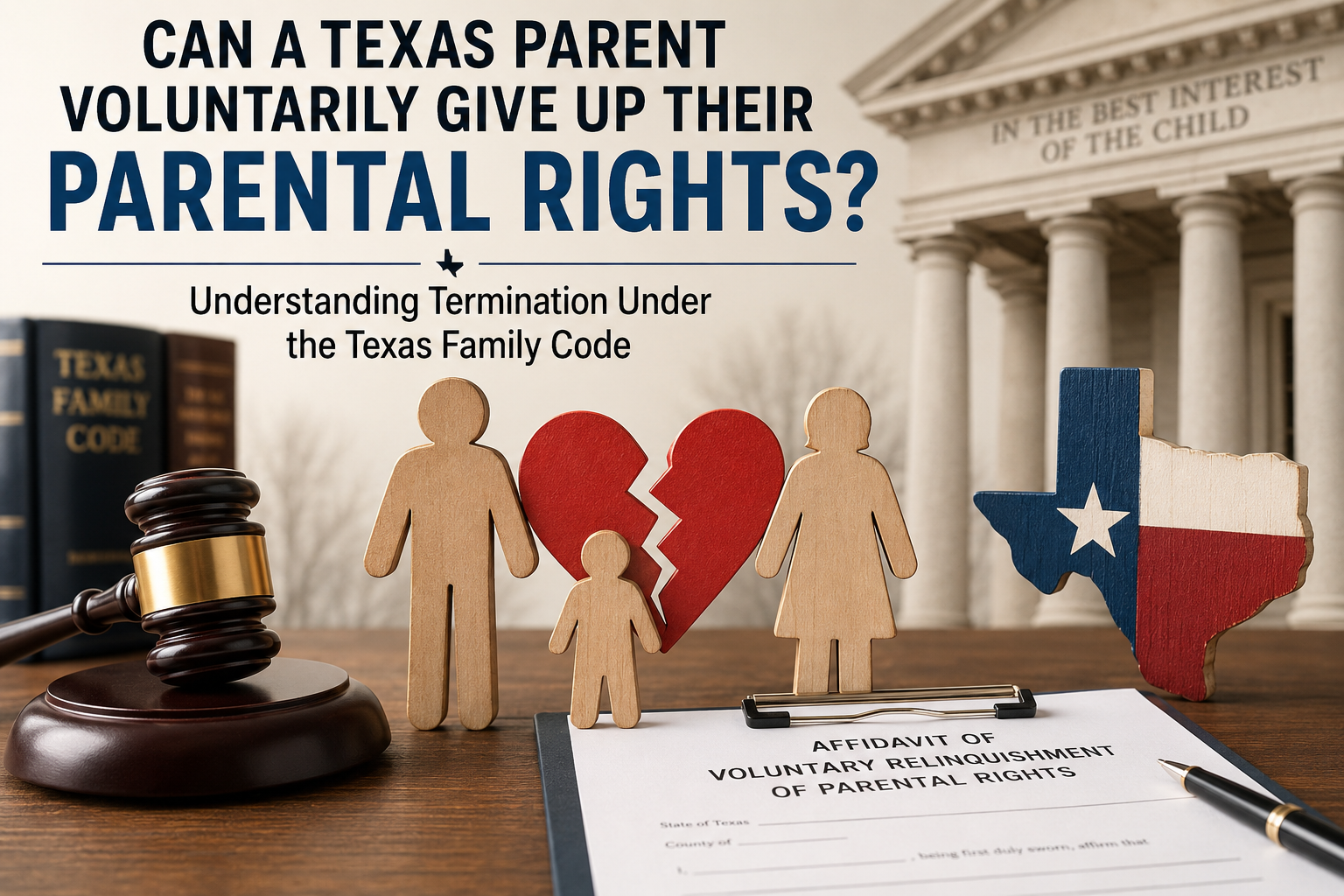
Parents occasionally ask an attorney a surprisingly common question:
"Can I just sign away my parental rights?"
The short answer is usually no.
Texas law treats the parent-child relationship as one of the most important legal relationships recognized by the courts. Because of that, a parent generally cannot simply decide to walk away from parental responsibilities by signing paperwork. Even if both parents agree, a Texas court must determine whether terminating parental rights is authorized by statute and is in the child's best interest.
Understanding how voluntary termination works can save families significant time, expense, and disappointment.
What Are Parental Rights?
Parental rights include much more than visitation.
They generally include the right to:
- Make important decisions regarding the child
- Receive information about the child's education and health
- Consent to medical treatment
- Direct the child's upbringing
- Seek possession or access to the child
- Inherit from the child under certain circumstances
Termination permanently ends nearly all of these legal rights and responsibilities.
Texas Law Governing Voluntary Termination
The Texas Family Code allows a court to terminate parental rights under certain circumstances.
For example, Texas Family Code § 161.001(b) provides:
"The court may order termination of the parent-child relationship if the court finds by clear and convincing evidence:
(1) that the parent has committed one or more acts or omissions enumerated by this section; and
(2) that termination is in the best interest of the child."
Notice that the statute requires both:
- a statutory ground for termination, and
- a finding that termination serves the child's best interest.
Simply wanting to surrender parental rights is generally not enough.
Can a Parent Voluntarily Sign an Affidavit?
Yes—but that alone does not terminate parental rights.
Texas Family Code § 161.103 authorizes a parent to execute an affidavit of voluntary relinquishment of parental rights.
However, signing the affidavit does not automatically terminate the parent-child relationship.
Instead, the affidavit becomes evidence that a court may consider in deciding whether termination should be granted.
The court still has the final say.
Why Courts Are Reluctant to Grant Termination
Texas courts generally focus on protecting children rather than accommodating agreements between adults.
If one parent simply wishes to avoid future responsibilities—particularly child support—a court will often decline to terminate parental rights absent another legally sufficient reason.
The guiding question is:
Is termination actually in the child's best interest?
Not:
Do the parents agree?
Those are very different questions.
Adoption Is the Most Common Situation
One of the most common situations involving voluntary termination occurs in a stepparent adoption.
For example:
- Mother remarries.
- Stepfather wishes to adopt the child.
- Biological father voluntarily relinquishes parental rights.
- Court approves the termination and adoption if all statutory requirements are met.
In that circumstance, the child is not being left with only one legal parent. Instead, another parent is stepping into the legal relationship.
Does Child Support Automatically End?
Many people mistakenly believe:
"If I terminate my rights, I won't owe child support."
Texas law is more nuanced.
Termination may eliminate future obligations depending upon the circumstances and court order, but accrued child support arrearages generally remain collectible unless otherwise addressed by law or court order.
More importantly, courts generally do not approve termination simply so a parent can avoid future support obligations.
What Standard Does the Court Use?
Termination cases require proof by clear and convincing evidence, a higher burden than the ordinary civil standard.
This reflects the seriousness of permanently severing the parent-child relationship.
Texas courts recognize that termination is one of the most significant actions a court can take affecting a family.
Every Case Is Different
Whether termination is appropriate depends on many factors, including:
- Whether another parent intends to adopt
- The child's best interest
- The parent's circumstances
- The statutory grounds alleged
- The evidence presented to the court
There is no universal form that simply allows someone to "sign away" parenthood.
When Should You Speak With an Attorney?
You should consult an attorney if:
- You are considering a stepparent adoption.
- A parent wishes to voluntarily relinquish parental rights.
- CPS has filed a termination proceeding.
- You have been served with a petition seeking termination.
- You have questions regarding the legal effect of an affidavit of relinquishment.
Because termination is permanent in most cases, obtaining legal advice before signing any documents is extremely important.
Conclusion
Texas law protects the parent-child relationship by requiring judicial oversight before parental rights may be terminated. While a parent may voluntarily execute an affidavit relinquishing rights in certain circumstances, the court must still determine that statutory requirements have been satisfied and that termination is in the child's best interest.
If you are considering relinquishing parental rights—or opposing such a request—understanding the Texas Family Code before taking action can help protect both your rights and the child's future.
At David C. Barsalou, Attorney at Law, PLLC, we help clients navigate business, family, tax, estate planning, and real estate matters ranging from document drafting to litigation with clarity and confidence. If you’d like guidance on your situation, schedule a consultation today. Call us at (713) 397-4678, email barsalou.law@gmail.com, or reach us through our Contact Page. We’re here to help you take the next step.