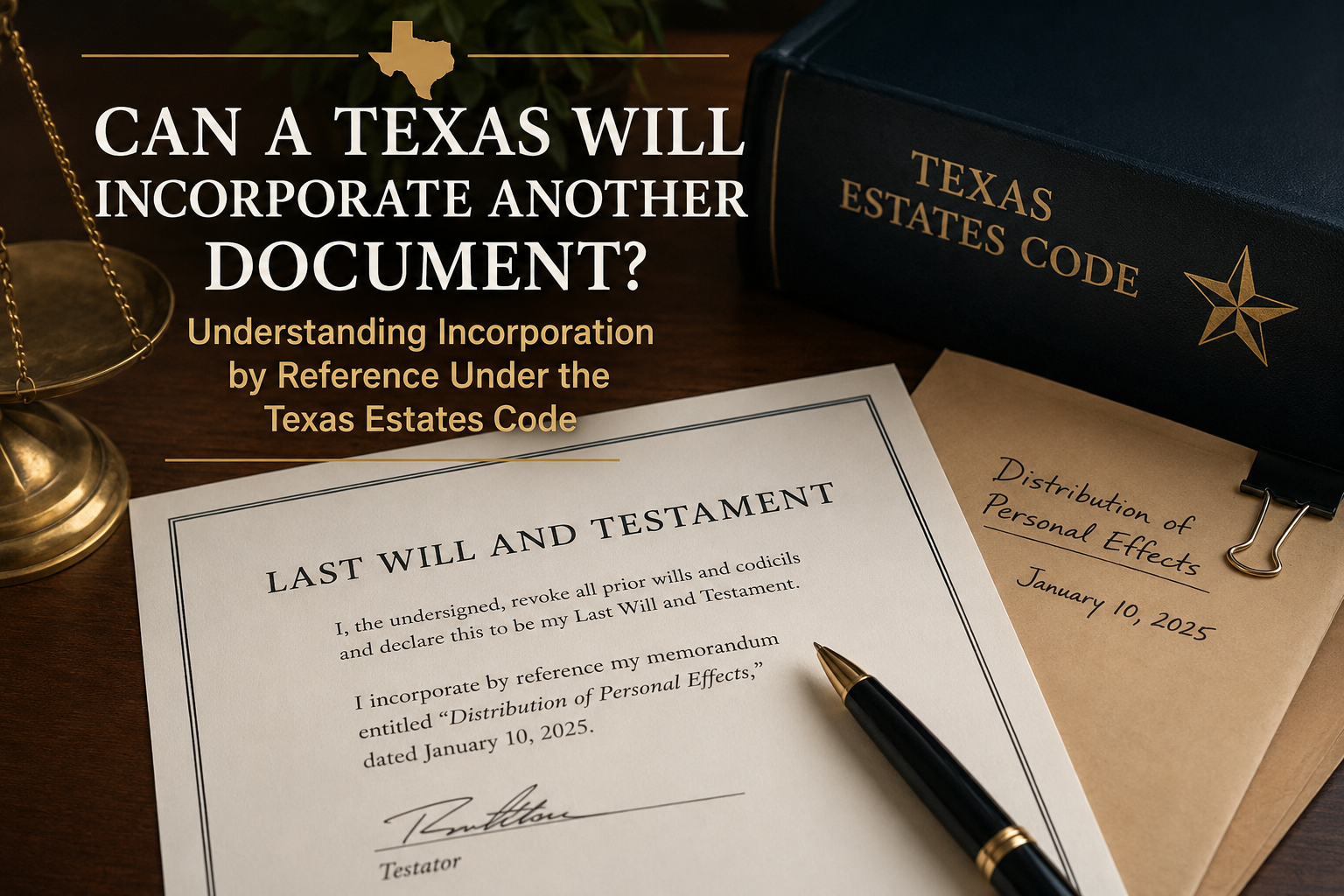
Many people assume that everything a person wants to accomplish through a will must be written directly into the will itself. Texas law, however, recognizes a lesser-known doctrine called incorporation by reference, which allows a will to legally include the terms of another document under certain circumstances.
This rule can be extremely important when a will references separate instructions, lists, agreements, or memoranda. If the legal requirements are not satisfied, the referenced document may be ignored entirely during probate.
What Is Incorporation by Reference?
Texas has codified the doctrine of incorporation by reference in the Texas Estates Code.
Texas Estates Code § 254.005 provides:
"A written statement or list referred to in a will is treated as part of the will if:
(1) the statement or list was in existence when the will was executed;
(2) the will manifests the testator's intent to incorporate the statement or list; and
(3) the will sufficiently describes the statement or list to permit its identification."
This statute creates an exception to the general rule that testamentary dispositions must comply with all will-execution formalities.
Why Does This Matter?
Suppose a will states:
"I leave certain family heirlooms to the persons identified in the memorandum entitled 'Distribution of Personal Effects,' dated January 10, 2025."
If the memorandum existed when the will was signed and is adequately identified, the memorandum may become part of the will itself.
Without incorporation by reference, the separate memorandum could be legally meaningless.
The Three Requirements
1. The Document Must Already Exist
The referenced document must exist when the will is executed.
This requirement prevents a testator from signing a valid will and then later creating entirely new testamentary instructions without complying with the formalities required for wills.
A will cannot incorporate a future document that does not yet exist.
2. The Will Must Show Intent to Incorporate
The will must clearly demonstrate that the testator intended for the outside document to become part of the will.
Merely mentioning another document may not be enough.
For example:
"I have written notes concerning my wishes."
may not show sufficient intent.
By contrast:
"I incorporate by reference my memorandum dated January 10, 2025 concerning the distribution of my personal property."
provides much stronger evidence of intent.
3. The Document Must Be Identifiable
The will must describe the document with enough specificity that the probate court can determine exactly which document is being referenced.
A vague reference such as:
"See my written instructions."
may create substantial problems.
A detailed description including dates, titles, and subject matter greatly improves enforceability.
Common Estate Planning Uses
Incorporation by reference is frequently used for:
- Personal property distribution memoranda
- Family instruction letters
- Business succession documents
- Property inventories
- Written explanations concerning family heirlooms
- Related estate-planning agreements
The doctrine can add flexibility while avoiding the need to rewrite an entire will whenever a referenced document changes—although great care must be taken because changing the referenced document may create separate legal issues.
Potential Probate Disputes
Incorporation-by-reference cases often arise when:
- Multiple versions of a document exist;
- A referenced document cannot be located;
- Family members disagree about authenticity;
- The document was created after the will was signed; or
- The will's description is ambiguous.
These disputes can significantly increase probate costs and delay estate administration.
Practical Lessons for Texans
If you are creating a will, simply mentioning another document does not automatically make that document legally effective.
To maximize the likelihood that a referenced document will be enforced:
- Ensure the document already exists before executing the will.
- Clearly state your intent to incorporate the document.
- Describe the document precisely.
- Keep the document with your estate-planning records.
- Consult an experienced probate attorney before relying on incorporation by reference.
Final Thoughts
Texas Estates Code § 254.005 recognizes that certain documents outside a will may become legally enforceable parts of the will itself. However, the statute imposes strict requirements concerning existence, intent, and identification. Failure to satisfy those requirements can result in the referenced document being disregarded entirely during probate.
For Texans engaged in estate planning, incorporation by reference is a powerful but often overlooked tool that can add flexibility to a will while still preserving the safeguards required by probate law.
At David C. Barsalou, Attorney at Law, PLLC, we help clients navigate business, family, tax, estate planning, and real estate matters ranging from document drafting to litigation with clarity and confidence. If you’d like guidance on your situation, schedule a consultation today. Call us at (713) 397-4678, email barsalou.law@gmail.com, or reach us through our Contact Page. We’re here to help you take the next step.