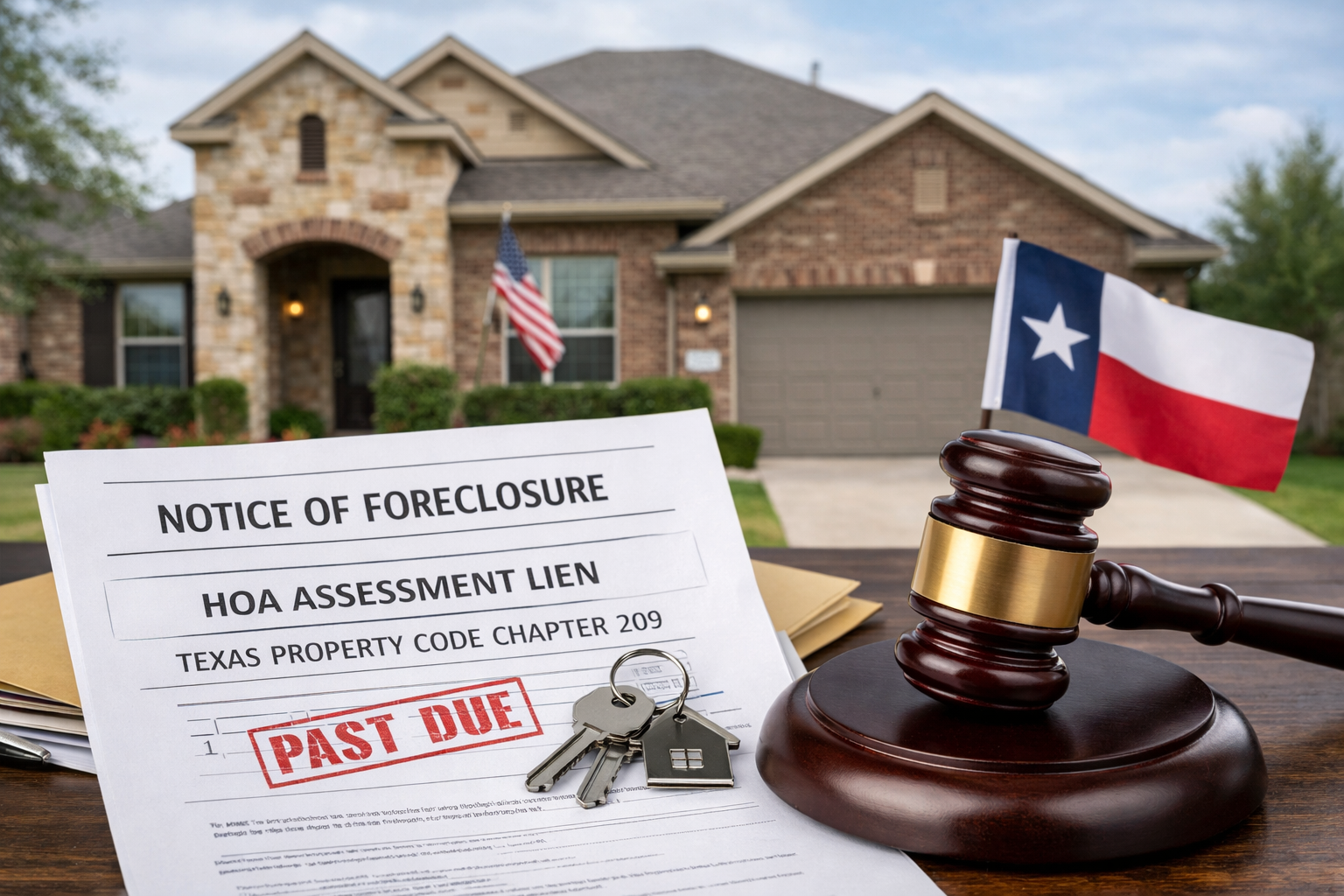
If you own property in a subdivision with a homeowners’ association (HOA), you likely pay regular assessments. But what happens if you fall behind? Can an HOA really foreclose on your home in Texas?
The short answer: yes, under certain conditions. But the process is heavily regulated, and homeowners have important statutory protections under the Texas Property Code.
1. HOA Assessment Liens Under Texas Law
In Texas, most HOAs are governed by Chapter 209 of the Texas Property Code (the Texas Residential Property Owners Protection Act).
Under Tex. Prop. Code § 209.0092(a):
“A property owners’ association may not foreclose a property owners’ association’s assessment lien unless the association has complied with this section.”
The HOA’s power to foreclose typically arises from:
- The Declaration of Covenants, Conditions, and Restrictions (CC&Rs), and
- A contractual lien securing unpaid assessments.
Unpaid dues are not just a bill—they can become a secured lien against the property.
2. Judicial vs. Nonjudicial Foreclosure
Most importantly, Texas law now requires judicial foreclosure for many residential HOA liens.
Under Tex. Prop. Code § 209.0092(b):
“A property owners’ association may not foreclose a lien on a lot owner’s property unless the association obtains a court order in an application for expedited foreclosure…”
This means:
- The HOA cannot simply post the property and sell it like a typical deed of trust foreclosure.
- A court must approve the foreclosure.
- The homeowner must receive notice and an opportunity to respond.
This is a significant protection compared to traditional mortgage foreclosures.
3. Mandatory Notices Before Foreclosure
Before filing for foreclosure, the HOA must provide specific notices.
Under Tex. Prop. Code § 209.006 and § 209.0094, the association must:
- Send written notice of delinquency.
- Offer a payment plan (in many circumstances).
- Provide notice of the right to request a hearing before the board.
- Wait required statutory time periods.
Failure to strictly comply can derail a foreclosure attempt.
4. What About Homestead Protections?
Texas has some of the strongest homestead protections in the country—but they do not automatically prevent HOA foreclosure.
Under Tex. Const. art. XVI, § 50(a), homesteads are protected from forced sale except for certain debts. One of the exceptions includes:
“the enforcement of a lien against a homestead for… an assessment for improvements or services provided by a property owners’ association.”
In other words:
HOA assessment liens are one of the constitutional exceptions to homestead protection.
So yes—an HOA can foreclose even on your homestead, if it follows statutory requirements.
5. What Can an HOA Foreclose For?
Typically:
- Unpaid regular assessments
- Special assessments
- Interest
- Late fees
- Attorney’s fees (if authorized)
Under Tex. Prop. Code § 5.006, reasonable attorney’s fees may be recoverable in actions based on restrictive covenants.
However, some fines and charges may be more legally vulnerable than basic assessments, especially if procedural requirements were not followed.
6. Can You Stop an HOA Foreclosure?
Possibly. Common defenses include:
- Improper notice
- Failure to offer a payment plan
- Accounting errors
- Unlawful fines
- Statute of limitations issues
- Failure to obtain proper judicial approval
In some cases, homeowners may seek:
- Temporary restraining orders (TROs)
- Declaratory relief
- Damages for wrongful foreclosure
Because HOA law blends contract law, property law, and statutory compliance, procedural defects can be powerful leverage.
7. Why This Matters in Texas
HOA foreclosures often start over relatively small amounts of money—but can escalate quickly once attorney’s fees and court costs are added.
In a strong property-rights state like Texas, many homeowners assume foreclosure “can’t happen” over HOA dues. That assumption can be dangerously wrong.
But the flip side is also true:
HOAs must strictly follow the Texas Property Code, and courts do not rubber-stamp foreclosure requests.
Final Thoughts
An HOA can foreclose on your home in Texas—but only if it strictly complies with:
- The governing Declaration
- Texas Property Code Chapter 209
- Constitutional homestead exceptions
- Judicial approval requirements
If you receive delinquency or foreclosure notices, do not ignore them. Early intervention often makes the difference between resolution and litigation.
At David C. Barsalou, Attorney at Law, PLLC, we help clients navigate business, family, tax, estate planning, and real estate matters ranging from document drafting to litigation with clarity and confidence. If you’d like guidance on your situation, schedule a consultation today. Call us at (713) 397-4678, email barsalou.law@gmail.com, or reach us through our Contact Page. We’re here to help you take the next step.