A child support order may have made perfect sense when it was signed.
Then life changes.
A parent loses a job. Another parent receives a substantial raise. A child begins living primarily with a different parent. Health insurance becomes more expensive. A parent becomes legally responsible for additional children. Or an order that was reasonable five years ago simply produces a very different result under today's income and circumstances.
That raises an extremely common question:
Can child support be changed in Texas?
Yes—but simply agreeing to pay a different amount usually is not enough.
Texas law provides specific grounds for modifying child support, and there is an especially important rule for parents who assume that losing a job, changing custody informally, or reaching a private agreement automatically changes what they owe.
It generally does not.
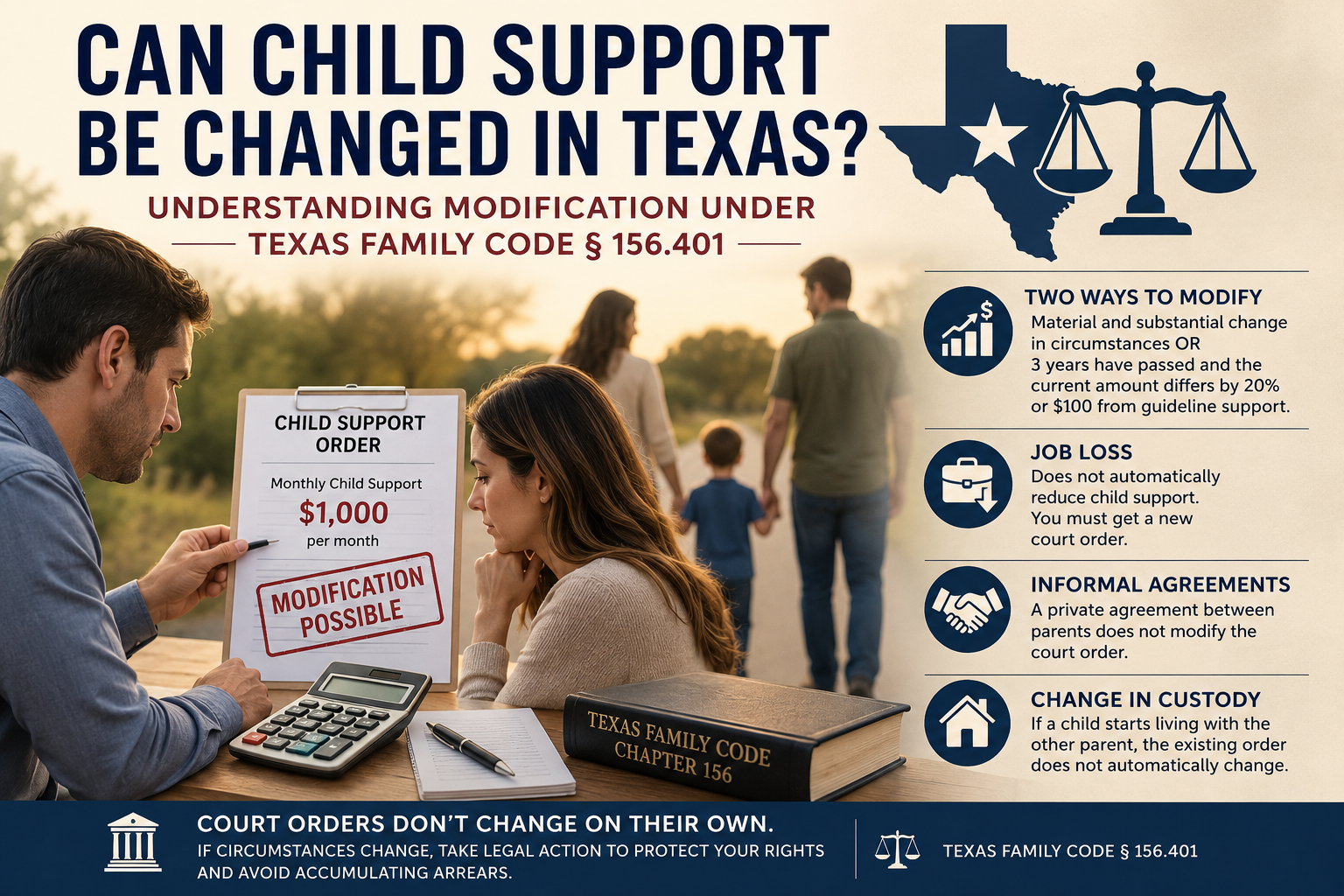
Texas Family Code § 156.401 Provides Two Major Paths to Modification
The starting point is Texas Family Code § 156.401.
The statute provides that, subject to several exceptions, a court may modify an order providing for child support if:
“the circumstances of the child or a person affected by the order have materially and substantially changed”
since the relevant prior order or settlement agreement.
But Texas law provides another route as well.
A court may also modify child support if three years have passed since the order was rendered or last modified and the existing monthly support differs by either 20 percent or $100 from the amount that would be awarded under the child support guidelines. Tex. Fam. Code § 156.401(a). (Texas Statutes)
These are important alternatives.
A parent does not necessarily have to wait three years if there has already been a material and substantial change in circumstances.
What Is a “Material and Substantial Change”?
The statute uses broad language because family circumstances can change in many different ways.
The Texas Office of the Attorney General identifies several common examples, including:
- an increase or decrease in the noncustodial parent's income;
- the noncustodial parent becoming legally responsible for additional children;
- a change in the child's medical insurance coverage; or
- the child beginning to live with a different parent. (Texas Attorney General)
Whether a particular change is sufficiently material and substantial can depend on the facts of the case.
A minor fluctuation in income is obviously different from losing a job altogether. Likewise, occasionally allowing a child to spend additional nights with the other parent is different from a child effectively moving into that parent's household.
The existing order, the circumstances when it was entered, and the circumstances today can all matter.
The Three-Year, 20-Percent-or-$100 Rule
Texas law also creates a relatively objective route to modification.
Texas Family Code § 156.401(a)(2) applies when:
- at least three years have passed since the support order was rendered or last modified; and
- the monthly support currently ordered differs from guideline support by either 20 percent or $100.
Notice the word or.
The statute does not require a difference of both $100 and20 percent. Either threshold can satisfy this portion of the statute. (Texas Statutes)
For example, suppose an existing order requires $800 per month, but applying the current guideline calculation would produce $1,000 per month.
The difference is:
That exceeds $100 and represents a 25-percent increase over the existing amount.
Assuming the other statutory requirements apply, the three-year provision could therefore provide grounds for seeking modification.
That does not necessarily mean a court will mechanically enter whatever number a parent requests. Child support remains governed by the broader provisions of the Texas Family Code.
There Is an Important Exception for Agreed Non-Guideline Support
There is a significant wrinkle that parents sometimes overlook.
Texas Family Code § 156.401(a-1) addresses orders in which the parties agreed to an amount of support that differed from the child-support guidelines.
For those orders, the statute provides that the court may modify the order only if:
“the circumstances of the child or a person affected by the order have materially and substantially changed”
since the order was rendered. (Texas Statutes)
In other words, the ordinary three-year/20-percent/$100 route does not necessarily rescue someone from a deliberately negotiated non-guideline support agreement.
That can make the wording and history of the original order extremely important.
Losing Your Job Does Not Automatically Reduce Child Support
This may be the most practically important part of the entire subject.
Suppose someone is ordered to pay $1,200 per month in child support.
He loses his job.
He may have a legitimate basis to seek modification, but his child support does not automatically become zero—or even automatically decrease—on the day his employment ends.
The Texas Attorney General expressly warns parents that losing a job or earning less does not itself change the existing obligation. Only a new order can change the court-ordered monthly amount. (Texas Attorney General)
That distinction can become enormously expensive.
A parent who loses employment in January and simply begins paying what he believes he can afford may discover months later that the original order continued accruing during that period.
The correct response to a major change in circumstances is generally to address modification promptly rather than simply treating the existing order as obsolete.
A Private Agreement Between Parents Does Not Modify the Court Order
Another common problem occurs when parents cooperate informally.
Suppose a father is ordered to pay $1,000 per month.
His hours at work are cut. The parents discuss the situation, and the mother agrees that he can pay $600 for the next year.
That agreement may seem entirely reasonable between them.
But it does not necessarily modify the existing court order.
The Texas Attorney General states plainly that informal agreements between parents do not change the court-ordered amount; modification must occur through the appropriate legal process. (Texas Attorney General)
That means a well-intentioned parent can accumulate a substantial arrearage even while making every payment the other parent verbally agreed to accept.
This is one of those situations where being cooperative is good—but formalizing the cooperation matters.
Modification Usually Does Not Erase Support That Has Already Accrued
Timing is particularly important because Texas Family Code § 156.401(b) limits how far backward a modification of the support amount can generally operate.
The statute provides that support may be modified as to obligations accruing after the earlier of:
“the date of service of citation”
or
“an appearance in the suit to modify.”
Tex. Fam. Code § 156.401(b). (Texas Statutes)
That creates a powerful practical reason not to wait.
Imagine that a parent suffers a major reduction in income but waits six months before filing anything.
Even if the circumstances ultimately justify lower support, the parent should not assume the court can simply rewrite the entire preceding six months as though the old order never existed.
Modification and forgiveness of already-accrued support are very different concepts.
What If the Parent Is Unemployed?
Unemployment can support a request for modification, but unemployment does not necessarily mean that support will be calculated using zero income.
The Attorney General explains that when a parent has no income, a court may consider factors including past employment, ability to work, and the federal minimum wage when setting modified support. (Texas Attorney General)
This becomes especially important when unemployment or underemployment is disputed.
A parent generally should not assume that voluntarily quitting a high-paying job will allow that parent to reduce support proportionately.
Texas child-support litigation can involve not merely what someone currently earns, but the circumstances surrounding that person's employment and earning capacity.
What If the Child Starts Living With the Other Parent?
This is another situation where parents can get themselves into trouble by relying exclusively on practical reality.
Suppose the mother is the custodial parent under an existing order and the father pays child support.
Several years later, the teenager moves in with the father full time.
From an ordinary person's perspective, the obvious reaction may be:
Why would he continue paying her child support when the child now lives with him?
But the existing order does not necessarily disappear merely because the family's actual living arrangement has changed.
The change in possession may provide grounds for modification—the Attorney General specifically identifies a child living with a different parent as a potentially material change—but the order still needs to be addressed legally. (Texas Attorney General)
That may involve issues beyond child support as well, including conservatorship, possession, medical support, and the right to designate the child's primary residence.
Requesting a Modification Can Also Increase Child Support
Modification is not inherently a downward process.
A parent asking for review because circumstances have changed should understand that the resulting calculation may show that support should actually increase.
The Attorney General specifically cautions that if the paying parent now earns more than when the existing order was entered, a modification review can result in increased support. (Texas Attorney General)
That is worth considering before filing a modification based merely on the assumption that an old order must be unfavorable.
The current financial information should be examined first.
How Is Child Support Actually Modified?
For cases handled through the Texas Child Support Division, the Attorney General describes two methods for changing the support amount: the Child Support Review Process (CSRP) and a court hearing. (Texas Attorney General)
A parent may also pursue a modification through a court proceeding.
The important point is that there must ultimately be legally effective action changing the existing order.
A conversation, text message, handshake, or private spreadsheet showing what the parents believe should be paid is not a substitute for modification of the order.
Do Not Simply Stop Paying Because You Think the Order Is Wrong
An old child-support order can become badly disconnected from present circumstances.
That does not make it optional.
The Attorney General explains that the court-ordered amount remains in effect until it is changed and that unpaid support continues to accumulate. (Texas Attorney General)
So if income collapses, a child moves households, insurance changes, or another major event occurs, waiting can make the eventual problem considerably worse.
The legal system does provide a mechanism for changing child support.
But the parent generally has to use it.
The Bottom Line
Yes, child support can be modified in Texas.
Texas Family Code § 156.401 generally provides two major grounds: a material and substantial change in circumstances, or—in qualifying cases—the passage of three years combined with a guideline difference of at least 20 percent or $100. (Texas Statutes)
But several traps deserve particular attention:
A job loss does not automatically reduce support. A private agreement between parents does not automatically change the order. A child moving into the other parent's home does not automatically erase the existing obligation. And waiting to seek modification can leave support accruing under an order that no longer reflects the family's actual circumstances.
When life changes substantially, the better question is therefore not merely:
“Should the child support amount be different?”
It is:
“Do I need to modify the court order now?”
For many Texas parents, the answer may be yes.
This article is for general informational purposes only and is not legal advice. Child-support modification depends on the existing order, the history of the case, the parties' circumstances, and other facts. Anyone considering modification should review the specific order and applicable Texas law.
For readers who want the state procedure, the Texas Attorney General's child-support modification guide explains the review process and eligibility requirements. The current statutory text is available through the Texas Legislature's Family Code Chapter 156.
At David C. Barsalou, Attorney at Law, PLLC, we help clients navigate business, family, tax, estate planning, and real estate matters ranging from document drafting to litigation with clarity and confidence. If you’d like guidance on your situation, schedule a consultation today. Call us at (713) 397-4678, email barsalou.law@gmail.com, or reach us through our Contact Page. We’re here to help you take the next step.