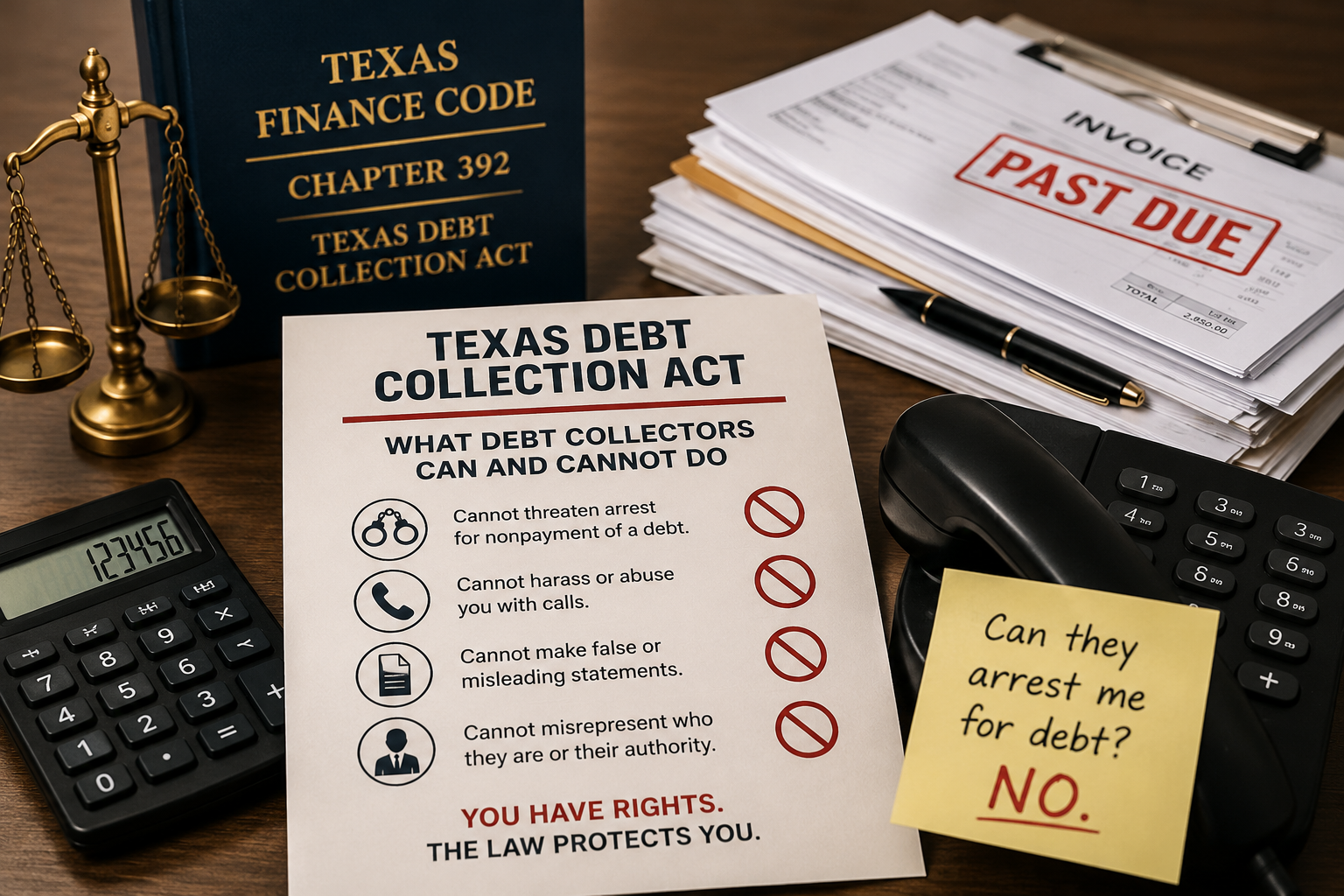
Consumers often assume that debt collectors can say almost anything in an effort to collect a debt. That is not true. Texas has its own debt collection law—the Texas Debt Collection Act ("TDCA"), found in Chapter 392 of the Texas Finance Code—that limits how debts may be collected.
Although creditors are generally entitled to pursue legitimate debts, they must do so within the bounds established by Texas law.
What Is the Texas Debt Collection Act?
The Texas Debt Collection Act regulates debt collection practices within Texas and prohibits collectors from using threats, coercion, harassment, deception, or unfair methods to collect consumer debts.
Importantly, the Act applies in many situations beyond third-party collection agencies. Depending on the circumstances, original creditors may also be subject to portions of the statute.
Threats That Are Prohibited
One of the most common misconceptions is that someone can be arrested simply because they owe money.
Texas law directly addresses this issue.
Texas Finance Code § 392.301(a)(5) provides that a debt collector may not use threats, coercion, or attempts to coerce by:
"threatening that the debtor will be arrested for nonpayment of a consumer debt without proper court proceedings."
Likewise, a collector generally cannot threaten criminal prosecution simply because someone has fallen behind on an ordinary consumer debt.
There are, of course, exceptions involving actual criminal conduct, such as fraud or issuance of bad checks under certain circumstances, but failing to pay a debt alone is generally a civil matter.
Harassment Is Also Prohibited
The statute also prohibits various forms of harassment.
For example, Texas Finance Code § 392.302 prohibits debt collectors from engaging in conduct intended to harass or abuse debtors, including repeatedly calling with the intent to harass or making repeated or continuous telephone calls with the intent to annoy, abuse, or harass.
A collector is allowed to attempt to collect a debt.
A collector is not allowed to turn that effort into intimidation or harassment.
False or Misleading Representations
Texas law also prohibits deceptive collection tactics.
Among other things, debt collectors generally may not:
- Misrepresent the amount of a debt.
- Falsely claim to be attorneys or government officials.
- Use false names or false documents.
- Misrepresent the legal consequences of failing to pay.
- State that legal action has already been taken when it has not.
These prohibitions are found throughout Texas Finance Code Chapter 392, particularly in Sections 392.304 and 392.304(a).
What If a Debt Is Actually Owed?
Many people mistakenly believe that abusive collection practices only matter if the debt is invalid.
That is incorrect.
Even when a debt is completely legitimate, collectors must still comply with Texas law while attempting to collect it.
A debtor may owe every dollar being demanded while still having legal remedies if unlawful collection tactics are used.
Can Creditors Still Sue?
Absolutely.
Nothing in the Texas Debt Collection Act prevents a creditor from filing a lawsuit on a valid debt.
If a creditor obtains a judgment, Texas law provides several lawful methods of collection, including certain judgment liens, turnover orders in appropriate cases, and other post-judgment remedies authorized by Texas law.
The Act simply requires that debt collection occur through lawful means rather than intimidation or deception.
Practical Advice
If you receive collection calls:
- Keep copies of letters, emails, and text messages.
- Save voicemail recordings.
- Write down dates and times of phone calls.
- Avoid ignoring court papers if a lawsuit is actually filed.
- Consult an attorney if you believe collection efforts have crossed the line.
Likewise, businesses attempting to collect debts should ensure that their collection practices comply with Chapter 392. Aggressive collection efforts that violate the statute can create liability separate from the underlying debt.
Conclusion
Texas strikes a balance between protecting creditors' rights and protecting consumers from abusive collection practices. The Texas Debt Collection Act does not eliminate legitimate debts, but it does require that collection efforts remain truthful, lawful, and free from threats or harassment.
Whether you are attempting to collect a debt or believe you have been subjected to unlawful collection practices, understanding Chapter 392 of the Texas Finance Code can help you protect your legal rights.
At David C. Barsalou, Attorney at Law, PLLC, we help clients navigate business, family, tax, estate planning, and real estate matters ranging from document drafting to litigation with clarity and confidence. If you’d like guidance on your situation, schedule a consultation today. Call us at (713) 397-4678, email barsalou.law@gmail.com, or reach us through our Contact Page. We’re here to help you take the next step.