When parents divorce, many assume that only the parent with primary custody may communicate with a child's school or obtain educational records. In many cases, that assumption is incorrect.
Texas law gives parents significant rights regarding their children's educational information, even after divorce. However, those rights may be modified by a court order. Understanding how the Texas Education Code interacts with your divorce decree can prevent unnecessary conflict and ensure that both parents remain informed about their child's education.
The General Rule
Section 26.004 of the Texas Education Code provides important protections for parents.
It states:
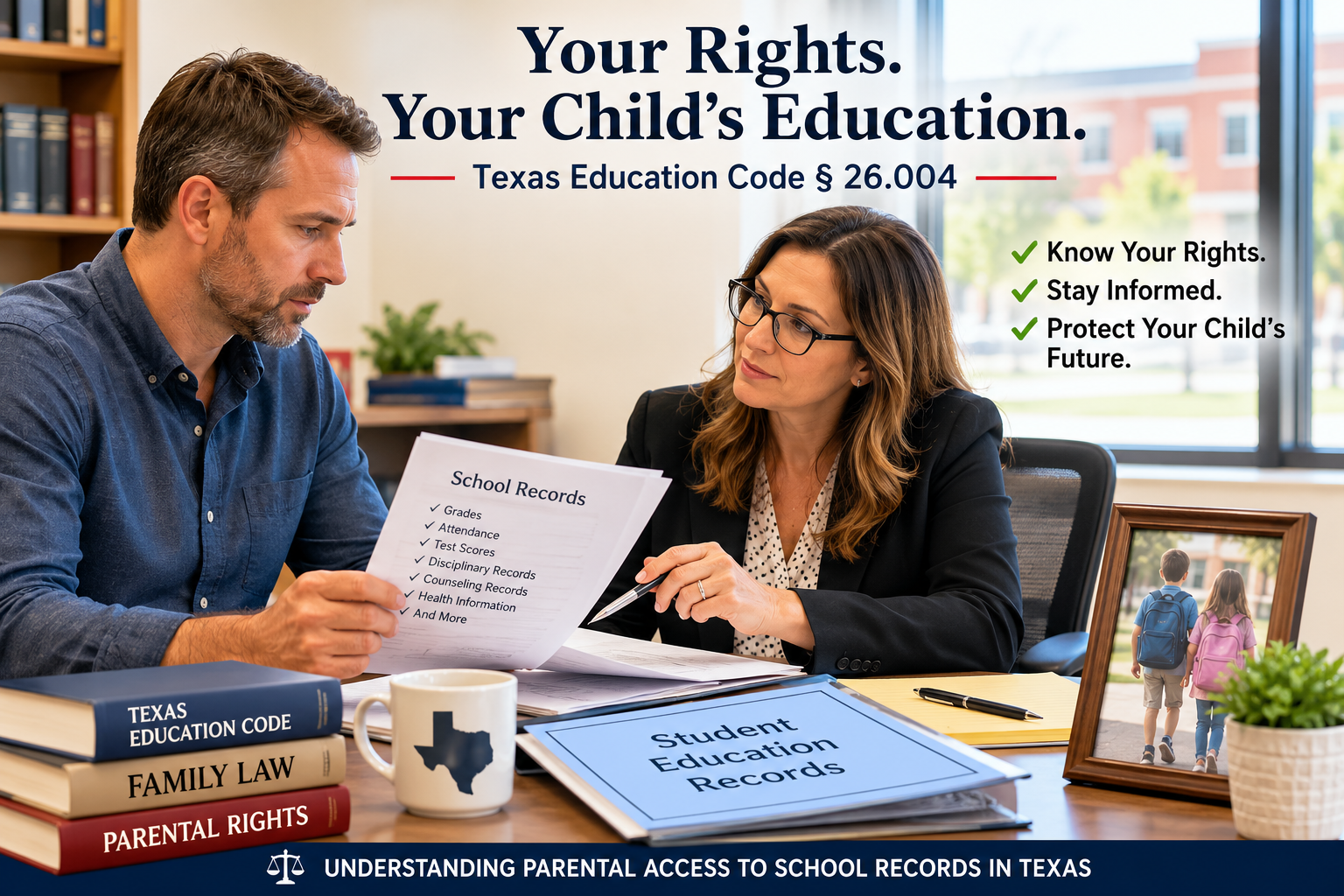
"A parent is entitled to access to all written records of a school district concerning the parent's child, including attendance records, test scores, grades, disciplinary records, counseling records, psychological records, applications for admission, health and immunization information, teacher and counselor evaluations, reports of behavioral patterns, and records relating to assistance provided for learning difficulties."
This provision establishes a broad presumption that parents may inspect virtually every educational record maintained by a Texas public school regarding their child.
More Than Just Report Cards
Many parents think school records consist only of grades and report cards.
In reality, the statute reaches much further.
Examples include:
- Attendance history
- State testing results
- Classroom grades
- Disciplinary referrals
- Suspension records
- Counseling records
- Special education documentation
- Teacher evaluations
- Health and vaccination records
- Records relating to learning disabilities
- Behavioral reports
These documents can become highly relevant in family law proceedings involving conservatorship, visitation, modification, or child support issues.
Does Divorce Automatically Remove These Rights?
No.
A divorce decree does not automatically terminate a parent's right to educational information.
Instead, the controlling question becomes whether the court has entered an order limiting those rights.
Texas family courts frequently appoint both parents as joint managing conservators, and many educational rights remain shared even when one parent has the exclusive right to determine the child's primary residence.
If no court order limits access, schools generally should provide records to either parent consistent with applicable law.
When Can Schools Restrict Access?
The Texas Education Code also recognizes that court orders control.
Section 26.004 further provides:
**"The board of trustees shall limit or deny access to a parent as specified by a court order."
Accordingly, if a divorce decree, protective order, termination order, or other court order expressly restricts a parent's access to educational records, the school district must comply with that order.
Schools generally are not authorized to decide custody disputes on their own—they follow the court's orders.
Educational Rights Are Different from Decision-Making Authority
Parents often confuse two separate concepts:
- Access to information
- Authority to make decisions
A parent may have the legal right to inspect school records while lacking the exclusive authority to:
- Change schools
- Approve special education services
- Consent to certain educational programs
- Make other educational decisions assigned by a divorce decree
Simply having access to records does not necessarily give a parent decision-making authority.
Federal Law Also Plays a Role
Federal law—primarily the Family Educational Rights and Privacy Act (FERPA)—generally protects parents' access to their children's educational records as well.
Texas schools routinely comply with both FERPA and the Texas Education Code. In most situations, the two laws work together rather than conflict.
Common Problems That Arise
Family law attorneys frequently encounter disputes such as:
- One parent tells the school not to communicate with the other parent.
- A parent claims sole custody means exclusive access to records.
- Schools misunderstand the divorce decree.
- Parents disagree about who may attend conferences.
- One parent refuses to share report cards or disciplinary notices.
Many of these disputes can be resolved simply by carefully reviewing both the divorce decree and the applicable provisions of the Texas Education Code.
Practical Advice
If you are divorced or involved in a custody dispute:
- Keep a copy of your final order available.
- Provide the school with any relevant court orders.
- Communicate professionally with school personnel.
- Do not assume the other parent has lost educational rights simply because they are not the primary conservator.
- If the school refuses access, determine whether the refusal is based on a court order or a misunderstanding of the law.
When You Should Speak With an Attorney
Disputes over educational records often arise alongside broader custody disagreements. If your child's school is refusing access, or if the other parent is interfering with your rights, it may be time to review your court orders with an attorney.
A family law attorney can determine whether the school is properly following the Texas Education Code and whether modification or enforcement proceedings may be appropriate.
Need Help With a Texas Family Law Matter?
Whether you are dealing with conservatorship issues, enforcement of a divorce decree, custody modifications, or disputes involving your child's education, David C. Barsalou, Attorney at Law PLLC assists clients throughout Texas with practical, results-oriented legal representation.
Contact us today to schedule a consultation and discuss your case.
At David C. Barsalou, Attorney at Law, PLLC, we help clients navigate business, family, tax, estate planning, and real estate matters ranging from document drafting to litigation with clarity and confidence. If you’d like guidance on your situation, schedule a consultation today. Call us at (713) 397-4678, email barsalou.law@gmail.com, or reach us through our Contact Page. We’re here to help you take the next step.
