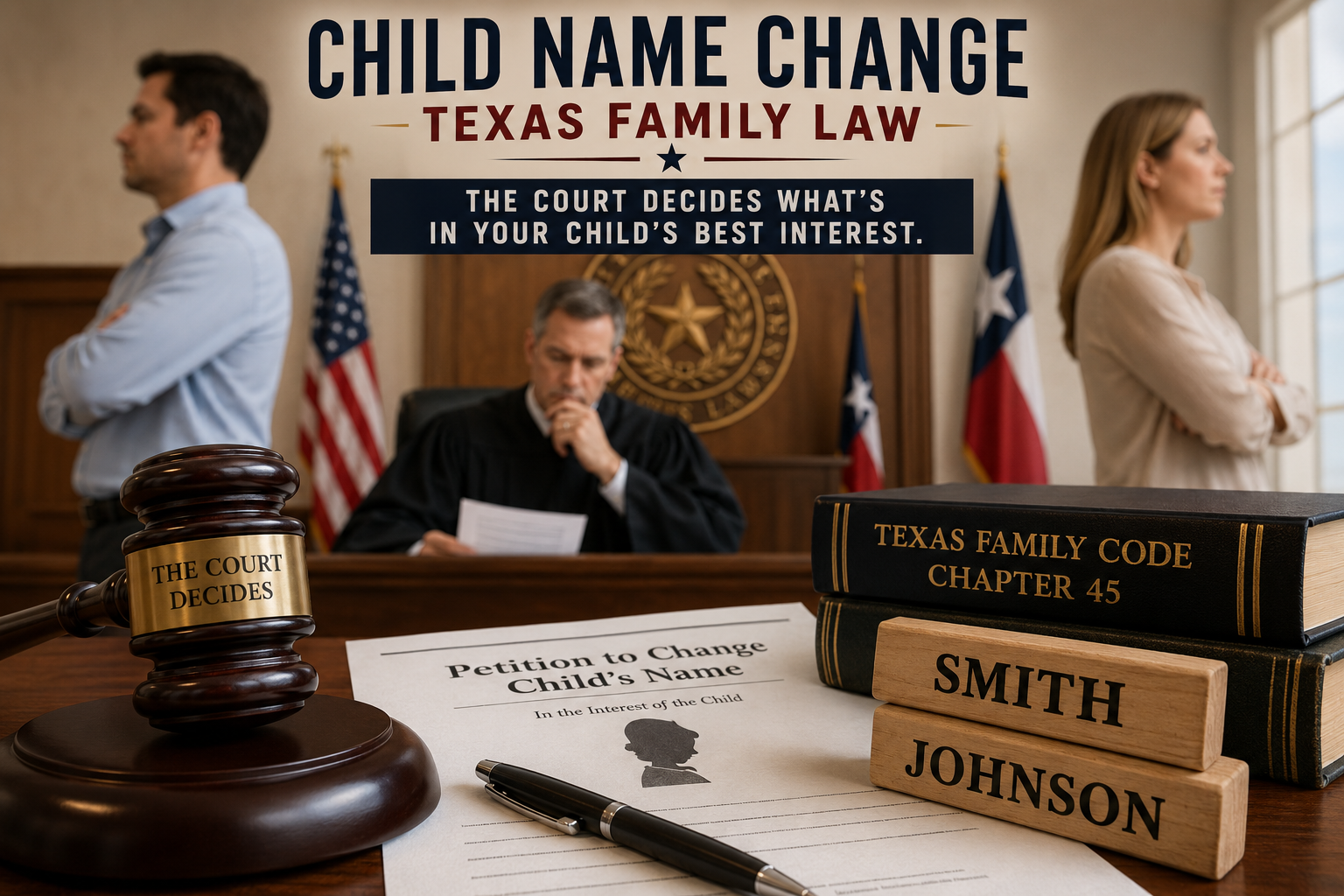
Parents often assume that if they have primary custody of their child, they can simply change the child's last name whenever they wish. That is not how Texas law works.
Whether after a divorce, following the establishment of paternity, or years after a custody order, changing a child's legal name usually requires court approval. In many situations, the other parent must be notified and given an opportunity to object.
Understanding how Texas courts approach child name changes can save families significant time, expense, and frustration.
Texas Courts Focus on the Child's Best Interest
Texas courts do not change a child's name simply because one parent wants it.
Instead, judges evaluate whether the requested name change serves the child's best interest.
This is consistent with the overall philosophy of the Texas Family Code, which repeatedly places the child's welfare above the preferences of either parent.
What Does the Texas Family Code Say?
Texas Family Code § 45.004 provides:
"The court may order the name of a child changed if the change is in the interest or to the benefit of the child."
Notice what the statute does not say.
It does not state that the parent with primary custody gets to decide.
It does not say the child automatically receives the mother's surname after divorce.
It does not say the child automatically receives the father's surname.
Everything comes back to one question:
Is the change in the child's best interest?
Does the Other Parent Have to Agree?
Not necessarily.
However, the other parent is generally entitled to notice of the proceeding and may appear in court to oppose the requested name change.
If the parents disagree, the judge—not the parents—makes the final decision.
What Factors Might a Court Consider?
Texas courts have considered numerous factors when deciding whether a name change benefits a child, including:
- The strength of the child's relationship with each parent.
- The length of time the child has used the current name.
- Whether the child identifies with the existing surname.
- Potential embarrassment or confusion.
- Whether the proposed name promotes stability.
- The child's own wishes, depending upon age and maturity.
No single factor automatically controls the outcome.
When Courts May Be More Likely to Grant a Name Change
Although every case is different, courts are generally more receptive when:
- The other parent has had little or no involvement in the child's life.
- The child has consistently used another surname for many years.
- The proposed change avoids confusion in school or medical records.
- The change strengthens the child's family identity.
- There is evidence the child wants the change.
Again, the focus remains on the child's welfare—not on rewarding or punishing either parent.
Simply Remarrying Is Not Enough
One common misconception is that remarriage automatically justifies changing a child's surname to match a stepparent.
Texas courts do not automatically approve a name change for this reason alone.
A judge still must determine whether the change actually benefits the child.
Can a Teenager Request a Name Change?
Yes.
As children grow older, courts may give greater weight to their own preferences.
An older child's desire to use a particular surname can become an important consideration, although it is not necessarily controlling.
Name Changes Are Different From Adoption
Many people confuse a name change with an adoption.
A name change affects only the child's legal name.
It does not terminate parental rights.
It does not eliminate child support obligations.
It does not change conservatorship or possession rights.
Those are entirely separate legal proceedings.
Why Legal Advice Matters
Even though a name change may appear straightforward, disputes between parents can quickly become emotionally charged.
Proper notice, appropriate pleadings, and persuasive evidence regarding the child's best interest can significantly affect the outcome.
An experienced Texas family law attorney can help evaluate whether a name change is likely to be granted and guide parents through the required court process.
Contact a Texas Family Law Attorney
If you are considering changing your child's legal name—or if you have been served with a petition seeking to change your child's name—it is important to understand your rights under Texas law.
At David C. Barsalou, Attorney at Law, PLLC, I represent clients throughout Texas in divorce, conservatorship, child support, and other family law matters. If you have questions about your family's situation, contact my office to schedule a consultation.
At David C. Barsalou, Attorney at Law, PLLC, we help clients navigate business, family, tax, estate planning, and real estate matters ranging from document drafting to litigation with clarity and confidence. If you’d like guidance on your situation, schedule a consultation today. Call us at (713) 397-4678, email barsalou.law@gmail.com, or reach us through our Contact Page. We’re here to help you take the next step.