Divorced and separated parents frequently disagree about what happens when a child is staying with the other parent.
One parent may object to the child's bedtime, meals, discipline, activities, babysitters, church attendance, haircut, medical care, or countless other day-to-day decisions. This can lead to an important question:
When a child is in your possession under a Texas custody order, what decisions are you actually allowed to make?
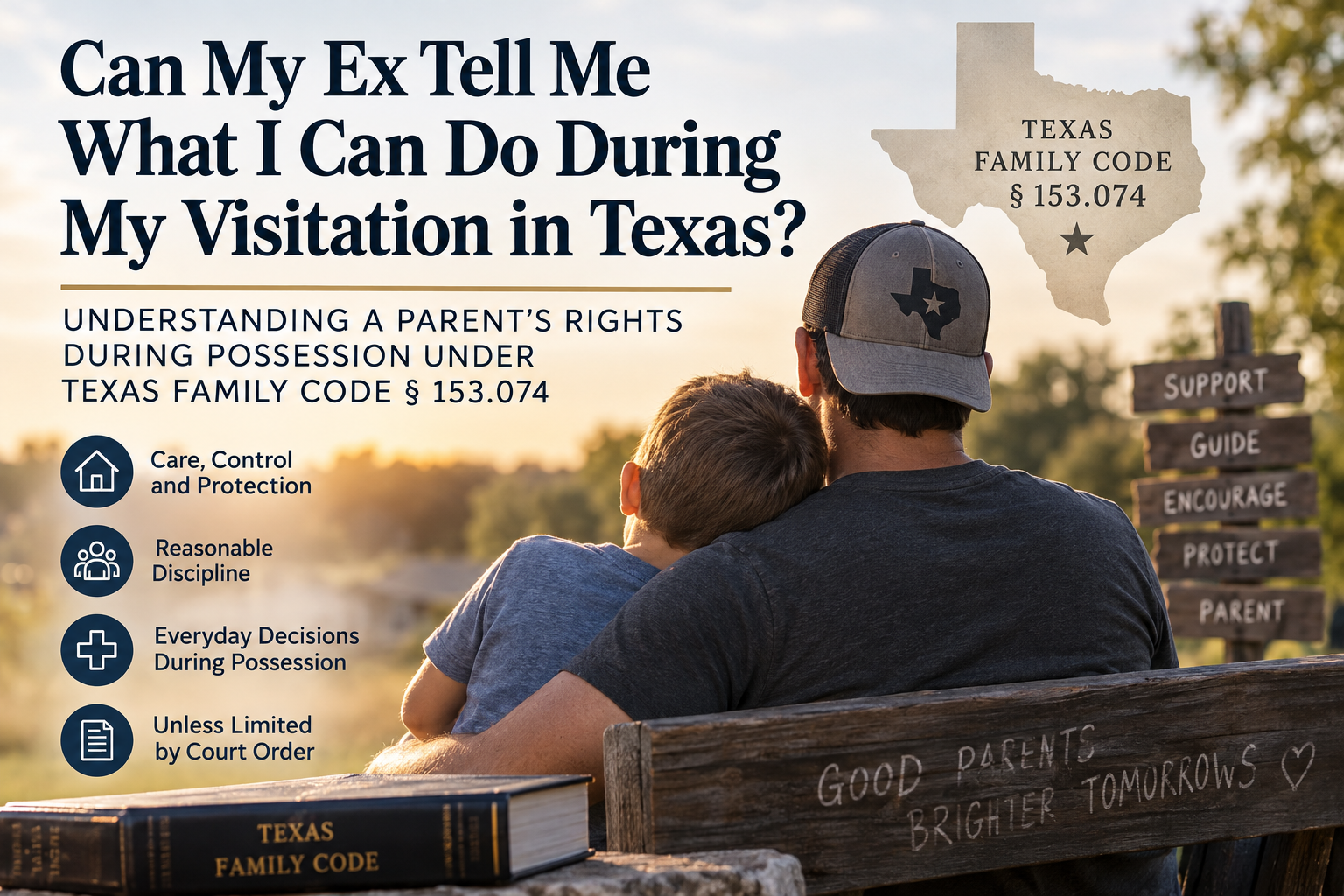
Texas law gives a parent appointed as a conservator certain rights and duties while that parent has possession of the child. Many of those rights are found in Texas Family Code § 153.074.
The answer, however, depends on both the Family Code and the specific language of the court order.
Texas Parents Have Rights and Duties During Their Periods of Possession
Texas Family Code § 153.074 begins with an important qualification:
“Unless limited by court order, a parent appointed as a conservator of a child has the following rights and duties during the period that the parent has possession of the child.”
That introductory language matters.
A possession schedule does more than determine where the child sleeps on a particular weekend. During a parent's period of possession, Texas law generally gives that parent authority to handle many of the ordinary responsibilities involved in actually caring for a child.
Section 153.074 includes, among other things, the:
“duty of care, control, protection, and reasonable discipline of the child.”
It also imposes a duty to support the child during the parent's possession, including providing necessities such as food, clothing, and shelter.
In practical terms, a parent generally does not become a mere babysitter simply because the other parent has the exclusive right to make certain major decisions.
Can the Other Parent Control Your Household During Visitation?
Usually, not completely.
Texas custody orders frequently allocate major parental rights between the conservators. One parent may have the exclusive right to designate the child's primary residence, for example. Rights concerning education, psychiatric treatment, invasive medical procedures, and other significant matters may likewise be allocated exclusively, independently, or jointly.
But those allocations should not be confused with every ordinary decision made while caring for a child.
If a child spends the weekend with a parent, someone necessarily has to decide ordinary matters such as what the child eats, when the child goes to bed, what recreational activities the child participates in, and how reasonable discipline is administered.
Section 153.074 recognizes that reality.
The other parent does not ordinarily acquire a general statutory right to supervise every minute of the other household merely because that parent is the primary conservator.
What About Medical and Dental Care?
This is where the distinction between routine care, emergency care, and major medical decisions becomes particularly important.
Texas custody orders can allocate medical decision-making rights in different ways. Accordingly, a parent should never assume that physical possession of the child gives unlimited authority to make every medical decision.
The Family Code separately identifies rights that parents may possess at all times, including access to medical, dental, psychological, and educational records and, unless otherwise limited, the ability to consent to treatment in an emergency involving an immediate danger to the child's health and safety.
The actual decree or custody order therefore matters enormously.
A parent dealing with a significant medical decision should read the order itself rather than relying on the assumption that “the child is with me, so I decide.”
Can a Parent Discipline a Child During Visitation?
Texas Family Code § 153.074 expressly refers to “reasonable discipline.”
That does not mean a custody order creates unlimited authority to discipline a child however a parent wishes. Abuse, neglect, family violence, endangerment, and conduct inconsistent with other provisions of Texas law are obviously different matters.
But the statute recognizes something more mundane: a parent who has possession of a child ordinarily needs authority to maintain reasonable rules and discipline within that parent's household.
This can become important in high-conflict custody situations where one parent attempts to dictate the minutiae of the other parent's parenting.
Texas law does not necessarily require two divorced parents to operate their homes identically.
What If the Parents Have Different Rules?
This is one of the practical realities of shared parenting.
A child may have an 8:30 p.m. bedtime at one house and a 9:00 p.m. bedtime at the other. One parent may permit more television. The other may require more chores. One household may eat differently or organize weekends differently.
Parents can certainly cooperate and establish consistent rules when doing so benefits the child. But disagreement alone does not necessarily create a violation of the custody order.
The important legal question is usually not:
“Does the other parent approve of this?”
It is:
“Who has the legal right to make this particular decision under the Family Code and the court's order?”
Those are very different questions.
The Court Order Can Change the Default Rules
Perhaps the most important words in § 153.074 are the first four:
“Unless limited by court order.”
A Texas family court can impose restrictions that materially alter what would otherwise be ordinary parental authority.
For example, an order may contain restrictions concerning possession, supervision, alcohol or drug use, particular individuals, travel, communications, medical decisions, or other matters based on the circumstances of the case.
Consequently, a general statement about the Family Code can never substitute for reading the actual custody order.
Two parents living in the same county with superficially similar possession schedules may have materially different legal rights because their orders contain different provisions.
Major Decisions Are Different From Day-to-Day Parenting
A useful way to understand Texas conservatorship law is to distinguish possession of the child from allocation of decision-making rights.
Having the child for the weekend does not necessarily mean a parent can unilaterally change the child's school, authorize major nonemergency medical treatment, or make another decision that the decree assigns exclusively or jointly.
At the same time, giving one parent an important exclusive right does not ordinarily transform the other parent into someone who must obtain permission for every ordinary act of parenting.
That distinction is one reason Texas custody orders can be lengthy. They do not simply establish a calendar. They allocate rights, duties, possession, access, and decision-making authority.
What If Your Ex Keeps Interfering With Your Parenting Time?
The first step is usually to read the order carefully.
Determine whether the disputed issue is actually addressed by the decree. If the order gives one parent an exclusive right, that provision may resolve the question. If the issue concerns ordinary care and control during a parent's possession, § 153.074 may be relevant.
The exact wording matters.
Repeated interference can sometimes lead to enforcement proceedings or, depending on the circumstances, contribute to a later request for modification. But ordinary disagreements about parenting styles should not automatically be confused with enforceable violations of a court order.
A court generally enforces what its order actually says—not what one parent wishes the order said.
Texas Custody Orders Govern More Than the Visitation Calendar
Parents understandably tend to focus on when they get the child.
But a Texas custody order also answers another important question: what can each parent do once the child is with them?
Texas Family Code § 153.074 recognizes that a parent in possession generally has real responsibilities and authority, including the duty of care, control, protection, and reasonable discipline, unless the court has limited those rights.
The practical lesson is straightforward:
Your ex does not necessarily control your household simply because you share a child—but possession does not give you unlimited authority either.
The Family Code establishes the framework. The custody order establishes the rules that apply to the particular family.
If a disagreement concerns medical care, education, discipline, travel, possession, or another significant parenting decision, reviewing the actual court order is often the best place to begin.
At David C. Barsalou, Attorney at Law, PLLC, we help clients navigate business, family, tax, estate planning, and real estate matters ranging from document drafting to litigation with clarity and confidence. If you’d like guidance on your situation, schedule a consultation today. Call us at (713) 397-4678, email barsalou.law@gmail.com, or reach us through our Contact Page. We’re here to help you take the next step.
