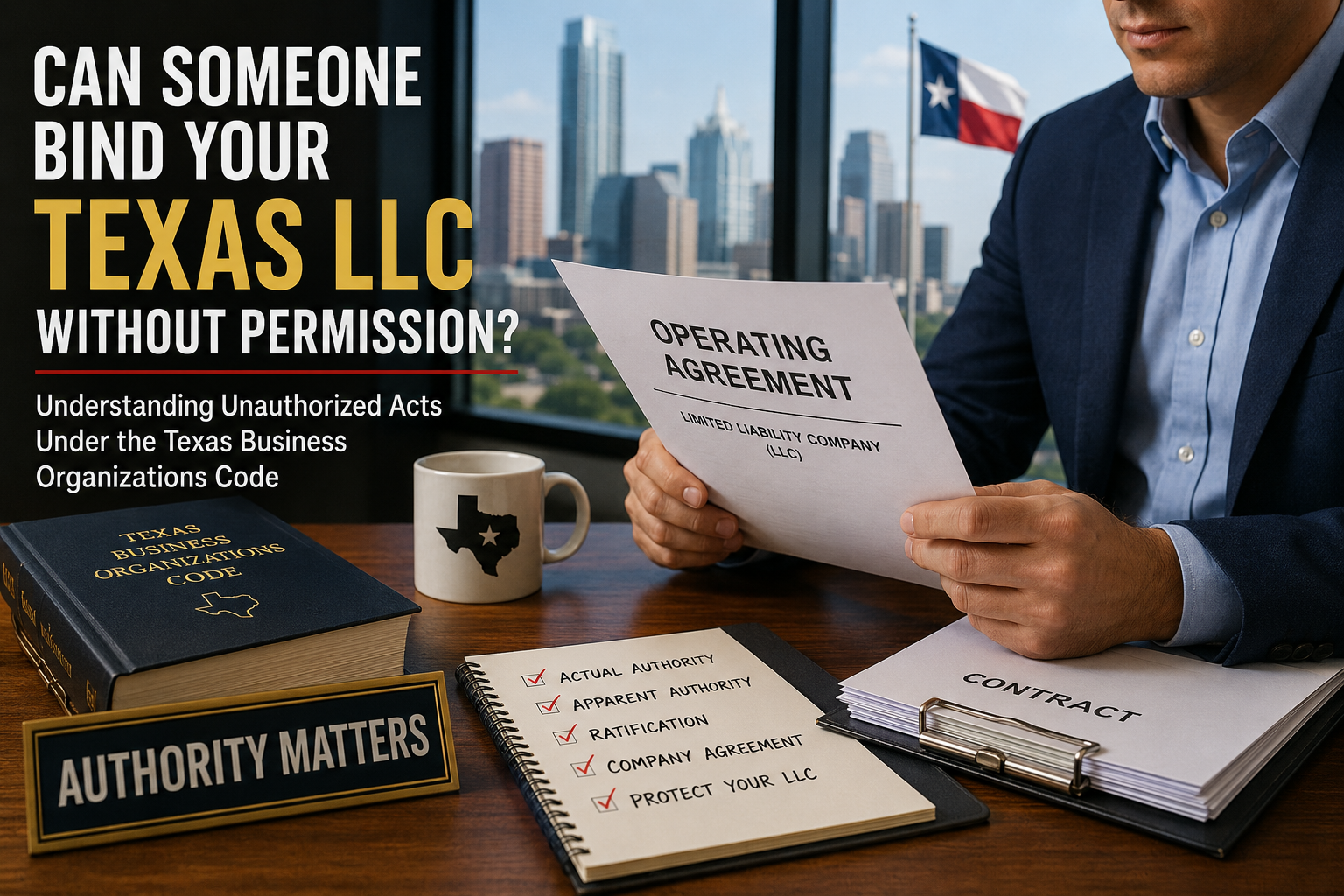
One of the biggest misconceptions among Texas business owners is that every owner automatically has unlimited authority to sign contracts on behalf of the company. In reality, the answer depends on how the company is structured, who has authority under the governing documents, and whether third parties were entitled to rely upon that person's actions.
This issue becomes particularly important when a disgruntled member signs a contract, an employee claims authority they never had, or one manager acts without obtaining the approvals required by the company agreement.
The Texas Business Organizations Code contains several provisions governing management authority, and understanding them can save businesses from expensive litigation.
Authority Depends on How the LLC Is Managed
Texas LLCs are generally organized as either:
- Member-managed LLCs
- Manager-managed LLCs
The Certificate of Formation and Company Agreement usually determine who has authority to manage the company.
Many business owners mistakenly assume that owning part of an LLC automatically allows them to bind the company. That is often incorrect.
The Texas Business Organizations Code
Texas Business Organizations Code § 101.254 provides:
"Except as otherwise provided by this code or the company agreement, each governing person of a limited liability company has the rights, powers, and authority granted under this code and the company agreement."
This seemingly simple provision has enormous practical consequences.
It means that authority comes from:
- the Business Organizations Code,
- the Certificate of Formation,
- the Company Agreement, and
- any other applicable governing documents.
Not every member necessarily has authority to enter contracts on behalf of the company.
Actual Authority vs. Apparent Authority
Even when someone lacks actual authority under the LLC's governing documents, disputes often arise over apparent authority.
Actual authority exists when the company has actually granted someone authority.
Apparent authority exists when the company's conduct reasonably causes a third party to believe someone has authority.
For example:
- A company allows one member to negotiate every contract for years.
- Vendors always communicate with that individual.
- That individual signs another contract.
Even if internal approval procedures were skipped, litigation may focus on whether the vendor reasonably relied upon that person's apparent authority.
Internal Violations Don't Always Protect the Company
Many owners believe that violating the Company Agreement automatically voids a transaction.
Not necessarily.
A contract may still be enforceable against the company depending upon:
- the authority granted to the individual,
- what the third party knew,
- whether the company previously permitted similar conduct,
- whether the company later accepted the benefits of the transaction, and
- other equitable doctrines recognized by Texas courts.
Corporate governance problems often become evidence issues rather than purely contractual issues.
Ratification Can Change Everything
Suppose a manager signs a contract without authority.
Later, the LLC:
- accepts payment,
- performs under the agreement,
- keeps the benefits, or
- expressly approves the transaction.
The company may have effectively ratified the unauthorized act.
Businesses frequently ratify transactions without realizing they have done so.
Why Company Agreements Matter
One of the greatest strengths of the Texas LLC statute is its flexibility.
A carefully drafted Company Agreement can specify:
- who may sign contracts;
- spending limits;
- approval thresholds;
- voting requirements;
- emergency authority;
- borrowing restrictions;
- real estate purchase requirements;
- admission of new members; and
- procedures for resolving internal disputes.
Without clear governance provisions, expensive litigation can arise over who actually possessed authority.
Common Litigation Scenario
Imagine three equal members own an LLC.
One member signs a five-year commercial lease without consulting the other two.
The landlord argues:
- the signer appeared to have authority,
- previous leases were signed the same way,
- the company moved into the building,
- rent was paid for several months.
The remaining members argue:
- unanimous approval was required,
- the Company Agreement prohibited unilateral action,
- the signer exceeded his authority.
Whether the LLC is bound may depend on far more than simply reading the Company Agreement.
Practical Tips for Texas Businesses
Business owners should consider:
- Maintaining a thorough Company Agreement.
- Clearly identifying who has signing authority.
- Documenting major approvals in written resolutions.
- Keeping governance records organized.
- Promptly objecting to unauthorized transactions.
- Consulting counsel before attempting to unwind questionable agreements.
Many authority disputes could have been avoided with a few well-drafted governance documents.
Conclusion
Unauthorized acts are one of the most common sources of internal LLC disputes. Although Texas law gives LLCs tremendous flexibility, that flexibility also requires careful governance. Whether a company is bound by a contract often depends upon the interaction between the Texas Business Organizations Code, the company's governing documents, and the conduct of both the company and the third party.
If you own or manage a Texas LLC and have questions regarding business governance, contract authority, operating agreements, or commercial disputes, consulting an experienced Texas business attorney before problems escalate can save substantial time and expense.
At David C. Barsalou, Attorney at Law, PLLC, we help clients navigate business, family, tax, estate planning, and real estate matters ranging from document drafting to litigation with clarity and confidence. If you’d like guidance on your situation, schedule a consultation today. Call us at (713) 397-4678, email barsalou.law@gmail.com, or reach us through our Contact Page. We’re here to help you take the next step.