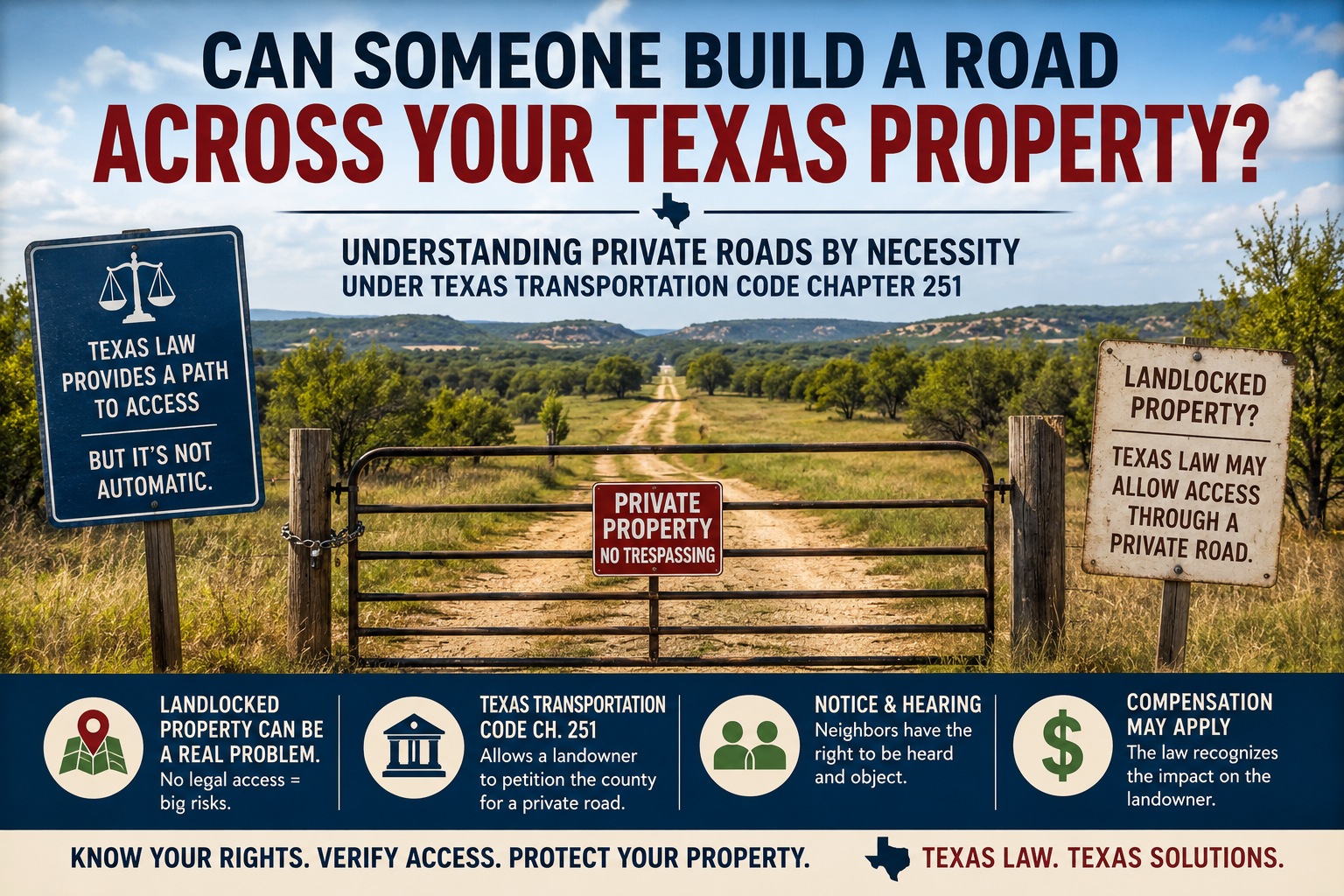
Sometimes Landlocked Property Creates Strange Legal Problems
Most Texans assume that if they own land, they can simply drive to it. Surprisingly, that is not always true. Occasionally, parcels become completely surrounded by neighboring property with no legal access to a public road. These "landlocked" properties raise one of Texas real estate law's more unusual questions:
Can a court force another landowner to allow a private road across their property?
The answer, in limited circumstances, is yes.
Texas law contains a little-known statutory procedure allowing certain landowners to seek the establishment of a private road when no practical access exists. Although these disputes are relatively uncommon, they can significantly affect property values, development potential, ranch operations, and real estate transactions.
The Statutory Authority
Texas has enacted a procedure governing certain applications for private roads.
Texas Transportation Code § 251.053 provides:
"A person who owns real property that has no public road access may apply to the commissioners court for establishment of a public access road."
The surrounding provisions of Texas Transportation Code Chapter 251 establish procedures for notice, hearings, damages, and the creation of access in qualifying circumstances.
Unlike ordinary easement litigation filed in district court, these proceedings involve the county commissioners court acting under statutory authority.
This Is Not the Same Thing as an Easement by Necessity
Many people confuse statutory private roads with common-law easements.
An easement by necessity generally arises when:
- one tract is divided,
- one parcel becomes landlocked,
- unity of ownership previously existed, and
- the access is reasonably necessary.
A statutory private road is different.
Instead of relying solely upon common-law property doctrines, the landowner seeks relief through a statutory procedure established by the Legislature.
Although both doctrines deal with access, they arise from different legal principles.
Why Would Property Become Landlocked?
Several situations create access problems.
Examples include:
- old ranch subdivisions;
- inherited family property;
- surveying mistakes;
- historic conveyances;
- omitted easements;
- boundary adjustments;
- abandoned roadways.
Sometimes the property has physical access but no legal access, which can make financing or selling the property extremely difficult.
The County Does Not Automatically Give You a Road
Many property owners assume that if their land lacks access, the county must provide one.
That is not how the law works.
The applicant generally must demonstrate that statutory requirements are satisfied. Neighboring landowners receive notice and have an opportunity to object.
The commissioners court may consider issues including:
- necessity;
- location;
- damages;
- impact upon neighboring property;
- practical alternatives.
These proceedings can become highly contested.
Compensation Matters
Texas law generally recognizes that forcing a roadway across another person's land affects valuable property rights.
For that reason, statutory procedures contemplate compensation when appropriate.
The precise measure of damages depends upon the facts and the governing statutory provisions.
Why Buyers Should Investigate Access Before Closing
One of the most important lessons is preventive rather than reactive.
Before purchasing rural property, buyers should verify:
- recorded easements;
- legal ingress and egress;
- title commitments;
- survey exceptions;
- county road status;
- physical versus legal access.
A beautiful piece of land may be worth substantially less if reaching it requires litigation.
Common Misconceptions
"I can simply drive across my neighbor's property."
Usually not.
Trespassing does not create legal access.
"If I've always used the road, I own it."
Not necessarily.
Long-term use may implicate other legal doctrines, but mere use does not automatically establish ownership or a permanent easement.
"The county must fix the problem."
Not automatically.
The statutory process is limited and fact-specific.
Practical Advice
Access disputes frequently involve overlapping legal issues, including:
- easements;
- title examination;
- adverse possession claims;
- boundary disputes;
- partition actions;
- quiet title litigation;
- deed interpretation.
Because multiple doctrines may apply simultaneously, resolving these disputes often requires a careful review of historical deeds, surveys, plats, and county records before deciding on a legal strategy.
Final Thoughts
Landlocked property presents one of the more unusual corners of Texas real estate law. While Texas provides statutory procedures that may allow access in appropriate circumstances, obtaining a private road is far from automatic. Careful title review before purchasing property is often the best way to avoid expensive litigation later.
If you own property without legal access—or if a neighboring landowner is seeking to establish a roadway across your land—obtaining legal advice early can help protect your property rights and identify the most effective path forward.
At David C. Barsalou, Attorney at Law, PLLC, we help clients navigate business, family, tax, estate planning, and real estate matters ranging from document drafting to litigation with clarity and confidence. If you’d like guidance on your situation, schedule a consultation today. Call us at (713) 397-4678, email barsalou.law@gmail.com, or reach us through our Contact Page. We’re here to help you take the next step.