Imagine buying a large tract of rural Texas land. The property is fenced. There is no public road running through it. You reasonably assume that, absent an easement or some other legal right, you can decide who enters your property.
Then someone contacts you and explains that an old family cemetery sits in the middle of your land—and that they want to cross your property to visit it.
Can you simply say no?
Under Texas law, the answer may be no.
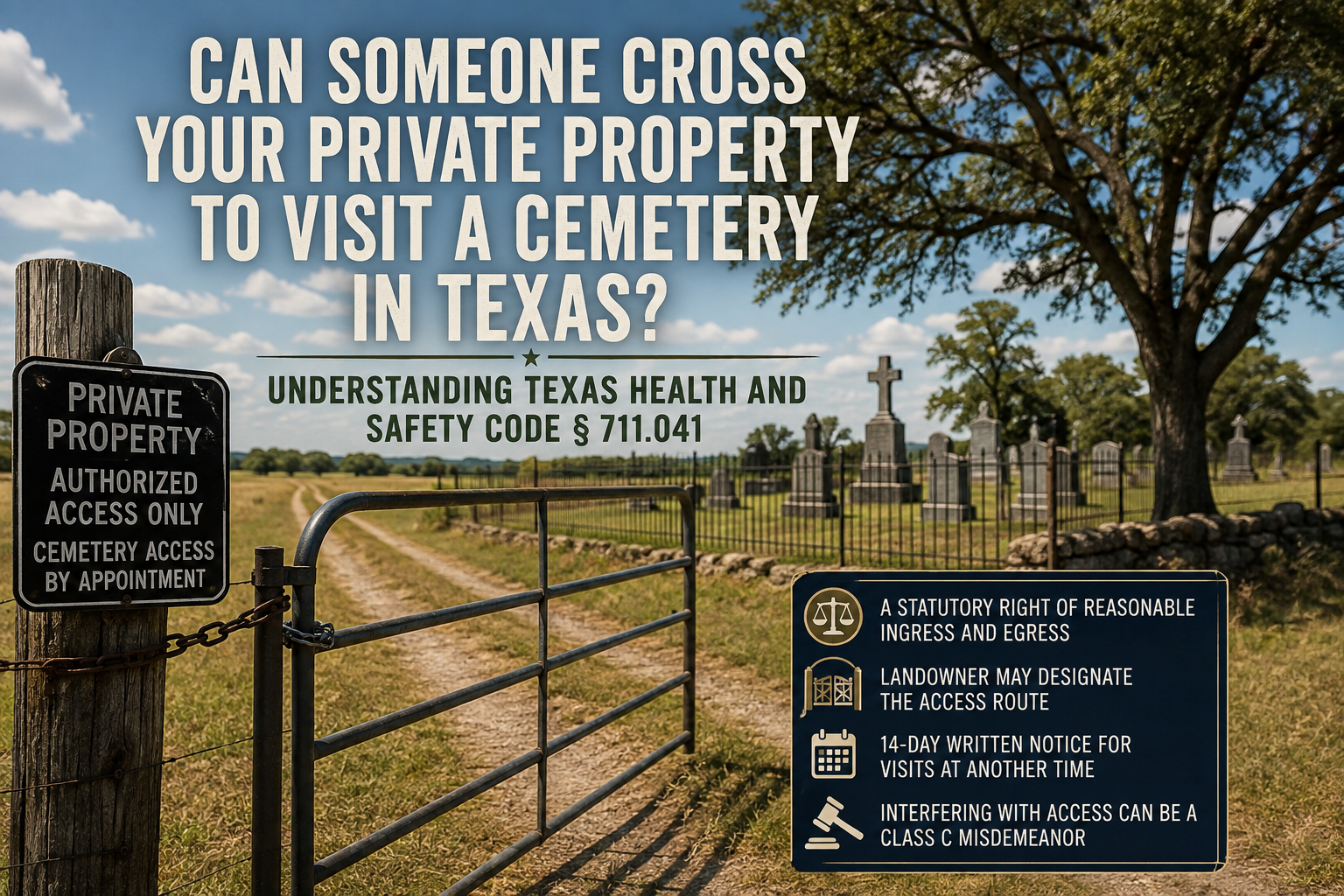
Texas Health and Safety Code Chapter 711 contains a surprisingly specific statutory right allowing people to obtain reasonable access to certain cemeteries and private burial grounds that cannot otherwise be reached from a public route.
For Texas landowners, buyers, heirs, and families with relatives buried on private property, this obscure provision can create an unusual collision between private property rights and cemetery access rights.
Texas Law Recognizes a Right of Access to Certain Cemeteries
Texas Health and Safety Code § 711.041 addresses cemeteries or private burial grounds for which no public ingress or egress is available.
The statute provides:
“Any person who wishes to visit a cemetery or private burial grounds for which no public ingress or egress is available shall have the right to reasonable ingress and egress for the purpose of visiting the cemetery or private burial grounds.”
That language is broader than many property owners might expect.
The statute does not merely regulate a cemetery operator. It addresses situations in which a cemetery or private burial ground is effectively surrounded by privately owned land.
In other words, purchasing the surrounding property does not necessarily give the new landowner an unrestricted ability to isolate the cemetery from visitors.
The Landowner Still Has Important Rights
The existence of a cemetery does not mean visitors can simply wander anywhere they want across the surrounding property.
Section 711.041 balances cemetery access against the rights of the surrounding landowner.
Among other things, the statute allows the landowner to designate the route of reasonable ingress and egress.
That distinction matters.
If an old cemetery is located behind a house, across a pasture, or inside a large ranch, the visitor ordinarily does not acquire a general license to explore the property. The legal right concerns reasonable access to the cemetery for cemetery-related purposes.
A landowner therefore may have legitimate reasons to direct visitors along a particular road, gate, driveway, or path.
The statute is a right of access—not a right to unrestricted use of somebody else's land.
What Counts as a Cemetery Visit?
Section 711.041 limits the statutory right to purposes “usually associated with cemetery visits.”
That seemingly simple phrase can become important in an actual dispute.
Visiting a relative's grave is the obvious example. Leaving flowers, paying respects, observing a family burial site, or engaging in other ordinary cemetery activities would generally fit naturally within the statutory language.
But the law should not be interpreted as granting unlimited access to the surrounding property merely because a cemetery happens to be located there.
A person attempting to use cemetery access as an excuse to hunt, inspect unrelated portions of the property, remove objects, conduct unrelated commercial activities, or otherwise use the land for purposes having nothing to do with the cemetery would present a very different situation.
As with many property disputes, the word “reasonable”does substantial work.
What If the Visitor Wants Access at a Different Time?
Texas law also provides a mechanism for requesting cemetery access outside the availability ordinarily established for the property.
Under § 711.041(c), the surrounding landowner must permit entry and exit for a cemetery visit at another reasonable time when certain statutory conditions are satisfied.
Among those conditions is advance written notice.
The statute requires the visitor to provide written notice:
“not later than the 14th day before the date the person wishes to visit the cemetery.”
The requested time must also be reasonable.
This provision is particularly useful because it creates something more concrete than an informal argument at a locked gate. A visitor seeking access can document the request in writing, while the landowner can document the route and reasonable conditions under which access will be provided.
Can a Landowner Lock a Gate?
A locked gate does not necessarily violate the statute.
A landowner has legitimate interests in controlling livestock, protecting a residence, preventing theft, maintaining security, and knowing who is entering the property.
The legal problem arises when reasonable regulation becomes effective prohibition.
A landowner who says, in substance, “Use this gate and this road to reach the cemetery,” is in a very different position from a landowner who says, “Nobody is ever crossing my property to reach that cemetery.”
The Texas Historical Commission describes § 711.041 as providing reasonable ingress and egress to cemeteries located on private property when the statutory requirements are satisfied.
Thus, the existence of a fence or gate does not necessarily determine the issue. The more important question is whether reasonable cemetery access is actually being provided.
Interfering With Cemetery Access Can Even Carry a Criminal Penalty
The statute becomes even more unusual when Texas Health and Safety Code § 711.0521 is considered.
That section provides:
“A person ... commits an offense if the person interferes with a person's reasonable right to ingress and egress under Section 711.041.”
The statute classifies the offense as a Class C misdemeanor.
That makes cemetery access considerably different from an ordinary disagreement between neighboring landowners.
A dispute about an easement may ordinarily develop into a civil lawsuit over title, declaratory relief, or an injunction. Interference with the statutory cemetery-access right can potentially carry consequences beyond the ordinary civil property dispute.
This does not mean every disagreement over a gate, route, vehicle, or visiting time constitutes a criminal offense. The underlying statutory right is expressly one of reasonable ingress and egress.
But simply ignoring the cemetery-access statute can create unnecessary legal risk.
What If the Cemetery Is Unverified?
There is another important limitation.
Section 711.041 expressly states that the cemetery-access provision does not apply to an unverified cemetery.
That can make the legal status of an alleged burial ground extremely important.
Texas contains thousands of historic, family, rural, abandoned, and poorly documented burial sites. A cluster of old stones or a family story that someone was buried on a particular tract may raise important historical questions, but the existence and legal status of the cemetery may need to be established before the statutory access provisions apply.
Accordingly, disputes sometimes involve two separate questions:
- Is there legally a cemetery or private burial ground on the property?
- If so, what constitutes reasonable access to it?
Those questions should not automatically be treated as identical.
Buying Land With a Cemetery Can Create Lasting Legal Issues
This statute also illustrates why unusual conditions on rural property should be investigated before closing.
A buyer might see a small fenced cemetery on a 100-acre tract and assume that it is merely an old feature of the land.
Legally, it can be much more significant.
The cemetery may affect how the property is used, where improvements can be placed, how visitors reach the burial ground, and what obligations the surrounding landowner must accommodate.
The issue can also survive changes in ownership. Selling the surrounding land does not make the people buried there disappear, and the statutory rules governing cemetery access do not necessarily disappear merely because a new owner acquires the property.
For buyers of rural acreage, inherited family land, ranches, and redevelopment property, an old cemetery deserves legal attention before it becomes a surprise after closing.
Cemetery Access Can Become a Real Estate Litigation Problem
Although Chapter 711 appears in the Texas Health and Safety Code, disputes under the statute can look remarkably similar to traditional real-property litigation.
Questions may arise concerning:
- the exact location and boundaries of the cemetery;
- whether the cemetery is verified;
- the route that constitutes reasonable ingress and egress;
- whether a gate or other obstruction improperly prevents access;
- whether the requested visitation time is reasonable;
- whether the visitor complied with applicable notice requirements;
- whether a landowner is regulating access or effectively denying it; and
- whether injunctive or other legal relief is appropriate.
Survey records, deeds, historical documents, cemetery records, photographs, correspondence, and witness testimony can therefore become relevant.
What initially sounds like a strange disagreement about an old family graveyard can develop into a genuine property-rights dispute.
Visitors Should Not Treat the Statute as Permission to Trespass
The opposite mistake is equally important.
Someone who believes § 711.041 gives them cemetery-access rights should not assume that the statute authorizes them to cut locks, damage fences, force open gates, enter buildings, or roam across unrelated portions of the property.
The statute speaks in terms of reasonable ingress and egress.
The better approach is ordinarily to identify the landowner, communicate the purpose of the requested visit, comply with applicable notice requirements, document communications, and attempt to establish a reasonable route to the cemetery.
If access is improperly refused, legal remedies may exist. Self-help can transform an otherwise legitimate access dispute into a much more complicated problem.
A Strange but Important Texas Property Rule
Texas strongly protects private property rights, but ownership of land has never meant that every legal interest affecting the property disappears at the boundary line.
Easements, mineral interests, restrictive covenants, utility rights, drainage rights, and other legal interests can all limit what would otherwise appear to be absolute ownership.
Cemetery access is one of the stranger examples.
Under Texas Health and Safety Code § 711.041, a cemetery surrounded by private land can carry with it a statutory right of reasonable access. And under § 711.0521, intentionally interfering with that right can potentially result in a Class C misdemeanor.
So if you purchase a Texas ranch and discover an old cemetery behind the back fence, the graves may represent more than a historical curiosity.
They may also mean that, under Texas law, some visitors have a legitimate right to cross your land to reach them.
Speak With a Texas Attorney About Cemetery and Property Disputes
Disputes involving cemeteries on private land can implicate real-property rights, statutory cemetery protections, title issues, access questions, and potentially civil litigation. The proper analysis depends heavily on the location and status of the cemetery, the surrounding property, the requested access, and the conduct of the parties.
A Texas attorney familiar with real estate and civil litigation can review the property records, applicable statutes, correspondence between the parties, and other evidence to determine what rights and obligations may exist.
This article is for general informational purposes only and does not constitute legal advice. Every property and cemetery-access dispute depends on its particular facts and applicable law.
At David C. Barsalou, Attorney at Law, PLLC, we help clients navigate business, family, tax, estate planning, and real estate matters ranging from document drafting to litigation with clarity and confidence. If you’d like guidance on your situation, schedule a consultation today. Call us at (713) 397-4678, email barsalou.law@gmail.com, or reach us through our Contact Page. We’re here to help you take the next step.
