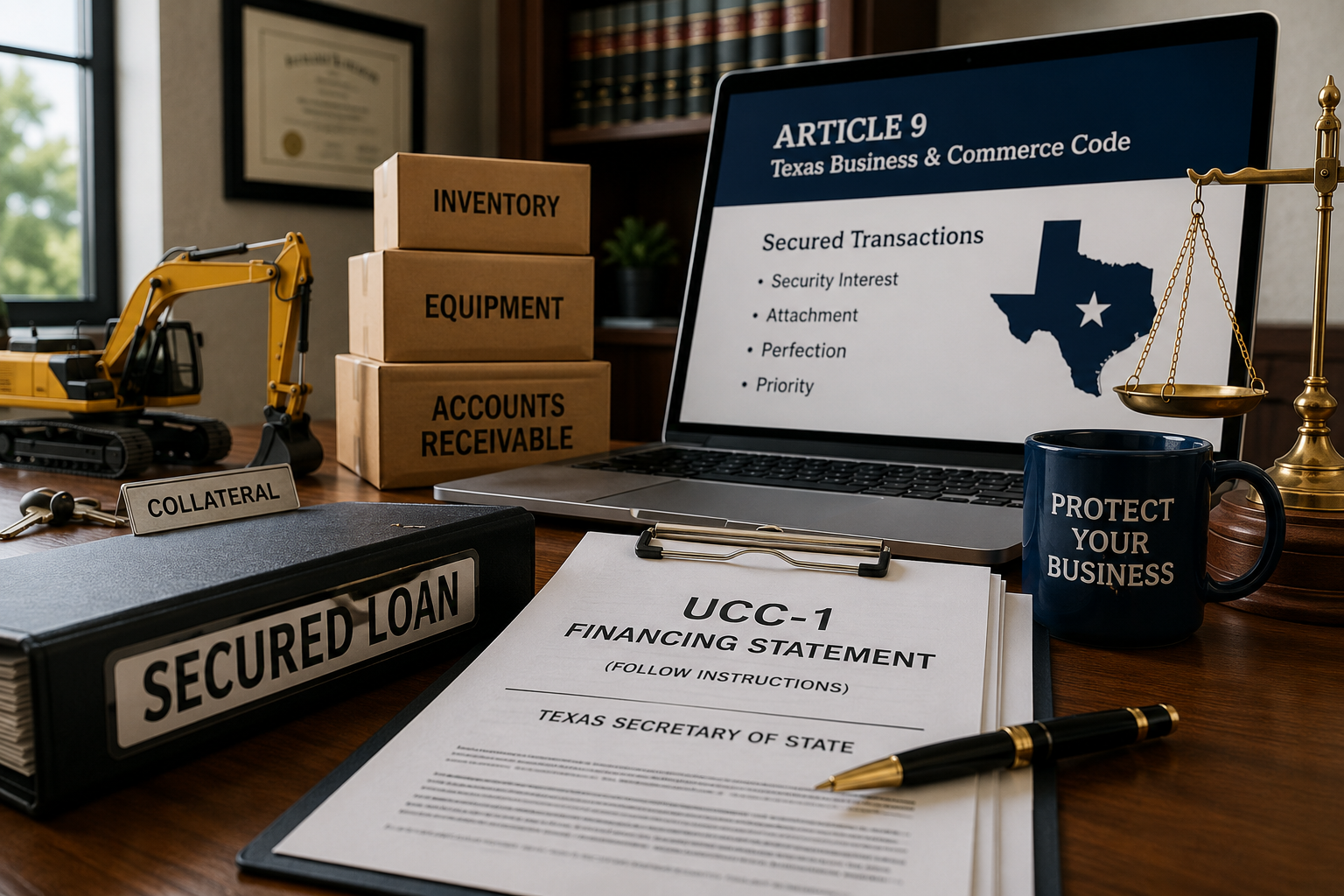
Most people think of a lien as something attached to real estate. In reality, many businesses have liens filed against their equipment, inventory, accounts receivable, and other personal property without ever transferring possession of those assets.
These liens are typically created through Article 9 of the Texas Business & Commerce Code by filing what is commonly known as a UCC-1 Financing Statement.
Whether you are borrowing money, selling goods on credit, buying an existing business, or extending commercial credit, understanding how UCC filings work can prevent expensive surprises.
What Is a UCC-1 Financing Statement?
A financing statement is a public filing that gives notice that a creditor claims a security interest in certain personal property.
Unlike a deed of trust recorded against real estate, a UCC filing generally concerns personal property, including:
- Business equipment
- Inventory
- Furniture
- Vehicles used as collateral (subject to special rules)
- Accounts receivable
- Fixtures
- Farm products
- Investment property
- Intellectual property in some circumstances
The filing itself does not create the security interest. Instead, it gives public notice that one exists.
Texas Law
Texas Business & Commerce Code § 9.502(a) provides:
"Subject to Subsection (b), a financing statement is sufficient only if it:
(1) provides the name of the debtor;
(2) provides the name of the secured party or a representative of the secured party; and
(3) indicates the collateral covered by the financing statement."
Although the filing requirements appear simple, mistakes involving the debtor's legal name or collateral description can create major litigation issues.
Why File a Financing Statement?
Imagine a business borrows $150,000 to purchase manufacturing equipment.
The lender does not want to physically possess the equipment because the borrower needs it to operate the business.
Instead, the lender:
- obtains a signed security agreement,
- perfects its interest by filing a financing statement,
- and keeps priority over many later creditors.
If the borrower later defaults, the lender may have important rights against the collateral.
Perfection Matters
One of the central concepts in Article 9 is perfection.
A lender may have a valid agreement with a borrower, but if the security interest is never perfected, another creditor—or even a bankruptcy trustee—may obtain superior rights.
For that reason, commercial lenders are usually meticulous about filing financing statements promptly.
What Property Can Be Covered?
Article 9 allows security interests in many different categories of personal property.
Examples include:
- Existing inventory
- Future inventory
- Equipment
- Accounts receivable
- Chattel paper
- Commercial tort claims (subject to special rules)
- Deposit accounts (generally perfected differently)
- Investment securities
- Fixtures
Some security agreements even include after-acquired property, meaning collateral obtained after the loan closes automatically becomes subject to the lender's security interest if properly drafted.
Where Are UCC Filings Made?
Most Texas UCC financing statements are filed with the Texas Secretary of State, not with the county clerk.
This is different from mortgages and deeds of trust, which are generally recorded in the county where the real property is located.
Because filings are centralized, prospective lenders and purchasers can search existing filings before completing commercial transactions.
How Long Does a Filing Last?
Texas Business & Commerce Code § 9.515(a) states:
"Except as otherwise provided in Subsections (b), (e), (f), and (g), a filed financing statement is effective for a period of five years after the date of filing."
If the secured party wants the filing to remain effective, it generally must file a continuation statement before expiration.
Otherwise, the financing statement usually lapses.
Does Filing Mean the Debt Is Valid?
Not necessarily.
A financing statement simply gives public notice of an asserted security interest.
Questions may still arise regarding:
- whether the debt exists,
- whether default occurred,
- whether collateral was properly described,
- whether the filing contains serious errors,
- whether the secured party complied with Article 9.
These issues sometimes become the subject of commercial litigation.
Common Litigation Issues
Commercial disputes involving Article 9 often involve questions such as:
- Which creditor filed first?
- Was the debtor's legal name entered correctly?
- Did the lender properly perfect its security interest?
- Was the collateral adequately described?
- Did the secured party properly dispose of collateral after default?
- Does the security agreement actually cover the disputed property?
Priority disputes can determine which creditor receives payment when collateral is sold.
Practical Advice
Before purchasing an existing business, extending commercial credit, or pledging business assets as collateral, it is often worthwhile to determine whether existing UCC filings already affect the property involved.
Likewise, businesses that have paid off secured loans should ensure that appropriate termination filings are made so outdated financing statements do not unnecessarily complicate future transactions.
Conclusion
Although they receive far less attention than real estate liens, UCC financing statements play a major role in commercial lending throughout Texas. They allow businesses to obtain financing while retaining possession of valuable assets and provide public notice that those assets secure repayment of a debt. Whether you are a borrower, lender, buyer, or business owner, understanding the basics of Article 9 can help you avoid costly disputes and protect your legal rights.
At David C. Barsalou, Attorney at Law, PLLC, we help clients navigate business, family, tax, estate planning, and real estate matters ranging from document drafting to litigation with clarity and confidence. If you’d like guidance on your situation, schedule a consultation today. Call us at (713) 397-4678, email barsalou.law@gmail.com, or reach us through our Contact Page. We’re here to help you take the next step.