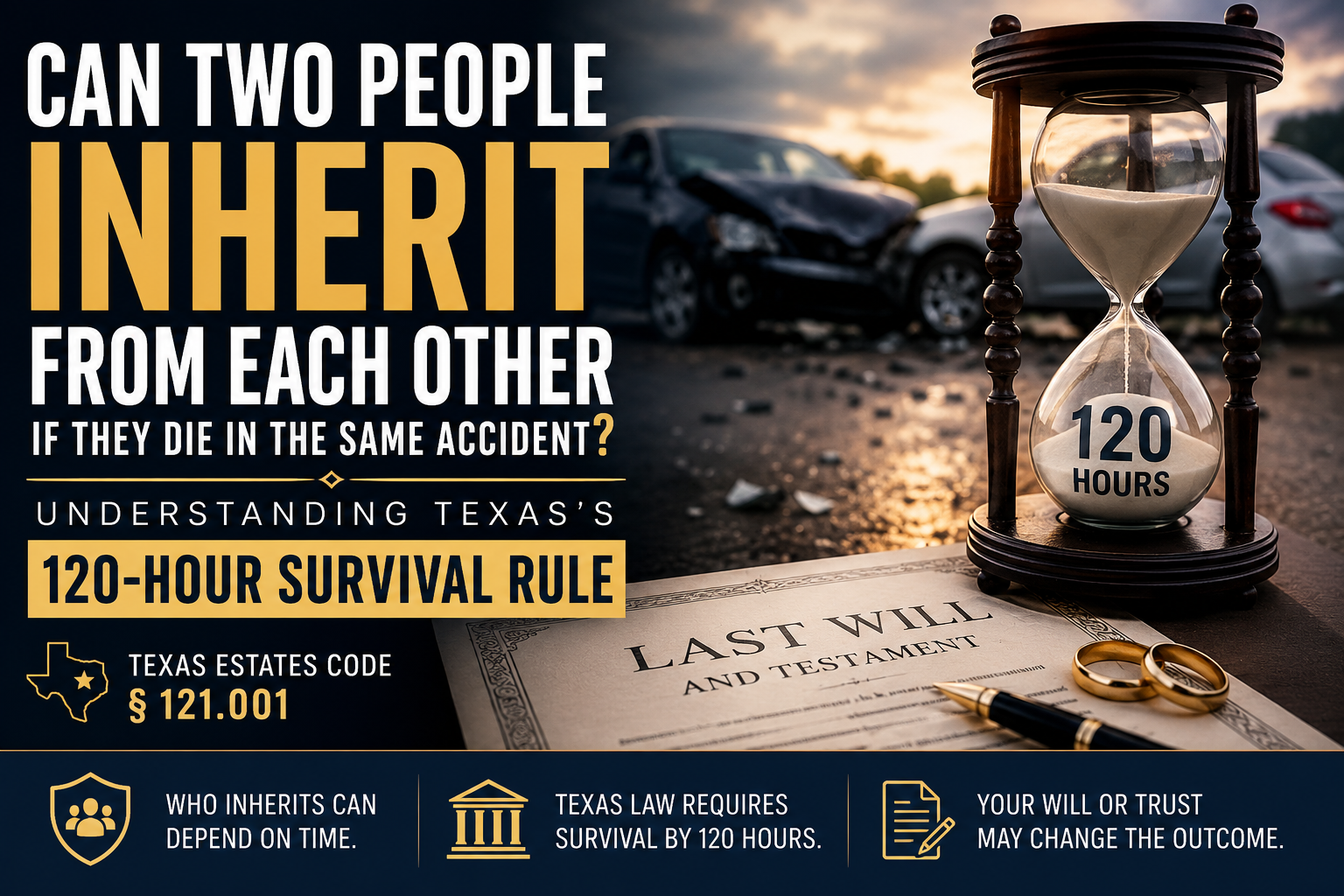
Most people assume that if a husband and wife die in the same accident, their estates simply pass through each other before ultimately reaching their children or other beneficiaries. Surprisingly, Texas law often does not allow that to happen.
Instead, Texas has a little-known probate rule commonly called the 120-hour survival rule. The rule can dramatically change who inherits property, whether probate is required, and even how estate taxes and creditor claims are handled.
Although the rule rarely makes headlines, it can significantly affect families after a tragedy.
What Is the 120-Hour Survival Rule?
The general rule appears in Texas Estates Code § 121.001, which provides:
"A person who is not established by clear and convincing evidence to have survived another person by 120 hours is considered to have predeceased that person for purposes of the other person's homestead, exempt property, and intestate succession."
In simple terms, unless it can be proven by clear and convincing evidence that an individual survived another person by at least 120 hours (five days), Texas law generally treats that person as though they died first.
This avoids property passing through multiple estates in rapid succession.
Why Did Texas Create This Rule?
Without the survival requirement, property could pass through several estates within a matter of hours.
Imagine the following:
- Husband dies at 10:00 a.m.
- Wife dies at 3:00 p.m.
- Husband leaves everything to Wife.
- Wife leaves everything to her siblings.
Without a survival requirement, Husband's estate could first pass to Wife, only to pass again several hours later to Wife's family.
The law instead attempts to avoid unnecessary multiple probate transfers where no meaningful survival occurred.
Does the Rule Apply to Every Asset?
No.
Whether the rule applies depends on how the property is owned and whether another controlling document changes the outcome.
For example:
- Property passing by intestate succession is generally governed by the statute.
- A will may expressly provide a different survival period.
- Life insurance policies, retirement accounts, payable-on-death accounts, and trusts often contain their own beneficiary provisions that may supersede the statutory default.
Because every asset transfers under its own legal framework, determining who inherits often requires reviewing multiple documents rather than relying on one rule.
What If Someone Lives Four Days?
Four days is not enough.
If the evidence fails to establish survival for the required 120 hours, Texas generally treats the person as having predeceased the other for purposes covered by the statute.
Even though four days may feel like a significant period of time emotionally, it does not satisfy the statutory requirement.
Can a Will Override the Rule?
Often, yes.
Many professionally drafted wills include customized survival clauses.
For example, a will might require a beneficiary to survive by:
- 30 days;
- 60 days; or
- another specified period.
If the governing instrument validly changes the survival requirement, that language generally controls instead of the statutory default.
This is one reason professionally prepared estate planning documents frequently produce different outcomes than relying solely upon Texas intestacy laws.
Why This Matters in Probate
The 120-hour rule can affect:
- who ultimately inherits property;
- whether property passes through one estate or two;
- which family members receive assets;
- administration costs;
- creditor claims;
- homestead rights; and
- exempt property determinations.
A seemingly small factual question—whether someone survived five days—can determine the entire distribution of an estate.
Final Thoughts
Texas's 120-hour survival rule illustrates how probate law often turns on technical statutory requirements rather than common assumptions.
When multiple family members die close together, determining inheritance may require careful analysis of the Texas Estates Code, wills, beneficiary designations, trusts, and other governing documents. What appears straightforward at first glance can become surprisingly complex.
If you have questions regarding probate administration, estate planning, or inheritance disputes in Texas, experienced legal counsel can help evaluate how these rules apply to your family's specific circumstances.
This article is provided for informational purposes only and does not constitute legal advice. Reading this article does not create an attorney-client relationship.
At David C. Barsalou, Attorney at Law, PLLC, we help clients navigate business, family, tax, estate planning, and real estate matters ranging from document drafting to litigation with clarity and confidence. If you’d like guidance on your situation, schedule a consultation today. Call us at (713) 397-4678, email barsalou.law@gmail.com, or reach us through our Contact Page. We’re here to help you take the next step.
