Real estate deeds tend to look formal.
They contain legal descriptions, acknowledgments, recording information, reservations, exceptions, and phrases that have been copied from one deed to another for generations.
Because of that formality, it is tempting to assume that a deed means only what it expressly says.
Texas law, however, contains an interesting exception.
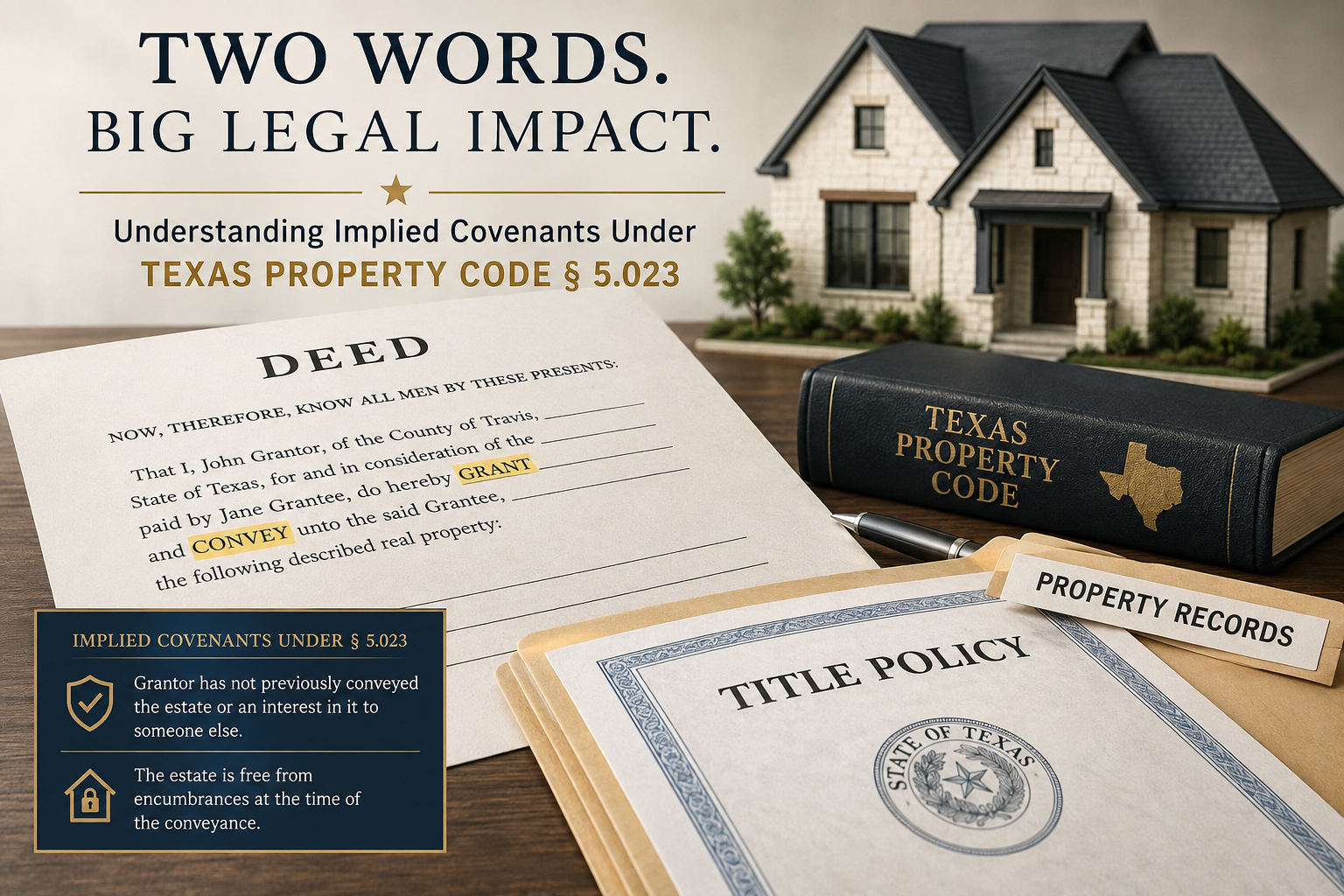
Under Texas Property Code § 5.023, simply using certain ordinary words in a deed can create legal covenants that are not expressly written into the document.
The words are remarkably simple:
“grant” or “convey.”
Depending on the language of the deed, those words can carry considerably more legal significance than a property owner might expect.
Texas Property Code § 5.023: Implied Covenants
Texas Property Code § 5.023(a) provides that, unless a conveyance expressly provides otherwise, the use of the words “grant” or “convey” in a conveyance of an estate of inheritance or fee simple implies certain covenants from the grantor.
The statute provides, in relevant part:
“Unless the conveyance expressly provides otherwise, the use of ‘grant’ or ‘convey’ in a conveyance of an estate of inheritance or fee simple implies only that the grantor and the grantor's heirs covenant to the grantee and the grantee's heirs or assigns…”
The statute then identifies two specific promises.
First, the grantor covenants that before executing the conveyance, the grantor has not already conveyed the estate or an interest in it to somebody other than the grantee.
Second, the grantor covenants that, at the time of the conveyance, the estate is free from encumbrances.
Those are substantial promises to arise from two relatively ordinary words.
The First Implied Covenant: “I Haven't Already Conveyed This Property”
Suppose Sally owns a piece of Texas land.
She signs a deed stating that she “grants and conveys” the property to Bob.
Unknown to Bob, Sally previously conveyed an interest in the same property to somebody else.
Even if Bob's deed does not contain a lengthy paragraph expressly promising that Sally never previously conveyed the property, § 5.023 may supply that covenant by operation of law.
In practical terms, the statute protects against a rather fundamental problem:
A seller should not convey an estate to you after already conveying that estate—or an interest in it—to somebody else.
The precise rights and remedies will depend on the deed, the competing interests, recording issues, and the facts of the transaction. But the statutory covenant can itself matter in later litigation.
The Second Implied Covenant: The Property Is Free From Encumbrances
The second covenant is potentially even more useful.
Section 5.023 provides that the use of “grant” or “convey” also implies that:
“at the time of the execution of the conveyance the estate is free from encumbrances.”
That immediately raises another question:
What counts as an encumbrance?
Texas Property Code § 5.024 provides a statutory definition. Among other things, “encumbrance” includes a tax, assessment, and lien on real property.
Imagine that a seller conveys property to a buyer and an undisclosed lien already burdens the property.
The dispute may involve title insurance, contractual representations, express deed warranties, or other legal doctrines. But § 5.023 can create an additional issue: did the language of the conveyance itself carry an implied covenant that the estate was free from encumbrances?
That is one reason seemingly routine deed language can become important years after a closing.
These Covenants Can Actually Support a Lawsuit
Perhaps the most important part of § 5.023 is subsection (b).
It states:
“An implied covenant under this section may be the basis for a lawsuit as if it had been expressed in the conveyance.”
In other words, this is not merely a rule telling courts how to interpret antique legal terminology.
The Legislature expressly provides that an implied covenant can serve as the basis of a legal claim just as though the covenant had actually been written into the deed.
That can matter when a title problem appears after a transaction has already closed.
Is This the Same Thing as a General Warranty Deed?
Not necessarily.
This is an important distinction.
Texas Property Code § 5.022 separately provides a statutory form for conveying fee-simple property with a general warranty. The statutory form includes language under which the grantor binds himself or herself to “warrant and forever defend” the property against persons lawfully claiming it. The same section expressly provides that a covenant of warranty is not required in a conveyance.
Section 5.023 is narrower.
The implied covenants arising from “grant” or “convey” concern the grantor's prior conveyances and existing encumbrances. They should not automatically be treated as identical to every obligation created by an express general warranty of title.
That distinction is particularly important when comparing general warranty deeds, special warranty deeds, and deeds containing limited or no express warranty language.
Can the Deed Eliminate the Implied Covenants?
Yes.
The opening language of § 5.023 is important:
“Unless the conveyance expressly provides otherwise…”
That means the statutory covenants are not necessarily unavoidable.
Parties can draft a conveyance so that its express language changes what would otherwise be implied from the words “grant” or “convey.”
This illustrates a broader principle of deed drafting: small differences in wording can create materially different legal consequences.
A person should therefore be cautious about assuming that all deeds transferring the same property accomplish exactly the same thing.
What About a Quitclaim?
Quitclaims create another important distinction.
A traditional quitclaim generally transfers whatever right, title, or interest the grantor may have rather than purporting to convey the property itself.
That distinction can have consequences far beyond § 5.023, including issues involving the character of the instrument and subsequent purchasers.
The important point for purposes of the implied-covenant statute is that the actual language of the instrument matters. Calling a document a “Deed,” “Special Warranty Deed,” or “Quitclaim” does not eliminate the need to read what the instrument actually says and determine what interest it purports to convey.
Why This Matters in Texas Real Estate Disputes
Most deeds never produce litigation.
A property is sold, the deed is recorded, the buyer takes possession, and everybody moves on.
Problems arise when something unexpected later appears.
Perhaps an old lien surfaces.
Perhaps somebody else claims an interest in the property.
Perhaps the seller previously executed another conveyance.
Perhaps the parties disagree about exactly what the seller promised concerning title.
At that point, lawyers may examine not only the sales contract and title policy but also the precise words used in the deed itself.
Texas Property Code § 5.023 demonstrates why.
A covenant does not always have to appear as a paragraph beginning with the words “the grantor hereby warrants.”
Sometimes Texas law supplies the covenant because of the words the drafter chose.
The Bottom Line
Under Texas Property Code § 5.023, the words “grant” or “convey” can have a surprisingly powerful effect.
Unless the conveyance expressly provides otherwise, those words can imply covenants that the grantor has not previously conveyed the estate or an interest in it to somebody else and that the estate is free from encumbrances when the conveyance is executed.
Texas law goes even further by expressly allowing those implied covenants to form the basis of a lawsuit as though they had actually been written into the deed.
For buyers, sellers, investors, and property owners, the lesson is simple:
There may be considerably more packed into the wording of a Texas deed than appears on the page.
Anyone dealing with a disputed conveyance, an unexpected lien, a competing ownership claim, or unusual deed language should have the instrument and the surrounding transaction reviewed carefully. The difference between what a deed expressly says—and what Texas law implies from those words—can affect valuable property rights.
At David C. Barsalou, Attorney at Law, PLLC, we help clients navigate business, family, tax, estate planning, and real estate matters ranging from document drafting to litigation with clarity and confidence. If you’d like guidance on your situation, schedule a consultation today. Call us at (713) 397-4678, email barsalou.law@gmail.com, or reach us through our Contact Page. We’re here to help you take the next step.
