A debt can become too old to enforce through a lawsuit.
But what happens if the debtor later sends an email admitting that the money is still owed and promising to take care of it?
Under Texas law, that communication can have consequences that many debtors—and even some creditors—may not expect.
Texas Civil Practice & Remedies Code § 16.065 recognizes a doctrine under which a written and signed acknowledgment of an existing obligation can potentially overcome a limitations defense. Texas courts describe a qualifying acknowledgment as creating a new promise or obligationconnected to the old debt.
That makes the wording of emails, letters, settlement communications, and other writings particularly important when dealing with old debts.
Texas Civil Practice & Remedies Code § 16.065 Addresses Acknowledgment of Claims
Section 16.065 provides:
“An acknowledgment of the justness of a claim that appears to be barred by limitations is not admissible in evidence to defeat the law of limitations if made after the time that the claim is due unless the acknowledgment is in writing and is signed by the party to be charged.”
The wording is somewhat old-fashioned, but the concept is important.
A debtor's casual oral statement that an old debt is legitimate generally does not satisfy the statute. The acknowledgment contemplated by § 16.065 must be in writing and signed by the party to be charged.
The Texas Supreme Court has developed additional requirements for determining whether a particular writing constitutes a sufficient acknowledgment.
What Must a Written Acknowledgment Contain?
In Stine v. Stewart, 80 S.W.3d 586 (Tex. 2002), the Texas Supreme Court explained that Texas courts have consistently interpreted § 16.065 as requiring an acknowledgment to:
- be in writing and signed by the party to be charged;
- contain an unequivocal acknowledgment of the justness or existence of the particular obligation; and
- refer to the obligation and express a willingness to honor it.
Those requirements are important because merely mentioning an old debt is not necessarily enough.
Consider the difference between these two statements:
“I remember that you claimed I owed you $25,000, but I continue to dispute that.”
and:
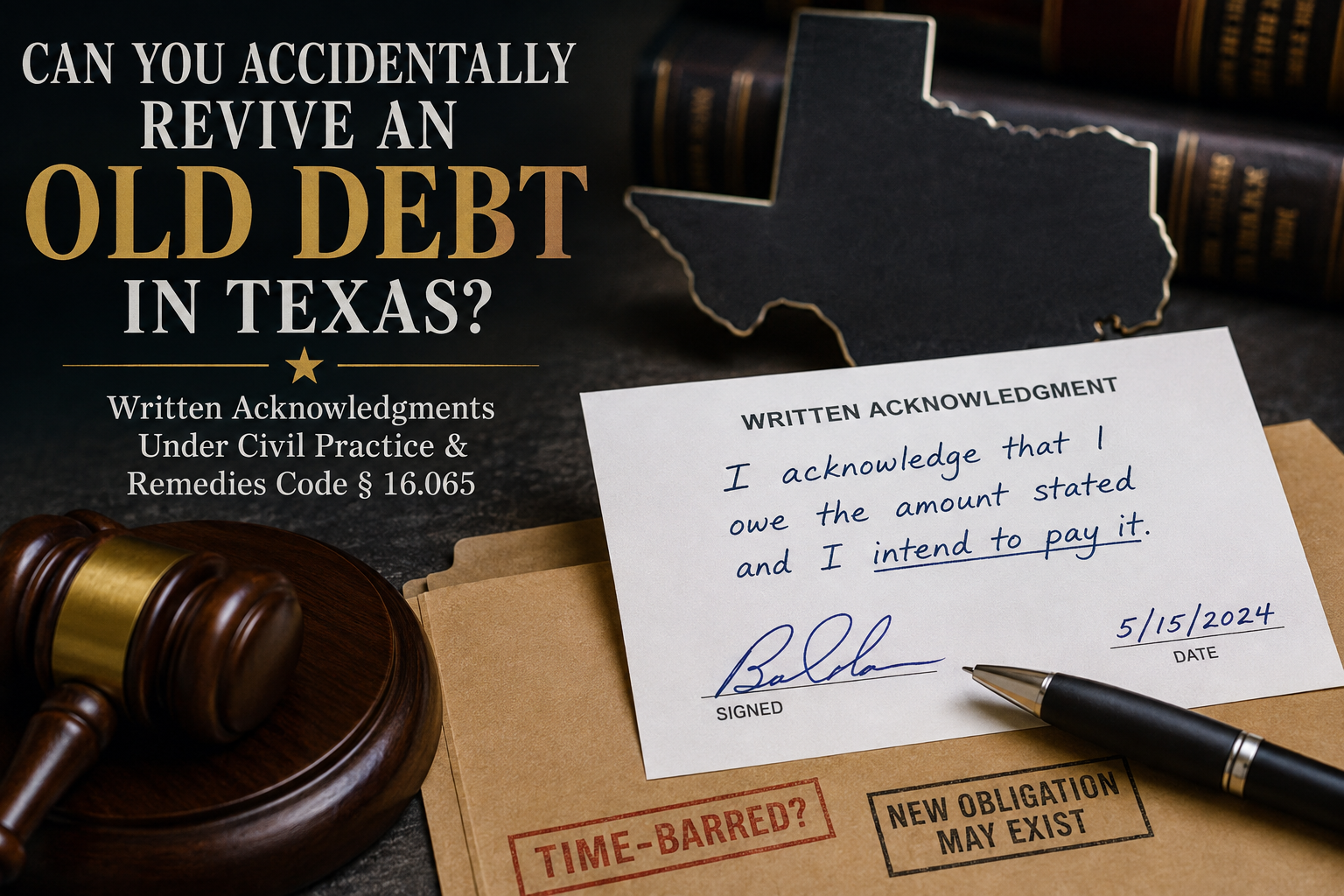
“I still owe you the remaining $25,000 on the loan, and I intend to pay it.”
Both writings discuss the same alleged debt. Their legal significance, however, may be very different.
The second statement much more closely resembles the kind of acknowledgment contemplated by § 16.065 because it recognizes the existence of the obligation and expresses a willingness to honor it.
A Valid Acknowledgment Can Create a New Obligation
This is the particularly technical—and interesting—part of the doctrine.
A qualifying acknowledgment is not simply evidence that the original debt existed.
The Texas Supreme Court has explained that an acknowledgment meeting § 16.065 can create a new obligation.
In Stine, the Court explained that when a writing acknowledges the justness of a claim, the acknowledgment can import both an admission that the claim remains a subsisting debt and a promise to pay it, provided circumstances do not negate the presumed willingness or intention to pay.
This distinction matters enormously when limitations has otherwise become a problem.
The creditor is not necessarily relying solely upon the original promise made years earlier. The subsequent acknowledgment can itself become legally significant.
The Creditor Must Plead the Acknowledgment Correctly
There is another procedural trap.
In DeRoeck v. DHM Ventures, LLC, 556 S.W.3d 831 (Tex. 2018), the Texas Supreme Court addressed how a creditor must plead an acknowledgment when attempting to avoid a limitations defense.
The Court explained that the pleading must be based upon the new promise created by the acknowledgment.
The Court stated that the proper practice is either to:
- quote the writing alleged to constitute the new promise; or
- attach the writing to the pleading as an exhibit.
That makes § 16.065 more than an abstract limitations doctrine. It has direct pleading consequences.
A creditor who simply sues on an ancient debt and later points to an acknowledgment may encounter a very different procedural situation from a creditor who properly pleads the written acknowledgment as the basis for avoiding limitations.
Emails Can Potentially Matter
Modern communications make the doctrine particularly interesting.
Historically, one might imagine a debtor signing a formal letter acknowledging a debt. Today, parties frequently communicate through email and other electronic writings.
Texas appellate courts have considered emails when determining whether an acknowledgment satisfies § 16.065.
That means an informal exchange such as:
“Yes, I know I still owe you the $12,000 from the loan. Business has been terrible, but I'll start paying again when I can.”
may present a much more complicated limitations question than the debtor realizes.
Whether a particular electronic communication satisfies the statutory signature and acknowledgment requirements depends upon the actual facts and applicable law. But parties should not assume that an informal electronic message is legally meaningless simply because nobody signed a traditional paper document with ink.
The Particular Debt Must Be Identifiable
The acknowledgment also must relate to the particular obligation being asserted.
This does not necessarily mean that every detail of the debt must appear within the acknowledgment itself. Texas courts have recognized that the obligation may sometimes be identified through the writing and surrounding circumstances.
Nevertheless, vagueness creates problems.
A statement such as:
“I know I owe you some money.”
is considerably less useful than:
“I acknowledge that I still owe the unpaid balance of the $40,000 loan you made to me in June 2021.”
When multiple transactions exist between the parties, identifying the particular debt can become especially important.
Conditional Promises Can Create Additional Problems
Not every acknowledgment is an unconditional promise to pay immediately.
A debtor might write:
“I know I owe you the money, and I'll pay it if the property sells.”
That language introduces a condition.
Texas law has long recognized that when an acknowledgment contains a conditional promise, the creditor may have to establish satisfaction of that condition rather than relying upon a broader implied promise.
Accordingly, the exact wording of the acknowledgment matters.
One sentence can potentially determine whether a debt remains unenforceable, whether a new obligation exists, or whether payment depends upon the occurrence of some additional event.
Acknowledgment Is Different From Simply Restarting the Original Clock
It can be tempting to describe this doctrine by saying that acknowledging a debt simply “restarts the statute of limitations.”
That description is convenient but incomplete.
Texas Supreme Court authority treats a sufficient acknowledgment as creating a new promise or obligation.
That conceptual distinction helps explain why the creditor must properly plead the acknowledgment and why the precise terms of the later writing matter.
The case is no longer necessarily about nothing more than the original contract.
The later acknowledgment may itself become an essential part of the creditor's cause of action.
Creditors Should Preserve Written Communications
For creditors, § 16.065 provides another reason to preserve communications with debtors.
A debtor may make important admissions concerning:
- the existence of the debt;
- the unpaid balance;
- the debtor's willingness to pay;
- proposed repayment arrangements; or
- the circumstances preventing immediate payment.
Those communications can become important evidence if a limitations dispute later arises.
A creditor evaluating an older debt should therefore review not merely the original contract, promissory note, invoices, or account records, but also subsequent written communications between the parties.
Debtors Should Be Careful When Discussing Old Obligations
The doctrine works in the opposite direction for debtors.
Someone contacted about a very old debt may believe that limitations has already resolved the matter. Responding casually without understanding the legal consequences can complicate that analysis.
This does not mean that every statement such as “I remember the loan” revives an otherwise unenforceable debt.
Section 16.065 and the cases interpreting it impose specific requirements.
But a written statement that unequivocally acknowledges a particular debt and demonstrates a willingness to honor it can have substantially greater legal significance than ordinary conversation.
The Limitations Analysis Can Become Surprisingly Technical
Determining whether an old Texas debt remains enforceable may require answering several separate questions:
- What limitations period applies to the original claim?
- When did the cause of action accrue?
- Did limitations actually expire?
- Did the debtor subsequently acknowledge the obligation?
- Was the acknowledgment written and signed?
- Did it unequivocally acknowledge the particular obligation?
- Did it express a willingness to honor the debt?
- Was the promise conditional?
- Has the creditor properly pleaded the acknowledgment?
What initially appears to be a simple question—“Is this debt too old to sue on?”—can therefore turn into a much more complicated legal analysis.
Bottom Line
Texas Civil Practice & Remedies Code § 16.065 creates an important exception to the assumption that an apparently time-barred debt can never again become enforceable.
A qualifying written acknowledgment can create a new obligation based upon the debtor's recognition of the existing debt and willingness to honor it.
At the same time, not every reference to an old debt qualifies. The writing, signature, identification of the obligation, willingness to pay, conditions attached to the promise, and creditor's pleadings can all matter.
For Texas creditors and debtors dealing with old loans, unpaid invoices, promissory notes, or other contractual obligations, the safest approach is to evaluate both the original transaction and everything the parties wrote afterward.
A seemingly ordinary email can sometimes become the most important document in the case.
This article is for general informational purposes only and does not constitute legal advice. The application of statutes of limitations and acknowledgment doctrines depends upon the particular facts, communications, claims, and procedural history involved.
At David C. Barsalou, Attorney at Law, PLLC, we help clients navigate business, family, tax, estate planning, and real estate matters ranging from document drafting to litigation with clarity and confidence. If you’d like guidance on your situation, schedule a consultation today. Call us at (713) 397-4678, email barsalou.law@gmail.com, or reach us through our Contact Page. We’re here to help you take the next step.