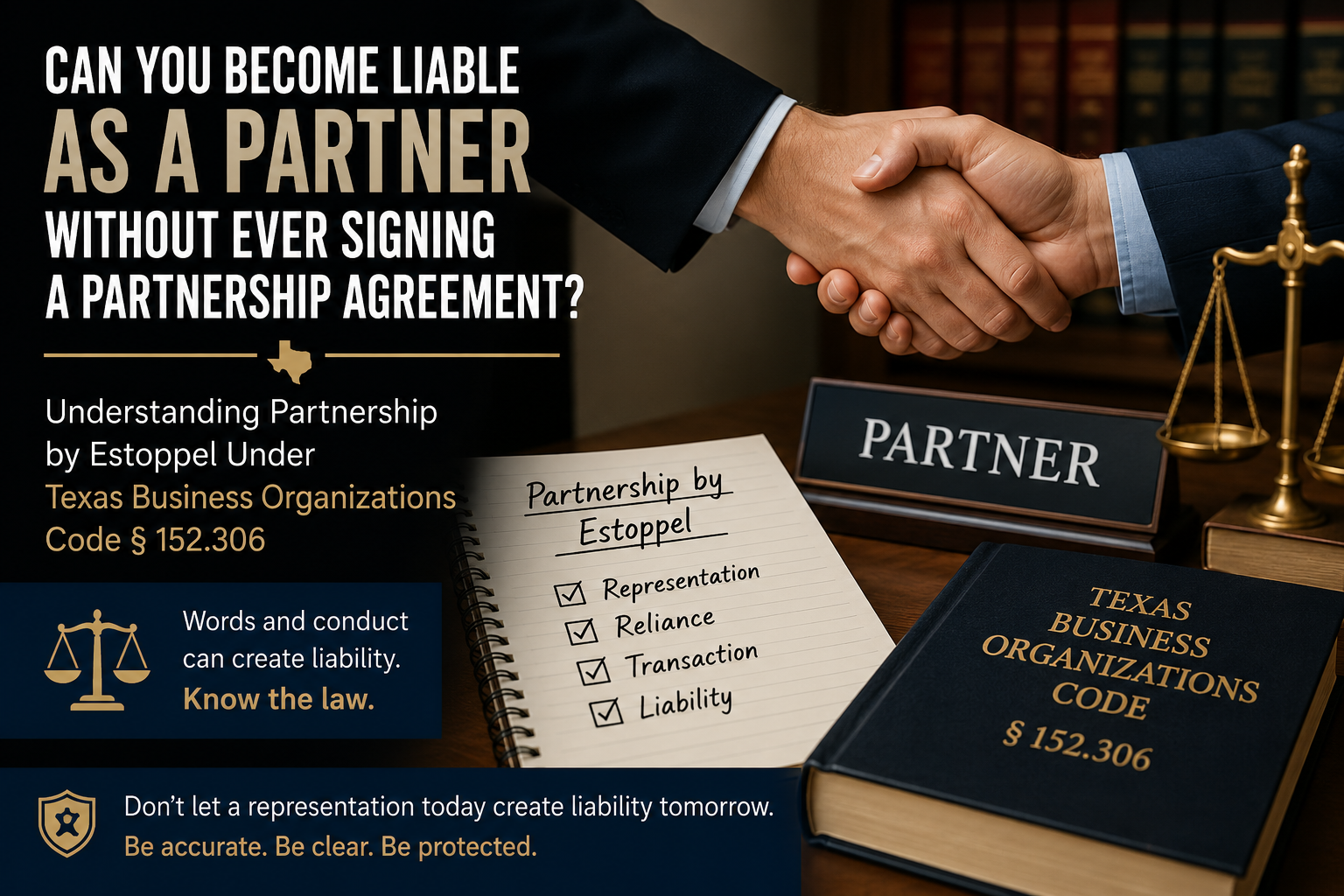
Most business owners understand that forming a partnership generally requires an agreement between two or more people to carry on a business for profit. What surprises many people, however, is that Texas law can sometimes impose partnership liability even when no actual partnership exists.
This legal concept is commonly referred to as partnership by estoppel, although the Texas Business Organizations Code uses the phrase "purported partner."
For entrepreneurs, investors, consultants, and business owners, understanding this doctrine can prevent expensive litigation and unexpected personal liability.
What Does Texas Law Say?
Texas Business Organizations Code § 152.306 provides, in relevant part:
"If a person, by words or conduct, purports to be a partner, or consents to being represented by another as a partner, in a partnership... the purported partner is liable to a person to whom the representation is made if that person enters into a transaction with the actual or purported partnership in reliance on the representation."
Unlike an actual partnership, this statute does not create a partnership merely because someone casually uses the word "partner." Instead, liability generally depends upon whether a third party reasonably relied upon that representation when entering into a business transaction.
Why Does This Rule Exist?
The statute protects innocent third parties.
Imagine someone publicly presents themselves as one of the owners of a business. Customers, vendors, or lenders may decide to extend credit or enter contracts because they believe that individual stands behind the business.
If that representation later proves false, Texas law may prevent the purported partner from simply denying responsibility.
In short, the law discourages people from enjoying the credibility of partnership status without accepting the potential legal consequences.
Common Examples
Partnership by estoppel issues frequently arise when someone:
- Allows their name to appear on business letterhead.
- Introduces themselves as an owner or partner.
- Permits others to advertise them as a partner.
- Signs correspondence suggesting ownership authority.
- Participates in negotiations while allowing others to believe they are a partner.
In each case, the critical question becomes whether another person relied upon that representation when deciding to do business.
What Must Be Proven?
Although every case is fact-specific, courts generally examine whether:
- A representation of partnership was made.
- The purported partner made or consented to the representation.
- A third party learned of that representation.
- The third party relied upon it.
- The reliance resulted in entering a transaction that caused damages.
Without reliance, the statute often will not impose liability.
Does This Mean an Actual Partnership Exists?
No.
One of the more confusing aspects of this doctrine is that partnership by estoppel does not necessarily create an actual partnership between the parties themselves.
Instead, the doctrine primarily concerns liability to third parties who reasonably relied upon representations of partnership status.
That distinction can become extremely important during litigation involving contracts, unpaid debts, or commercial disputes.
Practical Advice for Texas Businesses
Business owners can reduce unnecessary risk by:
- Clearly identifying titles and roles.
- Avoiding casual references to someone as a "partner" unless legally accurate.
- Carefully reviewing websites, advertisements, and social media profiles.
- Ensuring marketing materials accurately describe ownership.
- Promptly correcting inaccurate public statements regarding business ownership.
Many disputes involving purported partners begin with informal conversations or marketing materials rather than carefully drafted legal documents.
Why This Matters
As businesses grow, people often use the word "partner" loosely to describe investors, consultants, key employees, or trusted advisors. In ordinary conversation, that may seem harmless. In litigation, however, those representations can become evidence.
Texas Business Organizations Code § 152.306 reminds business owners that public representations carry legal consequences. Before allowing yourself—or someone else—to be presented as a partner, it is worth understanding what obligations Texas law may impose.
If you have questions about business formation, partnership disputes, commercial litigation, or contractual liability under Texas law, consulting an experienced Texas attorney early can often prevent far more expensive problems later.
At David C. Barsalou, Attorney at Law, PLLC, we help clients navigate business, family, tax, estate planning, and real estate matters ranging from document drafting to litigation with clarity and confidence. If you’d like guidance on your situation, schedule a consultation today. Call us at (713) 397-4678, email barsalou.law@gmail.com, or reach us through our Contact Page. We’re here to help you take the next step.