When someone files a lawsuit in Texas, it is natural to assume that the court will decide whether the defendant is responsible for the plaintiff's injuries or financial losses. But what happens when the defendant argues that someone else—someone who is not even a party to the lawsuit—was actually responsible?
Texas law provides a mechanism for precisely this situation.
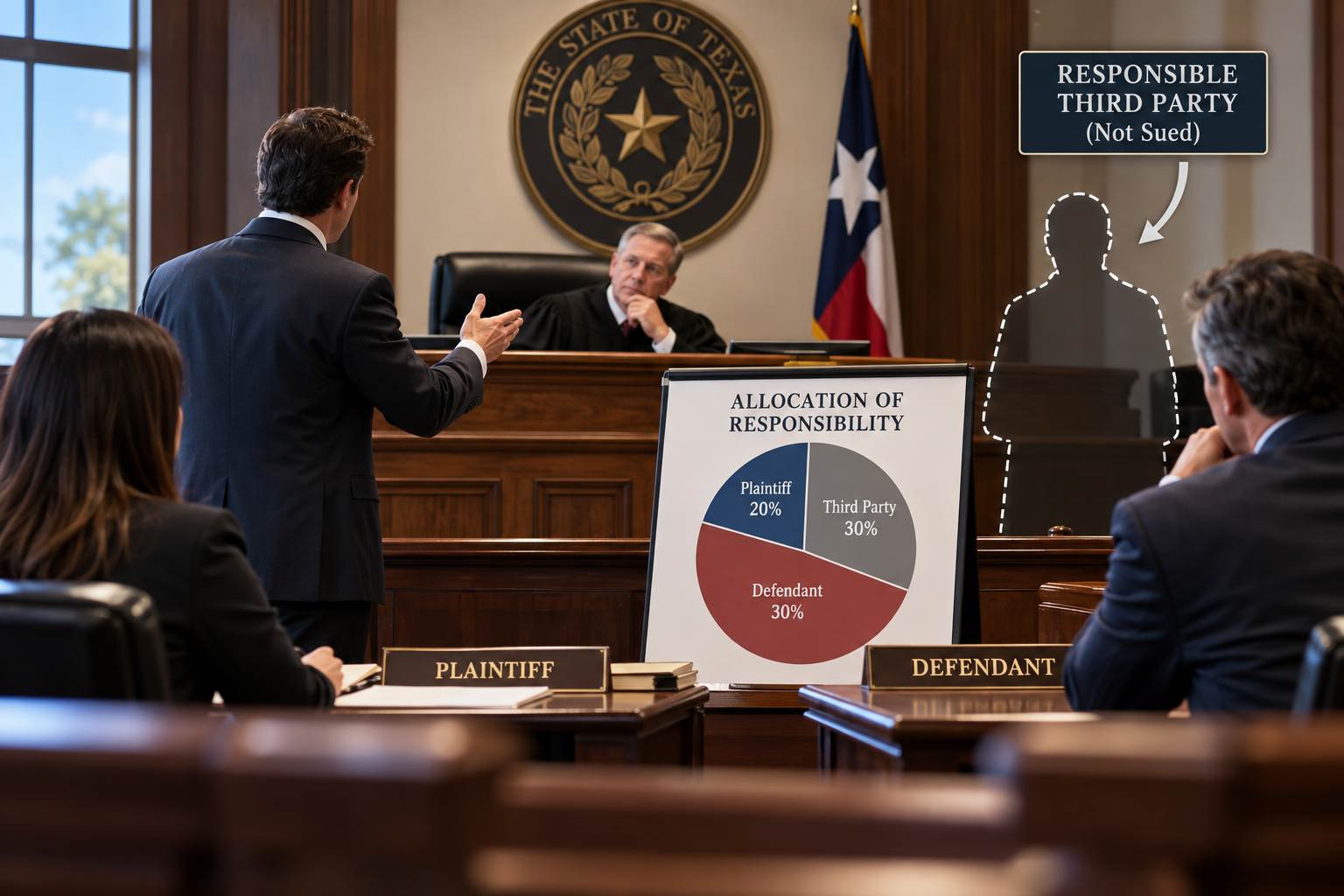
Under Texas Civil Practice and Remedies Code § 33.004, a defendant may ask the court to designate another person or entity as a responsible third party. If the designation is proper and supported by sufficient evidence, the jury may allocate a percentage of responsibility to that person, even though the person is not a defendant in the lawsuit.
This procedure can significantly affect the amount of money a plaintiff ultimately recovers.
Understanding how responsible third-party designations work is important for plaintiffs, defendants, business owners, and anyone involved in civil litigation in Texas.
What Is a Responsible Third Party Under Texas Law?
A responsible third party is a person or entity alleged to have caused or contributed to the harm for which the plaintiff seeks compensation.
The concept comes from Chapter 33 of the Texas Civil Practice and Remedies Code, which governs proportionate responsibility in many civil cases.
Under § 33.011(6), a responsible third party generally includes a person alleged to have caused or contributed to the harm through negligence, a defective product, or other conduct violating an applicable legal standard.
Consider a straightforward example.
A property owner hires a contractor to renovate a commercial building. During construction, a plumbing failure causes extensive damage to the building.
The property owner sues the general contractor, alleging negligent supervision.
The general contractor responds that an independent plumbing subcontractor performed the defective work.
Even if the property owner never sues the subcontractor, the general contractor may seek to designate that subcontractor as a responsible third party.
If the statutory requirements are satisfied and sufficient evidence supports the allocation, the jury may consider the subcontractor's share of responsibility.
The important distinction is that the subcontractor does not automatically become a defendant merely because the court permits the designation.
What Does Texas Civil Practice and Remedies Code § 33.004 Say?
Section 33.004(a) establishes the basic procedure for requesting a responsible third-party designation.
The statute provides, in relevant part:
"A defendant may seek to designate a person as a responsible third party by filing a motion for leave to designate that person as a responsible third party."
The statute also establishes a deadline.
Ordinarily, the defendant must file the motion no later than 60 days before trial, unless the court finds good cause to permit a later filing.
This requirement matters because a defendant cannot necessarily wait until the eve of trial to introduce an entirely new person or entity into the responsibility analysis.
The procedure is intended to identify potentially responsible persons while giving the other parties an opportunity to investigate and respond.
Does the Responsible Third Party Have to Be Sued?
No.
This is one of the most distinctive aspects of the statute.
A responsible third party may be included in the jury's allocation of responsibility without being joined as a defendant.
Section 33.004(i) makes clear that designation or a finding of fault does not, by itself, impose liability on the designated person.
In other words, a jury may assign responsibility to someone who will not be ordered to pay damages in that lawsuit.
For example, suppose a plaintiff seeks $100,000 in damages from a defendant. The jury determines that the defendant bears 60% responsibility and a designated responsible third party bears 40%.
Assuming Chapter 33 applies and no exception changes the result, the defendant's ordinary several-liability share would be $60,000.
The plaintiff generally cannot collect the remaining $40,000 from the responsible third party merely because the jury allocated responsibility to that person.
That difference can be substantial.
It also explains why defendants may have strong incentives to identify other potentially responsible persons early in litigation.
How Does a Defendant Designate a Responsible Third Party?
The process generally involves several steps.
First, the defendant identifies a potentially responsible person or entity.
This might occur through investigation, discovery responses, documents, witness testimony, or other evidence developed during litigation.
Second, the defendant files a motion for leave to designate the responsible third party.
The motion must allege sufficient facts explaining the person's potential responsibility.
Third, the opposing party has an opportunity to object.
Under § 33.004(f), an objection generally must be filed within 15 days after service of the motion.
Fourth, the court determines whether the statutory requirements for designation have been satisfied.
Section 33.004(g) generally requires the court to permit designation following a timely objection unless the objecting party establishes that the defendant failed to plead sufficient facts and still failed to do so after receiving an opportunity to replead.
The initial designation process is therefore not necessarily a determination that the third party actually caused the plaintiff's harm.
It is a procedural step allowing the responsibility issue to be developed and, if supported by the evidence, potentially submitted to the jury.
Can the Plaintiff Challenge the Designation?
Yes.
An initial designation does not mean the responsible third party will necessarily remain part of the case through trial.
Section 33.004(l) provides an important safeguard.
After an adequate time for discovery, a party may move to strike a responsible third-party designation on the ground that there is no evidence the designated person is responsible for any portion of the alleged injury or damage.
If the defendant cannot produce sufficient evidence to raise a genuine issue of fact regarding that person's responsibility, the court must strike the designation.
This creates an important distinction between alleging responsibility and proving that there is enough evidence for the issue to be considered.
A defendant cannot necessarily reduce its exposure simply by naming every contractor, employee, vendor, or other person who might conceivably have been involved.
There must ultimately be an evidentiary basis for submitting the person's responsibility to the jury.
What Happens If the Statute of Limitations Has Expired?
Limitations can create additional complications.
Section 33.004(d) restricts designation after the applicable limitations period has expired if the defendant failed to comply with its obligations, if any, to timely disclose that the person might be designated as a responsible third party.
This provision can become especially important when litigation has continued for several years.
A plaintiff may discover that the defendant intends to blame another person only after the deadline for suing that person has passed.
Whether designation remains available can depend on the defendant's compliance with the applicable disclosure requirements.
Consequently, plaintiffs should investigate potentially responsible persons early rather than assuming that the named defendant is the only party whose conduct matters.
Can an Unknown Person Be Designated as a Responsible Third Party?
In certain circumstances, yes.
Section 33.004(j) provides a specialized procedure involving an unknown person who allegedly committed a criminal act causing the plaintiff's injury or loss.
The statute imposes specific pleading requirements and deadlines.
Among other things, the defendant must timely allege the unknown person's criminal conduct in an answer, provide identifying characteristics known at the time, and satisfy the statutory requirements concerning the alleged criminal act.
An unknown person designated under this provision is identified as John Doe or Jane Doe until the person's identity becomes known.
This is not a general authorization to blame unidentified persons without supporting facts. The statute establishes particular conditions for using the procedure.
How Does Responsible Third-Party Designation Affect Settlement Negotiations?
Responsible third-party designations can also affect how civil cases are evaluated for settlement.
Suppose a plaintiff sues a business for $250,000 in alleged damages.
The business contends that another contractor caused most of the loss and obtains permission to designate that contractor as a responsible third party.
Even if the plaintiff believes the business remains primarily responsible, the designation introduces an additional issue that may influence the outcome at trial.
The plaintiff must consider whether the jury might allocate a substantial portion of responsibility to someone from whom the plaintiff cannot recover in that lawsuit.
The defendant, meanwhile, must consider whether it can produce enough evidence to support the allocation.
These competing risks may influence settlement discussions.
However, the mere existence of a designation does not establish that the defendant will prevail or that the plaintiff's recovery will necessarily be reduced.
Does Chapter 33 Apply to Every Texas Lawsuit?
No.
Chapter 33 applies to specified categories of civil actions, including many tort claims and claims under the Texas Deceptive Trade Practices–Consumer Protection Act.
It does not automatically apply to every dispute involving money.
For example, a conventional breach-of-contract lawsuit does not become subject to proportionate responsibility merely because the defendant believes another person contributed to the contractual dispute.
The nature of the claims, the applicable statutory provisions, and the legal basis for the alleged liability must be examined.
This distinction is especially important in business litigation, where a lawsuit may contain a mixture of contract, fraud, negligence, and other claims.
Why This Rule Matters in Texas Civil Litigation
Responsible third-party designations illustrate an important principle of Texas civil litigation: the people named in a lawsuit are not necessarily the only people whose conduct may affect the outcome.
For defendants, § 33.004 provides a way to seek an allocation of responsibility reflecting the conduct of persons who are not parties to the case.
For plaintiffs, it creates a reason to investigate potential contributors to the alleged harm before limitations and procedural deadlines become obstacles.
For both sides, the procedure makes factual development and timely litigation decisions particularly important.
The ultimate question is not simply whether someone else might have been involved. It is whether the law permits the designation and whether sufficient evidence supports allocating responsibility to that person.
Conclusion
Under Texas Civil Practice and Remedies Code § 33.004, a defendant may seek to designate a responsible third party even when the plaintiff has not sued that person.
The designation can materially affect the allocation of responsibility and the damages recoverable from the named defendants.
But designation is not automatic in every case, does not itself impose liability on the third party, and remains subject to procedural requirements and evidentiary challenges.
Anyone pursuing or defending a Texas civil lawsuit should carefully evaluate whether other persons may bear responsibility for the alleged harm—and whether Chapter 33 applies to the claims being asserted.
David C. Barsalou, Attorney at Law, PLLC, represents individuals and businesses in Texas civil litigation, commercial disputes, contract matters, and related legal proceedings. The firm assists clients with evaluating claims, defending lawsuits, and navigating the procedural issues that can affect litigation outcomes.
Disclaimer: This article provides general information about Texas law and is not legal advice. The application of Chapter 33 depends on the particular claims, facts, and procedural circumstances of each case.
At David C. Barsalou, Attorney at Law, PLLC, we help clients navigate business, family, tax, estate planning, and real estate matters ranging from document drafting to litigation with clarity and confidence. If you’d like guidance on your situation, schedule a consultation today. Call us at (713) 397-4678, email barsalou.law@gmail.com, or reach us through our Contact Page. We’re here to help you take the next step.