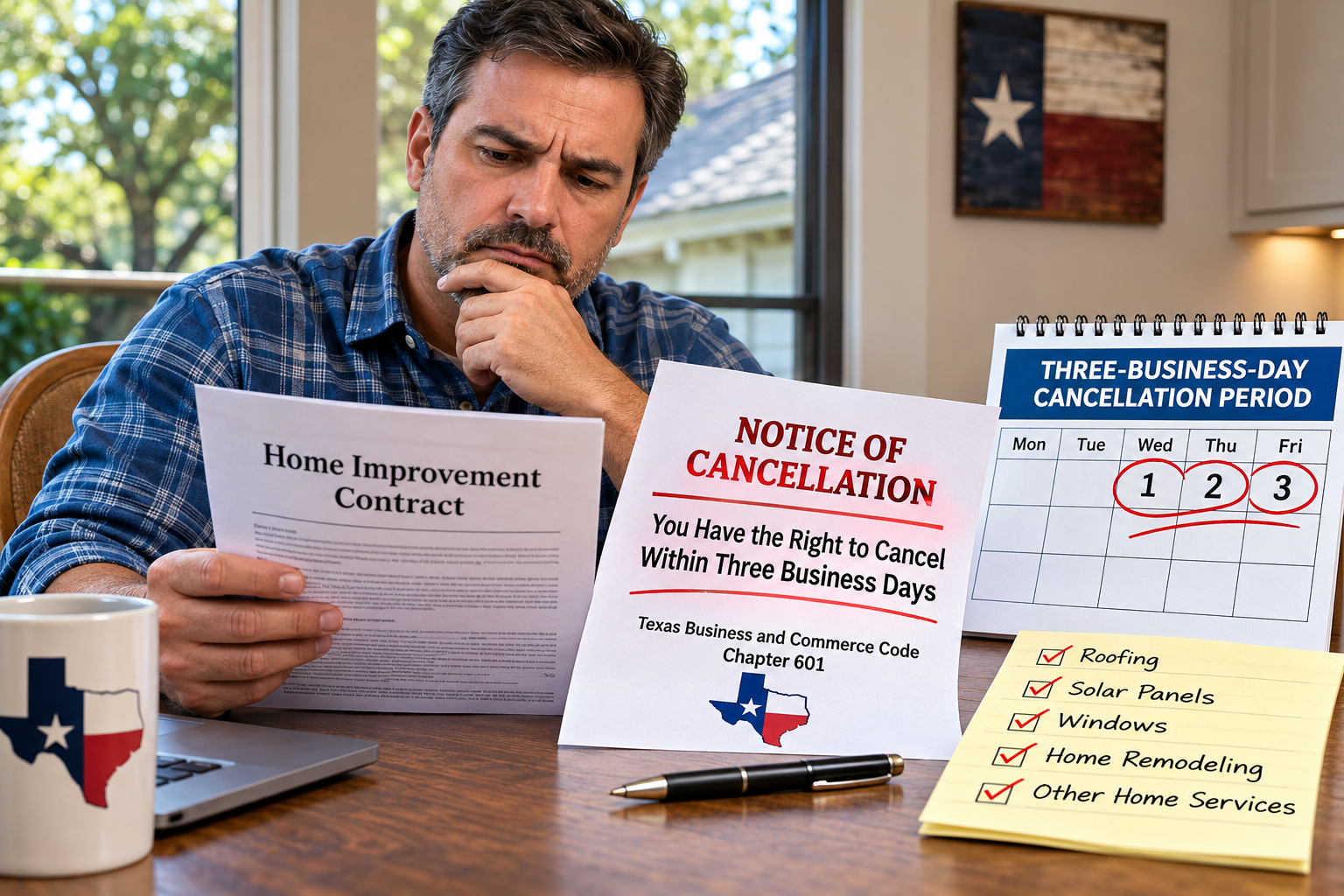
One of the most persistent misconceptions about Texas contract law is that consumers automatically have three days to cancel any contract they sign.
Although Texas law generally does not provide such a universal right, there is an important statutory exception that many consumers—and even some businesses—overlook.
Under Chapter 601 of the Texas Business and Commerce Code, certain consumer transactions conducted outside a merchant's regular place of business are subject to a three-business-day cancellation period, commonly known as a cooling-off period.
This law can have significant implications for homeowners who purchase solar panels, roofing services, water filtration systems, home security equipment, and other products or services from salespeople who visit their homes.
Moreover, a merchant's failure to comply with the statute can expose the business to civil liability, attorney's fees, and potentially the invalidation of the entire contract.
1. Does Texas Have a Three-Day Right to Cancel a Contract?
Texas does not provide a general three-day grace period during which consumers can reconsider every contractual obligation.
Ordinarily, a validly executed contract becomes binding when it is formed. Merely regretting a purchase, discovering a better price, or reconsidering the financial consequences of an agreement does not necessarily establish a legal basis for cancellation.
However, Texas Business and Commerce Code § 601.051 expressly provides that a consumer in a covered transaction may cancel the transaction:
"not later than midnight of the third business day after the date the consumer signs an agreement or offer to purchase."
This is a statutory right, rather than a privilege voluntarily extended by the merchant.
The distinction is important because businesses cannot simply eliminate this protection through contractual language.
2. What Transactions Qualify for the Texas Three-Day Cancellation Rule?
Texas Business and Commerce Code § 601.002 establishes the circumstances under which Chapter 601 applies.
Generally, three conditions must be satisfied:
- The merchant or the merchant's representative personally solicits the consumer somewhere other than the merchant's place of business.
- The consumer offers or agrees to make the purchase somewhere other than the merchant's place of business.
- The transaction involves goods or services costing more than $25, or real property costing more than $100.
The statute primarily protects individuals making purchases for personal, family, or household purposes.
Although frequently described as a door-to-door sales law, Chapter 601 is not necessarily limited to transactions occurring at a consumer's front door.
The location and circumstances surrounding the solicitation and formation of the agreement are important.
3. What Types of Contracts Might Be Covered?
Depending on the circumstances of the transaction, Chapter 601 may apply to contracts involving:
- Residential solar panel installations;
- Roofing and storm damage repairs;
- Replacement windows;
- Home security systems;
- Water filtration equipment;
- Pest control services;
- Residential landscaping;
- Home remodeling services;
- Vacuum cleaners and household appliances; and
- Other products or services sold through in-person residential solicitation.
For example, suppose a roofing company sends a salesperson into a Kingwood neighborhood following a severe thunderstorm.
The salesperson approaches a homeowner, inspects the roof, and persuades the homeowner to execute a $22,000 roof replacement agreement at the homeowner's kitchen table.
Assuming the transaction satisfies the statutory requirements and no exception applies, the homeowner may have three business days to cancel the agreement without penalty.
The mere fact that the homeowner signed a written contract does not eliminate the statutory cancellation right.
4. Does the Salesperson Have to Tell You About Your Right to Cancel?
Yes. One of the more significant features of Chapter 601 is that the merchant has affirmative disclosure obligations.
Under Texas Business and Commerce Code §§ 601.052 and 601.053, merchants generally must provide consumers with specified documents explaining their cancellation rights.
These requirements ordinarily include:
- A completed receipt or copy of the contract at the time of execution;
- The date of the transaction;
- The merchant's name and address;
- A conspicuous statement explaining the cancellation right;
- Two completed copies of a detachable cancellation notice; and
- Documentation in the language principally used during the sales presentation.
Federal Trade Commission cancellation forms may also satisfy certain Texas statutory notice requirements, and § 601.055 authorizes an alternative notice procedure for certain transactions not exceeding $200.
Additionally, § 601.152 prohibits merchants from failing to inform consumers orally of their cancellation rights or misrepresenting those rights.
In other words, merely burying cancellation language somewhere in a lengthy contract may not be sufficient.
5. What If the Sales Presentation Was Conducted in Spanish?
The language requirements of Chapter 601 are particularly relevant in linguistically diverse communities such as Greater Houston.
Texas Business and Commerce Code § 601.052(b)(1) requires the applicable documentation to be:
"in the same language as that principally used in the oral sales presentation."
Suppose a salesperson visits a Spanish-speaking homeowner, conducts the entire sales presentation in Spanish, and then presents an English-language contract and cancellation notice.
The merchant may have violated Chapter 601 even though the homeowner voluntarily signed the agreement.
Businesses conducting multilingual sales operations should pay particular attention to this requirement.
A standardized English-language contract may not satisfy the statute when the sales presentation was principally conducted in another language.
6. How Do You Cancel a Door-to-Door Sales Contract in Texas?
Consumers seeking to exercise their three-day cancellation rights should act promptly and create a clear written record.
A consumer should generally:
- Complete and sign the merchant's cancellation form, if provided.
- Mail or deliver the signed written cancellation notice to the appropriate merchant address before the statutory deadline.
- Retain copies of the cancellation notice and underlying contract.
- Preserve evidence of mailing or delivery.
- Notify any associated financing company of the cancellation and retain evidence of that communication.
Certified mail can be particularly useful because disputes frequently arise over whether a consumer actually exercised the cancellation right within the applicable period.
Consumers should not rely solely on telephone conversations with sales representatives.
Sample Texas Contract Cancellation Notice
If the merchant did not supply a cancellation form, a consumer may prepare a written notice substantially similar to the following:
NOTICE OF CANCELLATION
To: [Merchant's Name and Address]
I hereby provide written notice that I am canceling the consumer transaction entered into on [Date of Transaction] pursuant to Chapter 601 of the Texas Business and Commerce Code.
Please refund all payments made in connection with the transaction, cancel any associated obligations as required by law, and confirm receipt of this notice.
Date: __________________
Consumer's Name: __________________
Consumer's Signature: __________________
Consumers should ensure that the notice is properly addressed and timely mailed or delivered.
7. Can a Merchant Charge a Cancellation Fee After You Exercise Your Rights?
A valid statutory cancellation is fundamentally different from ordinary termination of a contract.
A merchant generally cannot impose a cancellation penalty that defeats the consumer's rights under Chapter 601.
Texas Business and Commerce Code § 601.101 states that a merchant is not entitled to compensation for services performed under a consumer transaction canceled pursuant to the chapter.
Consider a residential contractor who begins preparatory work immediately after obtaining a homeowner's signature.
If the homeowner subsequently exercises a valid statutory cancellation right, the contractor's decision to begin performance before the cancellation period expired may expose the contractor to financial loss.
For this reason, businesses engaged in residential solicitation should carefully evaluate their practices concerning immediate performance, deposits, and cancellation penalties.
8. How Long Does a Merchant Have to Refund Your Money?
Texas Business and Commerce Code § 601.154 imposes important obligations upon merchants following a valid cancellation.
Generally, within ten business days after receiving a valid cancellation notice, the merchant must:
- Refund payments made under the agreement;
- Return property received as a trade-in;
- Cancel and return applicable negotiable instruments;
- Take appropriate action to terminate security interests created by the transaction; and
- Notify the consumer whether the merchant intends to recover or abandon delivered goods.
The statute also establishes restoration obligations in certain transactions involving real property.
A merchant cannot necessarily retain a consumer's deposit merely because the agreement describes that deposit as nonrefundable.
The statutory cancellation right may supersede such contractual language.
9. What Happens to Products Already Delivered to Your Home?
Cancellation does not ordinarily mean that the consumer can immediately keep everything the merchant delivered.
Texas Business and Commerce Code § 601.103 establishes responsibilities concerning the return of goods and property.
Consumers generally must make delivered goods available to the merchant upon a timely demand and exercise reasonable care over those goods.
However, the consumer is not ordinarily required to tender the goods somewhere other than the consumer's residence.
The statute also establishes a presumption that 20 days constitutes a reasonable time for purposes of recovering the property.
If the merchant fails to demand possession within a reasonable time, the consumer may acquire ownership without an obligation to pay.
Nevertheless, consumers should consult an attorney before disposing of expensive equipment or permanently installed goods where a dispute remains unresolved.
10. What If You Missed the Three-Day Cancellation Deadline?
This is where Chapter 601 becomes particularly interesting.
A consumer who fails to exercise the ordinary three-business-day cancellation right does not necessarily lose every available remedy.
Under Texas Business and Commerce Code § 601.201, contracts entered into in violation of § 601.053(b) or Subchapter D of Chapter 601 are void.
Potentially relevant violations include:
- Omitting certain mandatory information from the cancellation forms;
- Misrepresenting the consumer's cancellation rights;
- Failing to provide the required oral disclosure;
- Attempting to obtain a contractual waiver of statutory protections;
- Prematurely transferring certain evidence of indebtedness to third parties; and
- Refusing to honor a valid cancellation.
This is substantially different from merely establishing that a merchant failed to perform a contractual obligation.
In an appropriate case, the statutory violation may undermine the enforceability of the agreement itself.
A homeowner who signed an expensive home improvement agreement several weeks earlier should not automatically assume that the passage of three business days has extinguished all possible legal remedies.
However, not every technical violation necessarily makes a contract void. The particular statutory requirement violated must be examined.
11. Can a Merchant Immediately Sell Your Contract to a Financing Company?
Many residential sales transactions involve third-party financing.
For example, a homeowner might purchase a solar energy system from one company while financing the purchase through an entirely separate lender.
Under Texas Business and Commerce Code § 601.153, a merchant is prohibited from negotiating, transferring, selling, or assigning certain evidence of indebtedness to a finance company or other third party before midnight of the fifth business day following the applicable transaction.
This restriction provides additional protection against the premature transfer of consumer obligations.
Nevertheless, transactions involving separate lenders, financing agreements, and security interests can become considerably more complicated.
Consumers should not assume that notifying the salesperson automatically resolves every issue relating to third-party financing.
12. Can You Sue a Business for Violating the Texas Door-to-Door Sales Law?
Yes.
Texas Business and Commerce Code § 601.202 establishes civil liability for merchants who violate Chapter 601.
Available monetary remedies include:
- Actual damages resulting from the statutory violation;
- Reasonable attorney's fees; and
- Court costs.
Furthermore, § 601.204 classifies violations of Chapter 601 as deceptive trade practices under the Texas Deceptive Trade Practices–Consumer Protection Act, commonly known as the DTPA.
Depending on the circumstances, consumers may therefore have additional remedies under the DTPA.
These may include enhanced damages where the applicable statutory requirements are satisfied.
Where a claim involves the DTPA, consumers and their attorneys should also evaluate the applicable presuit notice requirements under Texas Business and Commerce Code § 17.505.
A dispute that initially appears to be an ordinary breach-of-contract case may ultimately involve a significant statutory consumer protection claim.
13. What Transactions Are Excluded From the Texas Cooling-Off Rule?
Chapter 601 does not apply to every transaction occurring outside a traditional retail establishment.
Section 601.002(b) establishes several exceptions, including:
- Purchases of farm equipment;
- Certain regulated insurance transactions;
- Transactions conducted under preexisting revolving or retail charge agreements;
- Transactions following negotiations at qualifying fixed business establishments; and
- Certain real estate transactions involving licensed attorneys, real estate brokers, or property owners.
Other state and federal statutes may provide independent cancellation rights for particular transactions.
Consequently, the absence of protection under Chapter 601 does not necessarily mean that a consumer has no right to cancel.
The applicable contract, transaction history, financing arrangement, and governing statutes must be considered together.
14. What Should Texas Businesses Do to Protect Themselves?
Chapter 601 is equally important for Texas business owners.
Roofing companies, remodeling contractors, solar companies, and other businesses conducting residential sales should consider having their contracts and sales procedures reviewed for statutory compliance.
Businesses should establish procedures addressing:
- Mandatory cancellation notices;
- Oral disclosure requirements;
- Multilingual sales presentations;
- Documentation of contract execution;
- Timing of service performance;
- Deposit and refund policies;
- Third-party financing arrangements; and
- Processing of consumer cancellation requests.
A business might spend substantial money acquiring a customer, purchasing materials, arranging financing, and scheduling labor only to discover that its underlying agreement is legally unenforceable.
Proper documentation and statutory compliance are generally far less expensive than defending a consumer protection lawsuit.
Frequently Asked Questions About Canceling Contracts in Texas
Can I cancel any contract within 72 hours in Texas?
No. Texas does not recognize a universal 72-hour contract cancellation right. Chapter 601 applies to qualifying consumer transactions and provides a three-business-day cancellation period.
Can I cancel a solar panel contract signed at my house?
Potentially. Residential solar panel contracts may qualify if the solicitation and contractual agreement occurred outside the merchant's place of business and the other statutory requirements are satisfied.
Can I cancel a roofing contract after signing it?
A roofing contract obtained through qualifying residential solicitation may be subject to Chapter 601. Other contractual and statutory cancellation rights may also apply.
What if the salesperson never told me I could cancel?
The failure to disclose cancellation rights may constitute a statutory violation and potentially render the contract void under § 601.201.
Does signing a no-cancellation agreement waive my rights?
Not where Chapter 601 applies. Section 601.151 prohibits merchants from including provisions that waive the consumer's rights under the chapter.
Can I cancel a contract after the merchant starts working?
Potentially. Beginning performance does not, by itself, eliminate an otherwise applicable statutory cancellation right.
Can I recover attorney's fees if a business violates the law?
Yes. Texas Business and Commerce Code § 601.202 expressly authorizes recovery of reasonable attorney's fees, actual damages, and court costs for statutory violations.
Conclusion: Signing a Contract Does Not Always Mean You Are Permanently Bound
Texas generally respects the enforceability of private contracts. Individuals and businesses should ordinarily expect to honor the agreements they voluntarily execute.
However, the Texas Legislature has recognized that certain methods of consumer solicitation create circumstances in which additional contractual protections are appropriate.
Chapter 601 of the Texas Business and Commerce Code provides consumers with a meaningful opportunity to reconsider qualifying purchases while imposing significant disclosure and compliance obligations on merchants.
For consumers, understanding these rights can prevent substantial financial losses.
For businesses, understanding these obligations can prevent an otherwise profitable transaction from becoming an expensive lawsuit.
David C. Barsalou, Attorney at Law, PLLC, assists clients throughout Kingwood, Houston, Harris County, Montgomery County, and surrounding Texas communities with contract disputes, consumer protection matters, civil litigation, and business transactions.
If you are involved in a dispute concerning a residential sales agreement, home improvement contract, or another consumer transaction, consider obtaining legal advice before assuming that the agreement is either enforceable or unenforceable.
Statutory Authority: Texas Business and Commerce Code Chapter 601, including §§ 601.002, 601.051–601.055, 601.101–601.103, 601.151–601.154, and 601.201–601.205.
This article is provided for general informational and educational purposes and does not constitute legal advice or establish an attorney-client relationship.
At David C. Barsalou, Attorney at Law, PLLC, we help clients navigate business, family, tax, estate planning, and real estate matters ranging from document drafting to litigation with clarity and confidence. If you’d like guidance on your situation, schedule a consultation today. Call us at (713) 397-4678, email barsalou.law@gmail.com, or reach us through our Contact Page. We’re here to help you take the next step.