When people think about collecting a debt, they usually focus on the principal balance. But an important question often arises after payment becomes overdue:
Can you recover interest if the contract never says anything about interest?
Under Texas law, the answer is often yes—but only under specific circumstances.
For businesses, landlords, contractors, and individuals who are owed money, understanding Texas Finance Code § 302.002 can help avoid leaving money on the table.
Texas Has a Default Rule
Texas Finance Code § 302.002 provides:
"If a creditor has not agreed with an obligor to charge the obligor any interest, the creditor may charge and receive from the obligor legal interest at the rate of six percent a year on the principal amount of the credit extended beginning on the 30th day after the date on which the amount is due." (Texas Constitution and Statutes)
This statute creates a default legal interest rate even when the parties forgot to include an interest provision in their agreement.
What Does This Mean in Practice?
Suppose:
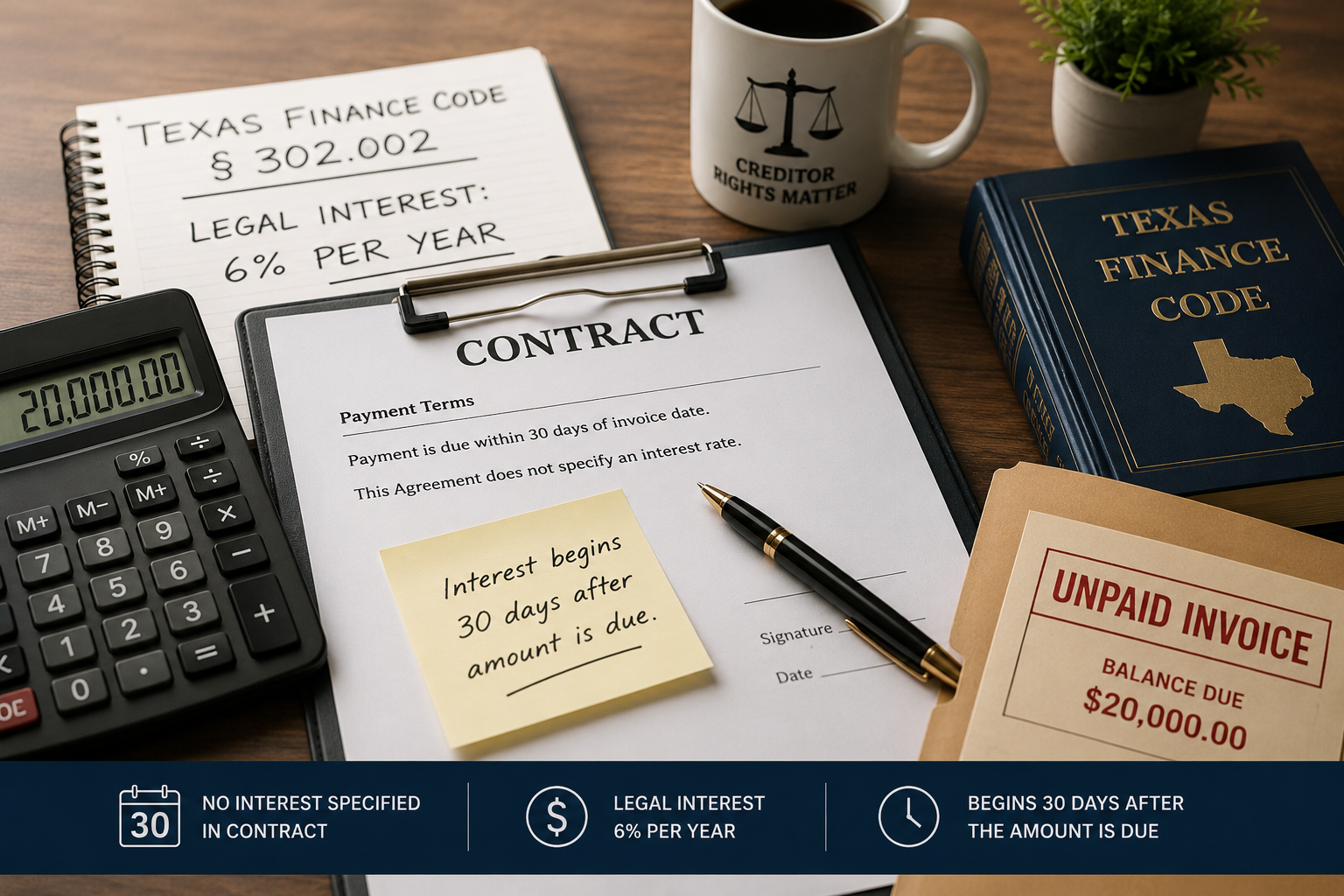
- A contractor completes a $20,000 project.
- The invoice requires payment within 30 days.
- The customer never pays.
- The contract contains no interest provision.
Under § 302.002, the contractor may generally begin charging 6% annual simple interest beginning on the 30th day after the amount became due. (Texas Constitution and Statutes)
The statute supplies the interest rate that the parties failed to negotiate.
This Is Different From a Contractual Interest Rate
Many commercial contracts include language such as:
"Past-due amounts shall accrue interest at 12% per annum."
When parties have validly agreed upon an interest rate, that contractual rate generally controls, provided it complies with applicable Texas law.
Section 302.002 primarily fills the gap when no interest rate was agreed upon at all. (Texas Constitution and Statutes)
The Interest Does Not Begin Immediately
One aspect of the statute that surprises many creditors is that interest does not automatically begin the day payment becomes due.
Instead, the statute provides that legal interest begins on the 30th day after the amount is due. (Texas Constitution and Statutes)
That timing can affect damage calculations in collection lawsuits.
Why This Matters in Litigation
Although 6% may not sound significant, interest can become substantial over time.
Consider a $100,000 unpaid debt:
- 6% annual interest equals $6,000 per year.
- Over several years of litigation, the accumulated interest may represent a meaningful portion of the total recovery.
Accordingly, attorneys often calculate statutory interest as part of the damages sought in a breach of contract or debt collection case.
Common Situations Where the Statute May Apply
Texas Finance Code § 302.002 frequently becomes relevant in disputes involving:
- Unpaid business invoices
- Contractor payment disputes
- Promissory notes that omit an interest provision
- Private loans between individuals
- Commercial sales
- Certain real estate transactions
- Other contracts involving unpaid monetary obligations
Each case depends on its specific facts, and other statutes or contractual provisions may affect the analysis.
Don't Confuse This With Usury
Many people hear "interest" and immediately think of Texas usury laws.
They are related but different concepts.
Texas usury law generally limits how much interest may legally be charged in various situations. By contrast, § 302.002 answers a different question:
What interest rate applies when the parties never agreed on one?
In that circumstance, Texas supplies a default legal rate of 6% per year beginning on the 30th day after payment becomes due. (Texas Constitution and Statutes)
The Bottom Line
A contract that is silent regarding interest does not necessarily mean that no interest can ever be recovered.
Texas Finance Code § 302.002 provides a default rule allowing creditors to recover 6% annual legal interest beginning on the 30th day after the debt becomes due when the parties did not otherwise agree on an interest rate. (Texas Constitution and Statutes)
If you are pursuing an unpaid debt—or defending against one—it is important to determine not only the principal amount owed, but also whether Texas law allows additional interest to be recovered.
At David C. Barsalou, Attorney at Law, PLLC, we help clients navigate business, family, tax, estate planning, and real estate matters ranging from document drafting to litigation with clarity and confidence. If you’d like guidance on your situation, schedule a consultation today. Call us at (713) 397-4678, email barsalou.law@gmail.com, or reach us through our Contact Page. We’re here to help you take the next step.