It is practical, receives steady search traffic, involves real estate litigation, contracts, probate, and title disputes, and lets you quote actual Texas statutes while discussing equitable principles.
Can You Correct a Mistaken Deed After It Has Been Recorded? Understanding Reformation of Deeds Under Texas Law
When people purchase or transfer real estate, they often assume that once a deed has been signed and recorded, it is permanent. In reality, deeds sometimes contain serious mistakes. A legal description may omit acreage, a grantee may be identified incorrectly, or a scrivener's error may accidentally transfer more—or less—property than the parties intended.
Fortunately, Texas law provides a remedy known as reformation, which allows courts to correct certain written instruments so they accurately reflect the parties' true agreement.
This article explains when a deed may be reformed, when it cannot, and why acting quickly can prevent expensive title litigation.
What Is Reformation?
Reformation is an equitable remedy.
Unlike cancelling a deed entirely, reformation simply changes the written document so that it matches what the parties actually agreed to before signing.
Texas courts generally require clear evidence that:
- an agreement actually existed;
- the written deed fails to express that agreement; and
- the discrepancy resulted from mutual mistake or, in some circumstances, fraud.
Texas Recognizes Corrective Instruments
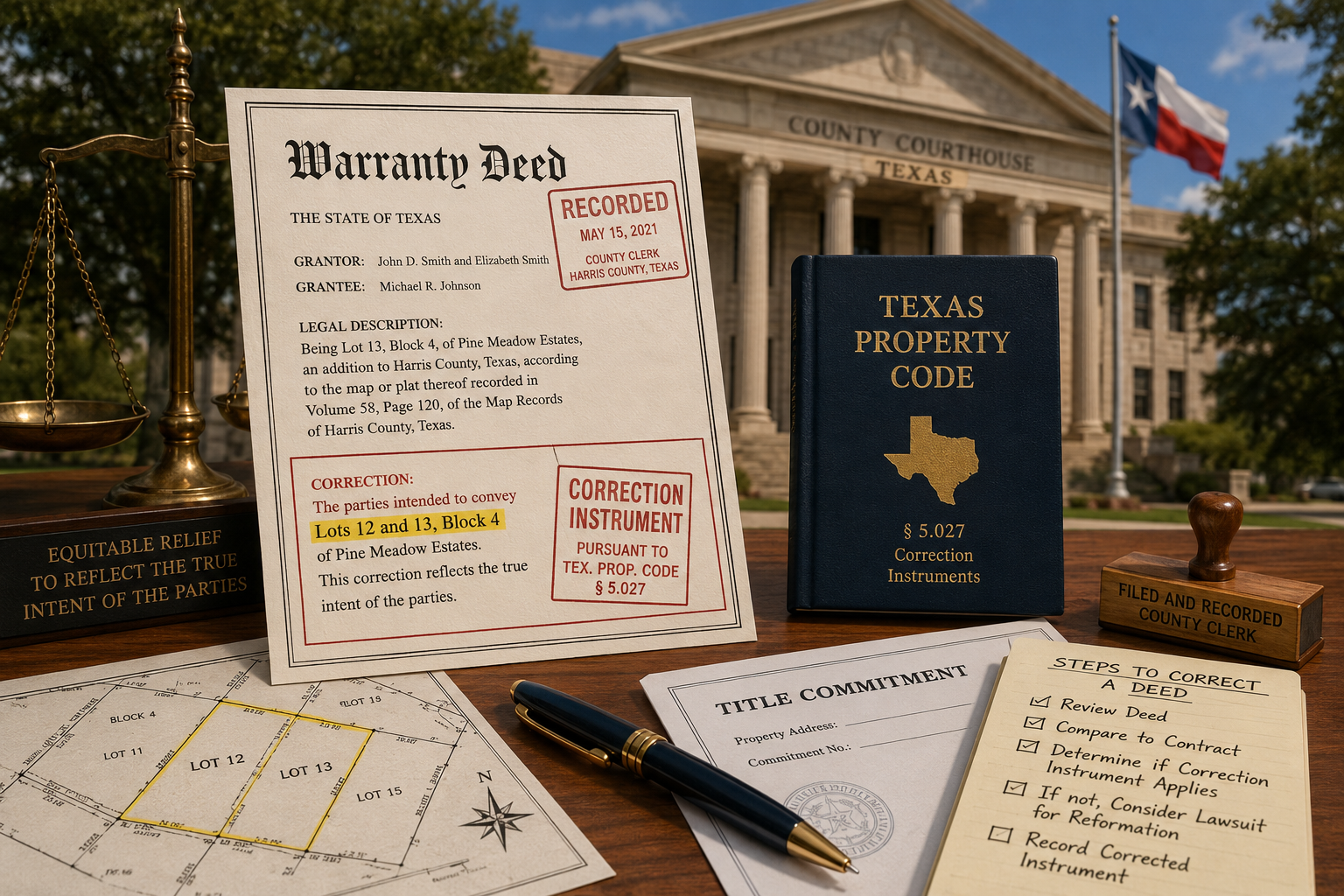
The Texas Property Code expressly recognizes corrective instruments.
Texas Property Code § 5.027 provides in part:
"A person who has personal knowledge of facts relevant to the correction of a recorded original instrument of conveyance may prepare or execute a correction instrument to correct the original instrument."
The statute further establishes procedures depending upon whether the correction is nonmaterial or material.
This statute has greatly reduced the need for lawsuits involving simple clerical mistakes.
What Mistakes Can Often Be Corrected Without Litigation?
Examples include:
- typographical errors
- incorrect middle initials
- misspelled names
- recording references
- omitted acknowledgments
- obvious drafting errors
- mistaken legal descriptions that everyone agrees should be corrected
When everyone cooperates, recording a proper correction instrument may solve the problem without filing suit.
When Is a Lawsuit Necessary?
Unfortunately, not every mistake is uncontested.
Suppose:
- one owner refuses to sign a correction deed;
- heirs disagree about what was intended;
- someone claims additional acreage was intentionally conveyed;
- multiple purchasers are involved; or
- a lender's interests have intervened.
At that point, filing a lawsuit seeking reformation may become necessary.
Mutual Mistake Is Often the Key
One of the most common grounds for reformation is mutual mistake.
For example:
The buyer agrees to purchase Lots 12 and 13.
The closing attorney accidentally prepares a deed describing Lots 13 and 14.
Everyone signs the document believing it is correct.
Years later the mistake is discovered.
Because both parties intended something different than what appears in the deed, a court may reform the instrument to reflect the original agreement.
Fraud Can Also Support Reformation
Reformation is not limited to innocent drafting mistakes.
If one party intentionally causes the deed to differ from the parties' agreement through fraud or inequitable conduct, Texas courts may also grant equitable relief.
The purpose is not to create a new contract—it is to enforce the one the parties actually made.
What If Someone Already Bought the Property?
This is where things become much more complicated.
Texas law strongly protects innocent purchasers who buy property for value without notice of competing claims.
If third-party rights have intervened, reformation may no longer be available against that purchaser.
This is one reason title disputes become highly fact-specific and should be evaluated promptly.
Recording Still Matters
Even after correcting a deed, recording remains critically important.
Texas Property Code § 13.001(a) provides:
"A conveyance of real property... is void as to a creditor or to a subsequent purchaser for valuable consideration without notice unless the instrument has been acknowledged, sworn to, or proved and filed for record as required by law."
Recording protects purchasers by providing notice to the world regarding interests affecting title.
Common Situations That Lead to Reformation Cases
Texas courts frequently see disputes involving:
- incorrect legal descriptions
- omitted mineral interests
- mistaken boundary calls
- clerical drafting errors
- family land transfers
- probate distributions
- divorce property transfers
- mistaken ownership percentages
- survey discrepancies
- scrivener's errors
Many of these mistakes are discovered only years after closing.
How Courts Evaluate These Cases
Courts generally examine:
- the purchase contract
- prior drafts
- title commitments
- surveys
- settlement statements
- correspondence
- witness testimony
- closing documents
- surrounding circumstances
Because reformation seeks to determine the parties' true intent, documentary evidence often becomes extremely important.
Practical Advice for Texas Property Owners
If you discover a mistake in a recorded deed:
- do not assume the mistake is harmless;
- obtain the recorded deed and compare it to the purchase contract;
- determine whether a statutory correction instrument can solve the problem;
- avoid preparing homemade corrective deeds without legal advice; and
- address the issue before the property is sold or refinanced.
Small drafting mistakes today can become expensive title disputes years later.
Conclusion
A recorded deed is not necessarily the final word if it fails to reflect what the parties actually intended. Texas law provides both statutory correction procedures and equitable remedies that can resolve many title defects. However, the availability of reformation depends upon the facts, the evidence, and whether third-party rights have intervened. Because real estate often represents a family's largest asset, promptly correcting title problems can prevent significant litigation and preserve marketable title.
Disclaimer: This article is for informational purposes only and does not constitute legal advice. Every real estate dispute involves unique facts. If you believe a deed affecting your property contains an error, consult a qualified Texas attorney to evaluate your legal rights and available remedies.
At David C. Barsalou, Attorney at Law, PLLC, we help clients navigate business, family, tax, estate planning, and real estate matters ranging from document drafting to litigation with clarity and confidence. If you’d like guidance on your situation, schedule a consultation today. Call us at (713) 397-4678, email barsalou.law@gmail.com, or reach us through our Contact Page. We’re here to help you take the next step.