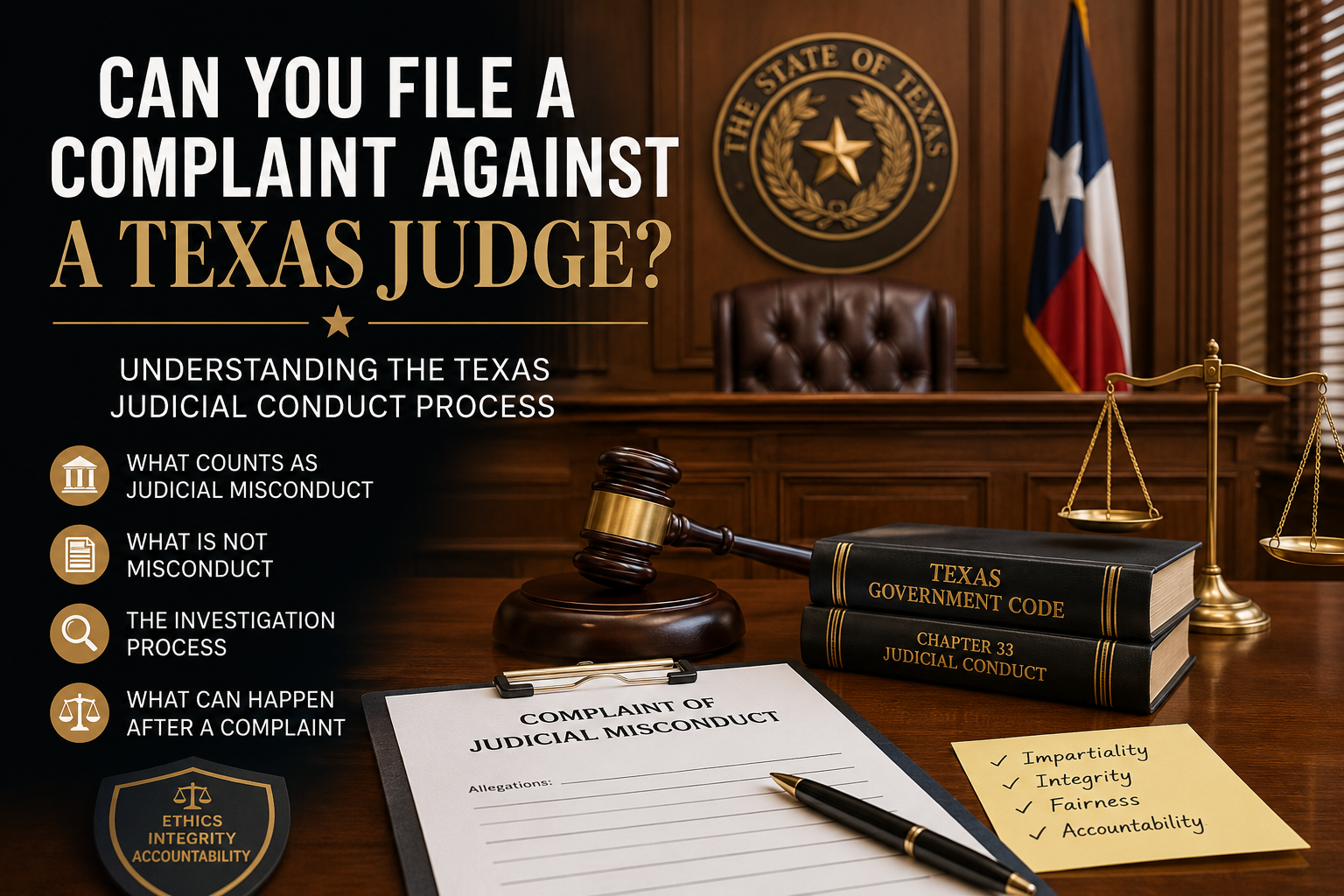
Most people assume that if a judge rules against them, they can file a complaint and have the decision overturned. That is not how the Texas judicial discipline system works.
Texas has an established process for investigating allegations of judicial misconduct, but that process exists to address judicial behavior—not disagreements with judicial rulings.
Understanding the difference can save litigants significant time and frustration.
Who Oversees Texas Judges?
The Texas Constitution establishes the State Commission on Judicial Conduct, an independent agency responsible for investigating allegations of judicial misconduct involving Texas judges.
The Texas Government Code recognizes the Commission's authority and confidentiality rules. For example, Texas Government Code § 33.032 provides:
"All papers filed with and proceedings before the commission are confidential prior to the filing of formal charges."
This confidentiality protects both judges and complainants while allegations are investigated.
What Counts as Judicial Misconduct?
Not every unfavorable ruling constitutes misconduct.
Examples that may warrant investigation include:
- Improper courtroom behavior
- Bias or prejudice
- Conflicts of interest
- Ex parte communications
- Abuse of judicial office
- Persistent failure to perform judicial duties
- Ethical violations
The judicial discipline process focuses on conduct, not whether the judge correctly interpreted the law.
What Is NOT Judicial Misconduct?
Many complaints are dismissed because they challenge legal decisions rather than judicial behavior.
Examples include:
- The judge ruled against you.
- The judge believed the other witness.
- The judge denied your motion.
- The judge interpreted a statute differently than you wanted.
- The judge admitted or excluded evidence.
Those issues are generally addressed through:
- motions for new trial,
- appeals,
- petitions for mandamus, or
- other appellate remedies.
The judicial discipline process is not a substitute for appellate review.
What Can Happen After a Complaint?
Depending upon the investigation, the Commission may:
- dismiss the complaint,
- issue a private sanction,
- issue a public sanction,
- recommend removal,
- recommend retirement under certain circumstances, or
- pursue formal disciplinary proceedings.
Many complaints are resolved without public discipline.
What Does the Texas Government Code Say?
Texas Government Code § 33.001 states:
"The commission shall investigate allegations of judicial misconduct or disability."
Likewise, Chapter 33 establishes procedures governing investigations, confidentiality, hearings, and disciplinary proceedings involving judges.
These provisions are designed to maintain public confidence in the judiciary while protecting judges from unfounded accusations.
Can Filing a Complaint Change Your Case?
Generally, no.
A judicial misconduct complaint usually does not affect the underlying lawsuit.
If you believe a judge committed reversible legal error, the proper remedy is generally found through the appellate process rather than through judicial discipline.
Likewise, filing a complaint does not automatically disqualify a judge from continuing to preside over your case.
Should You File a Complaint?
A complaint may be appropriate when you genuinely believe a judge violated ethical obligations or engaged in misconduct.
However, if your complaint is simply that the judge made an incorrect legal ruling, consulting an attorney about appellate remedies is usually the more productive course.
Understanding the distinction between judicial misconductand judicial error is critical because the two processes serve entirely different purposes.
Frequently Asked Questions
Can I file a complaint because I lost my case?
No. Losing a case alone is not evidence of judicial misconduct.
Can a complaint reverse the judge's ruling?
Generally, no. Complaints address judicial conduct rather than legal correctness.
Are judicial complaints public?
Not initially. Texas Government Code § 33.032 makes Commission proceedings confidential before formal charges are filed.
Can a judge be disciplined?
Yes. Depending on the facts, judges may receive private or public sanctions, or face more serious disciplinary proceedings authorized by law.
Conclusion
Texas provides a formal system for investigating judicial misconduct, but it is intentionally separate from the appellate process. While judges are accountable for unethical conduct, the judicial discipline system is not designed to correct ordinary legal errors. Understanding that distinction helps litigants pursue the remedy that actually fits their situation.
Disclaimer: This article is provided for general educational purposes only and does not constitute legal advice. Every case is unique. If you believe judicial misconduct or legal error has affected your case, consult a qualified Texas attorney regarding your specific circumstances.
At David C. Barsalou, Attorney at Law, PLLC, we help clients navigate business, family, tax, estate planning, and real estate matters ranging from document drafting to litigation with clarity and confidence. If you’d like guidance on your situation, schedule a consultation today. Call us at (713) 397-4678, email barsalou.law@gmail.com, or reach us through our Contact Page. We’re here to help you take the next step.
