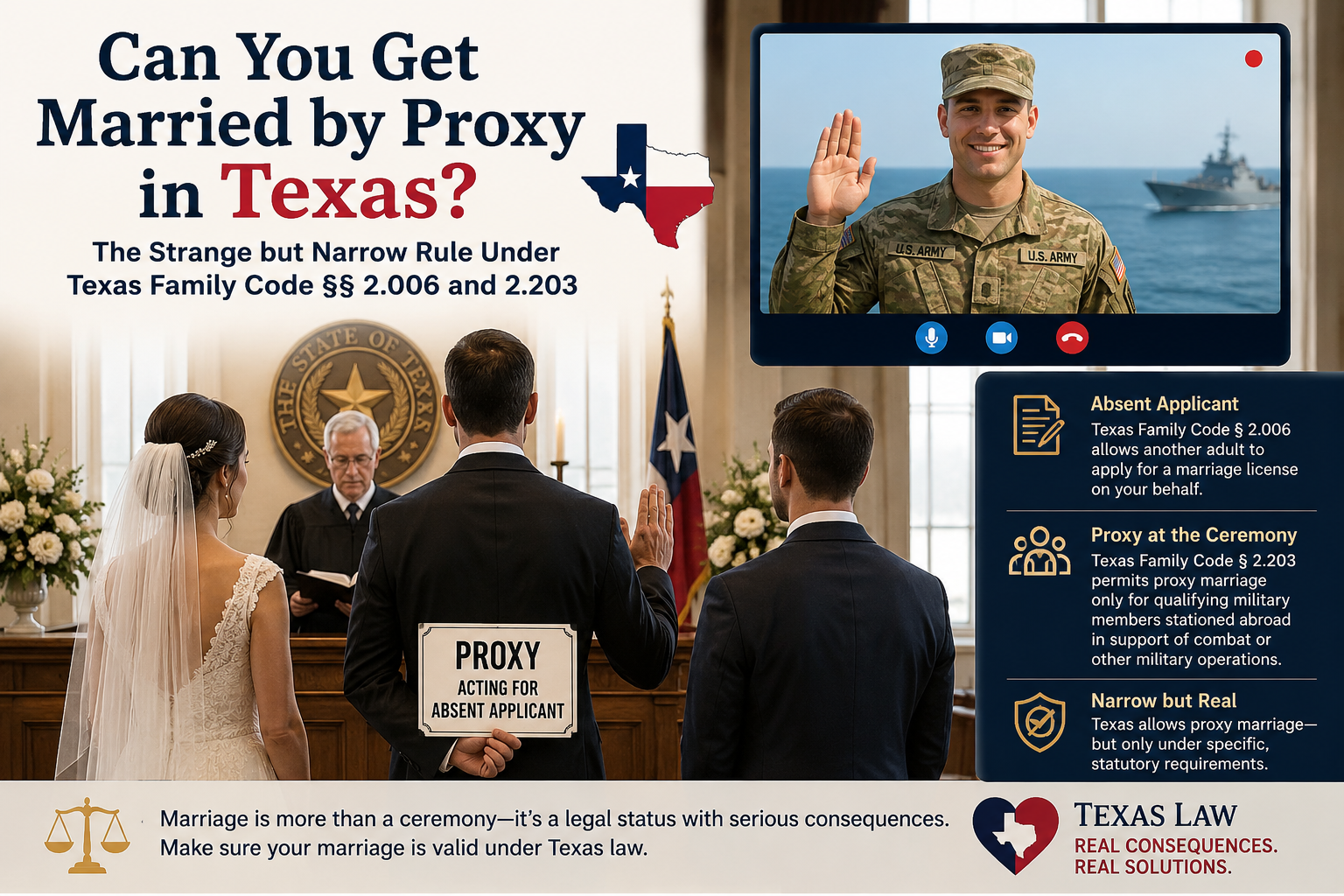
It sounds like something from an old movie.
One person stands at the wedding ceremony. The other person is thousands of miles away. Someone else literally stands in for the missing bride or groom.
Can that actually create a legal marriage in Texas?
Yes—but Texas proxy marriage is much narrower than many people assume.
Texas law distinguishes between being absent when applying for a marriage license and being absent from the marriage ceremony itself. Although Texas permits an adult to assist an absent applicant with the marriage-license process in certain circumstances, actually getting married through a proxy at the ceremony is generally reserved for a very specific class of deployed members of the United States armed forces.
The result is one of the stranger provisions hiding in the Texas Family Code.
Texas Law Allows an “Absent Applicant” for a Marriage License
The first important statute is Texas Family Code § 2.006.
It provides:
“If an applicant who is 18 years of age or older is unable to appear personally before the county clerk to apply for a marriage license, any adult person or the other applicant may apply on behalf of the absent applicant.”
Tex. Fam. Code § 2.006(a). (Texas Statutes)
That sounds extremely broad.
And, for the license application, it is broader than the rule governing the ceremony itself.
The person appearing for the absent applicant must provide the clerk with the absent applicant's notarized affidavit and proof of the absent applicant's identity and age. Tex. Fam. Code § 2.006(b). (Texas Statutes)
Texas therefore recognizes that circumstances may prevent an adult from physically appearing at the county clerk's office.
But this creates an important distinction:
Being an absent applicant for the marriage license does not necessarily mean you can also be absent from your wedding.
Texas Proxy Marriage at the Ceremony Is Much More Limited
The actual marriage ceremony is governed in part by Texas Family Code § 2.203.
Under that statute, a person may assent to marriage through a proxy appointed in the required affidavit only if the absent person falls within the statutory military requirements. The statute limits proxy participation to a member of the United States armed forces who is stationed in another country in support of combat or another military operation and is unable to attend the ceremony. Tex. Fam. Code § 2.203(b). (Texas Statutes)
That limitation matters.
A person ordinarily cannot decide:
“I don't feel like flying back to Texas. My brother will stand in for me.”
Nor does living in another state, being busy at work, being hospitalized, traveling overseas, or simply finding a proxy ceremony more convenient necessarily qualify someone to marry by proxy.
Texas has retained proxy marriage—but in a tightly restricted form.
The Proxy Cannot Simply Be Improvised at the Wedding
Texas law also specifies how the proxy gets appointed.
Under Texas Family Code § 2.007, the affidavit of an absent applicant contains extensive information about the applicant and the proposed marriage. Among other things, it includes the identity of the person the applicant intends to marry, the approximate date of the marriage, and the reason the applicant cannot personally appear.
For purposes of a proxy ceremony, the affidavit must appoint an adult other than the other marriage applicant to act as the proxy. The statute ties that appointment to an absent applicant who:
“is a member of the armed forces of the United States stationed in another country in support of combat or another military operation”
and is unable to attend the ceremony. Tex. Fam. Code § 2.007(8). (Texas Statutes)
So the proxy is not simply a friend who appears at the ceremony and announces that the missing person definitely wants to get married.
The authority comes from the statutory affidavit.
Can Both People Be Absent When Applying for the Marriage License?
Potentially—but here Texas law becomes even more particular.
Section 2.006(c) states that a county clerk generally may not issue a marriage license when both applicants are absent unless the person applying on behalf of each absent applicant provides an affidavit declaring that the applicant is a member of the U.S. armed forces stationed in another country in support of combat or another military operation. (Texas Statutes)
That produces an unusual statutory structure.
Texas recognizes three different situations that should not be confused:
First, both people personally appear for the license and ceremony. That is the ordinary marriage.
Second, one person may qualify as an absent applicant for purposes of obtaining the license under § 2.006.
Third, actually assenting to the marriage through a proxy during the ceremony is subject to the considerably narrower military requirements of § 2.203.
The phrase “proxy marriage” can therefore obscure several legally distinct questions.
Why Does Texas Allow Proxy Marriage at All?
The modern statute is easy to understand in its military context.
Imagine a service member stationed overseas who intends to marry but cannot return to the United States for the ceremony. Requiring physical presence could delay the marriage indefinitely because of circumstances largely outside the service member's control.
Texas law provides a mechanism through which the service member's consent can be formally documented and exercised through another adult.
The arrangement is unusual, but the underlying legal concept is not.
Marriage requires consent.
Texas law ordinarily expresses that consent through the parties' participation in a ceremony. The proxy statute creates a narrow mechanism for one qualifying person to manifest that consent without physically standing in the room.
Does the Proxy Become Married to Anyone?
No.
This may sound obvious, but it illustrates what the proxy is actually doing.
The proxy is not temporarily becoming one of the spouses. The proxy is acting on behalf of the absent applicant for purposes of participating in the ceremony.
The marriage is between the two people identified as the applicants.
The person standing at the ceremony is merely the legally authorized substitute through whom the absent applicant assents.
In other words, if John appoints Robert as his proxy so John can marry Mary, Robert does not briefly marry Mary on John's behalf.
John marries Mary.
Robert merely has an exceptionally strange assignment that afternoon.
Is a Proxy Marriage the Same as an Informal or Common-Law Marriage?
No.
Texas recognizes informal marriage under an entirely different portion of the Family Code. A valid informal marriage may arise when statutory requirements concerning agreement, cohabitation, and representation to others are satisfied.
A proxy marriage, by contrast, involves a marriage license and formal ceremony in which a properly appointed proxy participates for a qualifying absent applicant.
The doctrines solve entirely different problems.
One concerns whether conduct between two people can establish a marriage without a traditional ceremonial marriage.
The other concerns whether a person who cannot physically attend a ceremony can nevertheless participate in that ceremony through a legally authorized substitute.
What If the Couple Does Not Follow the Proxy Requirements?
This is where anyone contemplating an unusual marriage arrangement should be careful.
Marriage affects far more than whether two people may call themselves spouses.
Marital status can affect:
- community and separate property;
- inheritance;
- homestead rights;
- retirement benefits;
- insurance;
- taxes;
- divorce jurisdiction;
- spousal maintenance;
- creditor rights; and
- the characterization and division of property when the relationship ends.
A defective marriage procedure can therefore create a much larger dispute years later.
The worst time to discover uncertainty about whether a marriage was legally created is after someone dies, property has substantially appreciated, or one supposed spouse files for divorce.
Proxy Marriage Can Become a Probate Issue Too
This is one reason an obscure family-law rule can suddenly matter in probate litigation.
Suppose a person dies owning substantial property and another person claims to be the surviving spouse.
Whether the marriage was valid may determine rights involving the homestead, community property, inheritance, estate administration, and other benefits of surviving-spouse status.
If the claimed marriage involved an unusual ceremony with an absent participant, questions about the license, affidavit, proxy appointment, and statutory requirements can become extremely important.
What looked like a wedding technicality may become an estate dispute worth hundreds of thousands of dollars.
Do You Have to Be in Texas to Get Married Under Texas Law?
The more useful question is not simply where someone happens to be located.
It is whether the requirements of Texas law for the particular marriage procedure have been satisfied.
Texas law expressly contemplates an absent applicant during the licensing process. It also expressly contemplates a qualifying military member assenting through a proxy during the ceremony.
But those provisions should not be stretched into a general rule that Texas permits anyone to marry remotely.
It does not.
Can You Have a Zoom Wedding in Texas?
A video call creates a different question from statutory proxy marriage.
Seeing someone on a screen is not automatically the same legal mechanism as appearing through a proxy authorized under § 2.203. Nor should couples assume that technology eliminates statutory requirements concerning licenses, ceremonies, officiants, or participation.
Texas marriage statutes were not written simply to ask whether everyone could see and hear one another.
They establish legal requirements for creating the marital relationship.
Someone contemplating a remote, proxy, international, or otherwise unconventional ceremony should determine before the weddingwhether the proposed procedure satisfies Texas law.
The Bottom Line
Yes, proxy marriage still exists in Texas.
But it is not a general alternative to attending your own wedding.
Texas Family Code § 2.006 permits an adult to use an absent-applicant procedure for obtaining a marriage license under specified conditions. Texas Family Code §§ 2.007 and 2.203 impose substantially narrower requirements when an absent person actually wants another adult to serve as a proxy at the marriage ceremony. (Texas Statutes)
For the ceremony itself, the modern Texas proxy-marriage provision is essentially a specialized accommodation for qualifying members of the United States armed forces stationed abroad in support of combat or another military operation.
It is a wonderfully strange corner of family law because the concept sounds almost medieval:
You can, under limited circumstances, send another person to stand at your wedding for you.
But behind the oddity is a serious legal point.
Marriage is a legal status with enormous consequences, and Texas law cares not merely whether two people intended to be married, but how that marital status was created.
For couples considering an unconventional ceremony—and particularly when military service, international travel, property, or estate-planning concerns are involved—getting the procedure right at the beginning can prevent a much more difficult legal dispute later.
This article is for general informational purposes only and does not constitute legal advice. Marriage validity can depend on the particular facts, documents, ceremony, and applicable law.
At David C. Barsalou, Attorney at Law, PLLC, we help clients navigate business, family, tax, estate planning, and real estate matters ranging from document drafting to litigation with clarity and confidence. If you’d like guidance on your situation, schedule a consultation today. Call us at (713) 397-4678, email barsalou.law@gmail.com, or reach us through our Contact Page. We’re here to help you take the next step.