Getting divorced sometimes causes people to make dramatic changes rather quickly.
A new apartment. A new bank account. A new haircut. Maybe even a new relationship.
But if the next item on the list is a new marriage, Texas law may require a short delay.
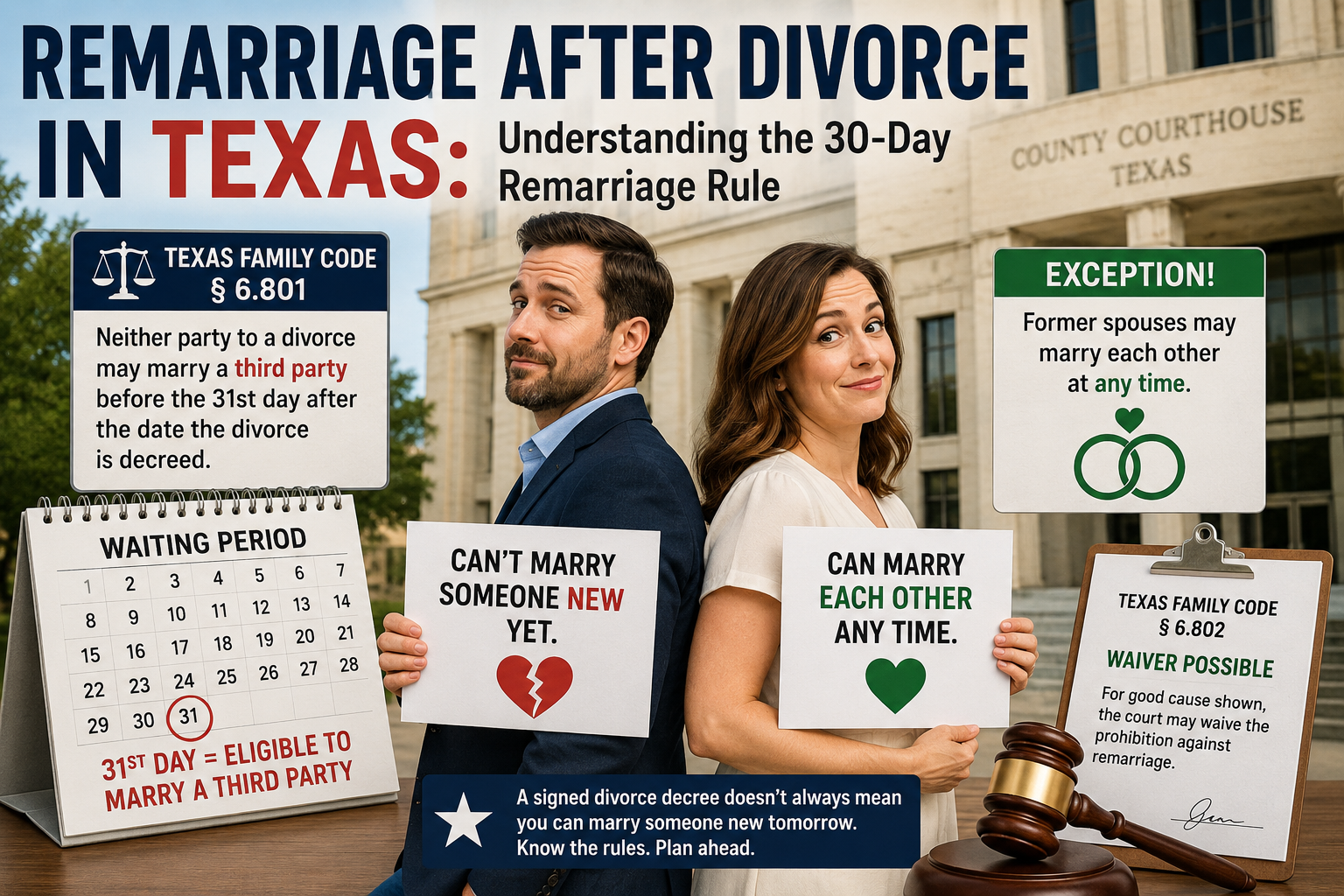
Texas has a surprisingly specific rule governing remarriage after divorce. In most circumstances, a person who has just been divorced cannot marry someone else until the 31st day after the divorce is decreed.
Even more strangely, the law contains an exception that sounds almost like the setup to a joke: you can immediately remarry the person you just divorced.
Here is how the rule actually works.
Texas Family Code § 6.801: The 30-Day Remarriage Rule
Texas Family Code § 6.801(a) provides:
“Except as otherwise provided by this subchapter, neither party to a divorce may marry a third party before the 31st day after the date the divorce is decreed.”
That means the restriction applies to both former spouses.
Suppose a Texas court signs a final divorce decree on September 1. One of the former spouses cannot ordinarily marry a new person on September 10 simply because the divorce itself is already final.
The statute requires the person to wait until the applicable 30-day period has passed.
This rule can surprise people because it is different from the question of whether the divorce itself has become effective. A divorce may have been granted, but Texas law separately regulates how quickly the former spouses may marry third parties.
But You Can Remarry Your Ex Immediately
Here is where Texas law gets considerably more entertaining.
Section 6.801(b) states:
“The former spouses may marry each other at any time.”
So Texas essentially says:
You cannot immediately marry somebody new, but if you decide the divorce was a terrible idea, apparently you may turn around and marry your ex again.
There is no 30-day waiting period under § 6.801 for the former spouses to remarry each other.
That is a narrow exception, but it illustrates why statutory language matters. The prohibition is not simply a blanket prohibition against marriage following divorce. It specifically restricts marriage to a third party.
Why Does Texas Have a Waiting Period After Divorce?
One practical reason for a waiting period is that a recently signed divorce decree may still be subject to post-judgment proceedings.
Texas courts retain certain powers after signing a final judgment, and parties may file motions for new trial or pursue appellate remedies.
The remarriage restriction creates a short buffer between one marriage ending and another beginning.
Whatever its historical or policy justification, however, the important point for someone planning a wedding is much simpler:
A signed Texas divorce decree does not ordinarily mean you can marry a different person tomorrow.
Can a Judge Waive the 30-Day Waiting Period?
Yes.
Texas Family Code § 6.802 provides an important exception:
“For good cause shown the court may waive the prohibition against remarriage provided by this subchapter as to either or both spouses if a record of the proceedings is made and preserved or if findings of fact and conclusions of law are filed by the court.”
In other words, the waiting period is not absolute.
A former spouse can ask the court to waive it. But the statute requires good cause, meaning the fact that someone simply would prefer not to wait is not necessarily enough.
Whether good cause exists will depend on the circumstances presented to the court.
For example, a person might have a wedding already scheduled shortly after the divorce becomes final and have significant logistical, financial, military, immigration, medical, or family circumstances surrounding the timing. Whether those facts justify a waiver is ultimately a matter for the court.
The important practical lesson is to address the issue before the planned marriage, rather than assuming the statutory waiting period can simply be ignored.
The Marriage-License Process Also Accounts for Recent Divorces
The restriction is not buried exclusively in the divorce provisions of the Family Code.
Texas Family Code Chapter 2, which governs marriage licenses, also addresses recently divorced applicants.
The marriage-license statutes require attention when an applicant indicates that he or she has been divorced within the preceding 30 days. The law recognizes exceptions when the applicants were divorced from each other or when the prohibition against remarriage has been waived under § 6.802.
So the 30-day rule can become a very practical problem when someone actually attempts to obtain the next marriage license.
What If You Already Scheduled the Wedding?
This is where advance planning matters.
Suppose someone has been separated for a long time and reasonably expects the divorce to be completed months before a planned wedding. Litigation takes longer than expected, however, and the divorce decree is finally signed only two weeks before the ceremony.
The person now has a problem.
The choices may include postponing the marriage ceremony until the statutory period expires or asking the divorce court to waive the prohibition for good cause.
What someone should not do is assume that being divorced automatically eliminates every legal restriction on immediate remarriage.
Does the 30-Day Rule Apply After Every Texas Divorce?
As a general rule, § 6.801 applies to parties to a Texas divorce unless an exception applies.
The two important possibilities are therefore easy to remember:
Marrying someone new: ordinarily wait until the 31st day after the divorce decree.
Remarrying your former spouse: § 6.801 expressly permits it at any time.
And if there is good cause to marry a third party sooner, § 6.802 gives the court authority to waive the restriction.
A Related—and Even Stranger—Texas Annulment Rule
Texas law contains another provision that shows the Legislature takes the 30-day period seriously.
Texas Family Code § 6.109 addresses what it calls a “concealed divorce.”
Under certain circumstances, a court may annul a marriage when one spouse had been divorced from a third person during the 30 days preceding the new marriage ceremony and the other spouse did not know—and reasonably would not have known—about that recent divorce.
There are additional statutory requirements, including restrictions concerning continued voluntary cohabitation after discovering the prior divorce, and an action under this provision generally must be brought before the first anniversary of the marriage.
That creates a remarkable scenario:
A person gets divorced, quickly marries someone else without disclosing how recently the divorce occurred, and the new spouse may potentially have statutory grounds to seek an annulment.
Texas family law has apparently contemplated more relationship drama than most people realize.
Divorce Dates Matter More Than People Think
People often focus on the emotional and financial issues surrounding divorce: custody, property division, support, retirement accounts, the family home, and attorney's fees.
But the actual date on which the divorce is decreed can have independent legal consequences.
For someone contemplating another marriage, that date can determine when the next marriage may legally occur.
This is particularly important when a wedding has already been planned while the divorce case is still pending. Court schedules change. Settlement negotiations stall. Documents require revisions. Hearings get reset.
A person should therefore be cautious about scheduling a new marriage based entirely on an optimistic prediction of when an existing divorce will be completed.
The Bottom Line
Texas generally does not allow a divorced person to immediately marry somebody new.
Under Texas Family Code § 6.801, neither former spouse ordinarily may marry a third party before the 31st day after the divorce is decreed.
But Texas law also contains two important escape routes from that rule.
Former spouses can remarry each other at any time, and a court may waive the prohibition against marrying a third party when good cause is shown under § 6.802.
It is an oddly specific little corner of Texas family law, but it can become extremely important to someone whose wedding date falls a few weeks too close to the date of the divorce decree.
If you have recently divorced in Texas and are planning to remarry before the 30-day waiting period expires, speaking with a Texas family-law attorney before the ceremony can help determine whether the waiting period applies and whether requesting a waiver may be appropriate.
This article is for general informational purposes only and does not constitute legal advice. The application of Texas family law depends on the particular facts and circumstances of each case.
At David C. Barsalou, Attorney at Law, PLLC, we help clients navigate business, family, tax, estate planning, and real estate matters ranging from document drafting to litigation with clarity and confidence. If you’d like guidance on your situation, schedule a consultation today. Call us at (713) 397-4678, email barsalou.law@gmail.com, or reach us through our Contact Page. We’re here to help you take the next step.